
Euphrosynus of Sinozersky
Our Venerable Father and Martyr Euphrosynus of Sinozero, Wonderworker of Novgorod
Venerable Martyr · Venerable · b. mid-16th century, Karelia — d. 1612
Commemorated 20 March — Slain by Polish-Lithuanian raiders at his hermitage in the Time of Troubles
Euphrosynus (mid-sixteenth century – 1612), born in Karelia and named Ephraim in the world, was a Russian hermit who withdrew into the forests of the Novgorod land and settled beside the remote Blue Lake (Sinozero), where he founded a hermitage of the Holy Trinity and lived in prayer and great austerity. In the anarchy of the Time of Troubles, when Polish-Lithuanian bands and brigands ravaged the northern countryside, Euphrosynus foresaw the coming of the raiders and warned the people who had taken refuge near him to flee; but he himself, together with the monk Jonah, refused to abandon his cell, and awaited the marauders in prayer. When they came, demanding the monastery's supposed treasure, they struck him down before his own cross on March 20, 1612. He is honoured as a venerable-martyr and wonderworker of the Novgorod land.
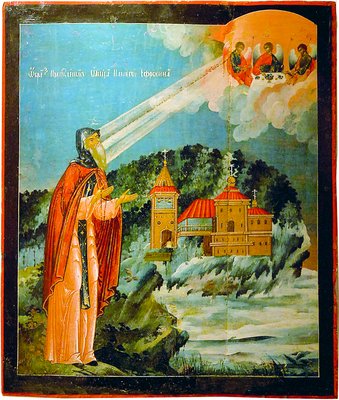

From Karelia to the desert of the north
Euphrosynus was born about the middle of the sixteenth century in Karelia, the land of lakes and forest north of Novgorod, and bore in the world the name Ephraim. Drawn young to the monastic life, he lived, the tradition says, for a time in the great houses of the Russian north — among them the Dormition monastery of Tikhvin — before the desire for stillness led him deeper into the wilderness. He withdrew at last, about the year 1600, to an utterly remote spot in the Novgorod land, on the shore of the little Blue Lake (Sinozero, "the blue lake"), in the forests near Ustyuzhna, and there built himself a cell and set up a cross, living alone in prayer, fasting, and the labour of his hands, sustained — the accounts tell — by the barest food of the forest.
As his holiness became known, others came to share his solitude, and about his cell grew a small brotherhood; Euphrosynus raised a church of the Holy Trinity, and so was founded the Trinity Blue-Lake Hermitage (the Sinozersky pustyn), a poor and hidden house of prayer in the deep woods. There he lived as its elder, a hermit and a spiritual father to the few who gathered to him.
The Time of Troubles and his martyrdom
The last years of Euphrosynus fell in the Time of Troubles, the years of dynastic collapse, foreign invasion, and civil war that followed the end of the old Muscovite line. In 1612 the armies and free companies of the Poles and Lithuanians, and the brigand bands that moved with them, were ravaging the Novgorod and Ustyuzhna country, burning villages and monasteries and killing without mercy. The people of the district fled to the forests, and many took refuge near the hermitage of Euphrosynus.
The tradition relates that the saint, given foreknowledge of the danger, warned those who had gathered to him to flee at once and save their lives, for the raiders were near. When they urged him to flee with them, he refused: he would not leave the church and the place he had consecrated, but would await whatever God permitted, and he remained with the monk Jonah (Iona) to keep vigil and prayer. On 20 March 1612 the raiders broke into the hermitage and demanded that Euphrosynus give up the treasure they supposed a monastery must hide. He answered that the treasure of the house was in the church — meaning the grace of God — and stood before his cross unresisting; and there they struck him down and killed him, and Jonah with him. So the hermit who had sought only stillness ended as a martyr, slain in the general slaughter of that ruinous time for refusing to abandon the altar he had raised.
Veneration
Euphrosynus was buried at his hermitage, which recovered after the Troubles and kept his memory as its founder and martyr; his relics rested there, and miracles were reported at his tomb. His local veneration in the Novgorod land was established, and he is numbered among the venerable-martyrs of the Russian Church and among the saints of Novgorod.
Feast and commemoration
Euphrosynus is commemorated on March 20 (church date; New Calendar civil March 20, Old Calendar civil April 2), the day of his martyrdom, in the Russian Church, which keeps his memory as a venerable-martyr and wonderworker of Novgorod; the day is also noted in the OCA calendar of Russian tradition. The feast falls within Great Lent, so that his commemoration is kept at the Lenten services where it does not meet a Saturday or Sunday. He is honoured together with those, like the Fathers slain at the Monastery of St Sabas kept on the same day, whom the fury of raiders made martyrs at the altar.
Hymns
Troparion — Tone 4
Thy martyr Euphrosynus, O Lord, in his struggle hath received from thee, our God, an incorruptible crown; for possessing thy strength, he cast down the tormentors and shattered the feeble boldness of the enemy. By his prayers, O Christ God, save our souls.
Original translation from the Slavonic
Iconography
Euphrosynus is depicted as a Russian hermit-monk of the northern forests: an elder with a long, narrow grey beard, in the monastic habit and mantle, his hand raised in blessing or holding a scroll, and often shown before the cross and the little wooden church of his Blue-Lake hermitage. The stored image is a Russian icon of the late eighteenth century inscribed "the Venerable-Martyr Euphrosynus of Sinozero," showing the saint half-length as a bearded elder in the schema, in the manner of the northern-Russian icon-tablets of local saints.