
Euphrosynus the Cook
Our Venerable Father Euphrosynus the Cook
Venerable
Commemorated 11 September
Euphrosynus the Cook (9th century) is the patron of the humble and hidden: an unlettered peasant who served as cook in a monastery kitchen, despised by some of the brethren for his rusticity and enduring their contempt in silence. His sanctity, concealed all his life, was revealed in a single night, when a priest of the monastery who had long prayed to see the good things prepared for those who love God was shown paradise in a vision — and found the monastery cook dwelling there, who gave him three apples from the garden. Waking, the priest found the apples beside him, fragrant and real; and Euphrosynus, his secret out, fled the monastery the same morning and was never found. He is commemorated on September 11.
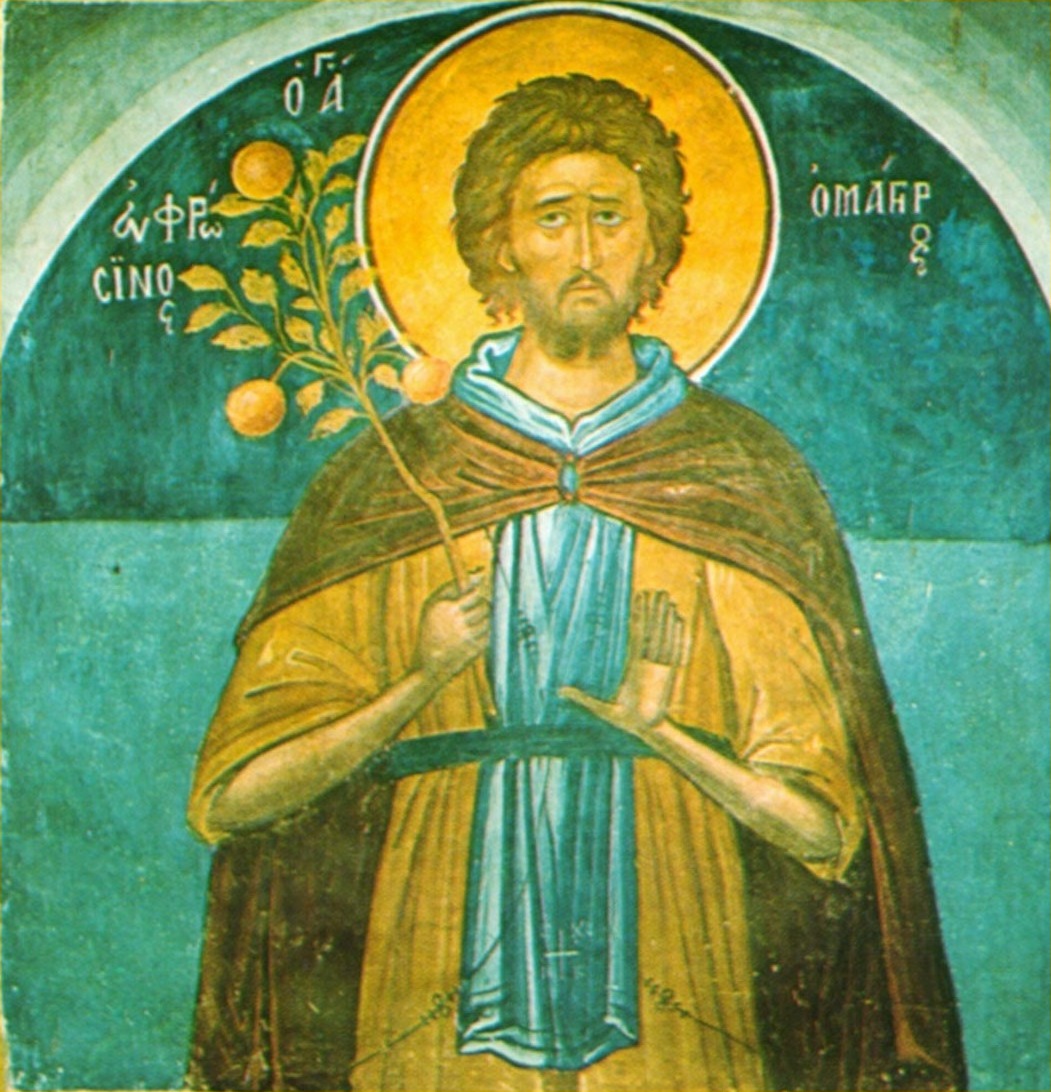

The hidden servant
Euphrosynus was born of peasant stock and received no schooling; the tradition remembers him as devout from his youth. Coming to a monastery, he was given the obedience of the kitchen, and remained in it: the lowest and hottest work of the community, feeding brethren who took the labour for granted. Some of the monks scorned the coarse, silent countryman and mocked his cooking; Euphrosynus answered nothing, bore the contempt without disturbance, and hid an inner life of unceasing prayer behind the smoke of the kitchen. The accounts add that he kept the ascetic's discipline in the midst of plenty — handling the best food daily and eating plain greens, depriving himself in order to give alms.
The vision of the garden
In the same monastery lived a priest of holy life who had long asked God to show him the good things prepared for those who love Him (1 Corinthians 2:9). One night in a dream-vision he found himself in a garden of inexpressible beauty, and saw, standing in the midst of it, the monastery cook. Astonished, he asked whose garden this was and how Euphrosynus came to be there; the cook answered that the garden was the dwelling of God's elect, and that by God's great goodness he himself dwelt in it, and had authority over what the priest saw. The priest asked whether he could give him something of it; Euphrosynus picked three apples and laid them in the priest's outer garment.
At that moment the semantron sounded for Midnight Office. The priest woke, took the vision for an ordinary dream — and found the three apples wrapped in his garment, filling the cell with fragrance. In church he pressed Euphrosynus to say where he had been that night; the cook at first answered, "Forgive me, father: nowhere — I have only just come to the service," and confessed the truth only when adjured to reveal it for the glory of God: he had been in the place the priest had long prayed to see, and it was he who had given him the apples, "for I am a worm and not a man."
The flight from glory
After Matins the priest told the brethren everything and showed the apples. The community, seized with wonder, ran to the kitchen to reverence their cook; but Euphrosynus was gone. Fleeing the honour of men in the same hour his holiness was disclosed, he left the monastery and could not be found, and the tradition says he ended his days in a remote hesychasterion. The apples were divided among the brethren as a blessing, and portions given to the sick who came to the monastery were found to heal them.
The Church has loved this story as a parable of hidden sanctity — that the kitchen is no farther from the Kingdom than the scholar's cell or the king's throne — and Euphrosynus has become the heavenly patron of cooks. A fragment of relics attributed to him is kept at the Monastery of Loukou in the Metropolis of Mantineia and Kynouria in the Peloponnese.
Feast and commemoration
September 11 (church date; Old Calendar civil September 24), within the afterfeast of the Nativity of the Theotokos. His memory stands in the Greek synaxarion of the day without a service of his own; the Russian books give him a proper troparion, and modern Greek devotion — in which he is widely loved as patron of cooks and refectories — has produced fuller akolouthias of recent composition.
Hymns
Troparion — Tone 5
In humility of heart thou didst offer thy service in the kitchen, O father Euphrosynus, and wast filled in truth with the Holy Spirit; wherefore God revealed thy glory to us through a venerable priest. Show us also partakers of that glory, O God-bearing one, by thy prayers.
Original translation from the Slavonic
Iconography
Euphrosynus's iconography is fixed by his story and is among the most endearing in the calendar: a young or middle-aged monk, often rough-featured, holding a branch bearing the three apples of paradise — sometimes a dish or a cooking vessel instead — the only saint of the kalendar identified by fruit. The stored image is the fresco of 1527 by Theophanes the Cretan in the katholikon of the Monastery of Saint Nicholas Anapausas at Meteora, inscribed Ὁ ἅγιος Εὐφρόσυνος ὁ μάγειρος ("the holy Euphrosynus the cook"): the saint in monastic mantle holds the flowering apple-branch against a deep green ground.
Disputed questions
- Place and date. The synaxaria transmit the story without firm anchors. The ninth century is the conventional dating. The OCA styles him "of Alexandria," while the Russian tradition calls him "of Palestine" (Евфросин Палестинский); the Greek books most often call him simply "the cook" (ὁ μάγειρας), and this entry follows the epithet on which all agree.
- Not to be confused with Euphrosynus of Pskov (†1481, May 15), nor with the venerable woman Euphrosyne of Alexandria (September 25), whose life — a woman hidden in a men's monastery — belongs rather with that of Theodora of Alexandria, commemorated the same day as Euphrosynus the Cook.