
Eupsychius of Caesarea
The Holy Martyr Eupsychius of Caesarea in Cappadocia
Martyr · d. c. 130
Commemorated 7 September — Martyrdom at Caesarea under Hadrian
Eupsychius (2nd century) was a Christian of Caesarea in Cappadocia — called in some synaxaria the son of a senator, Dionysius — who was martyred in the persecution under the emperor Hadrian. Arrested and tortured, he was healed of his wounds in prison by an angel; released, he gave away his goods to the poor, including a portion to the very informers who had denounced him. Seized again under a new governor, he was hung up, torn with iron hooks, and beheaded. He is commemorated on September 7, and is to be distinguished from the later and more famous Eupsychius of the same city, martyred under Julian (April 9) — whom many hold to be, in fact, the same martyr doubled.
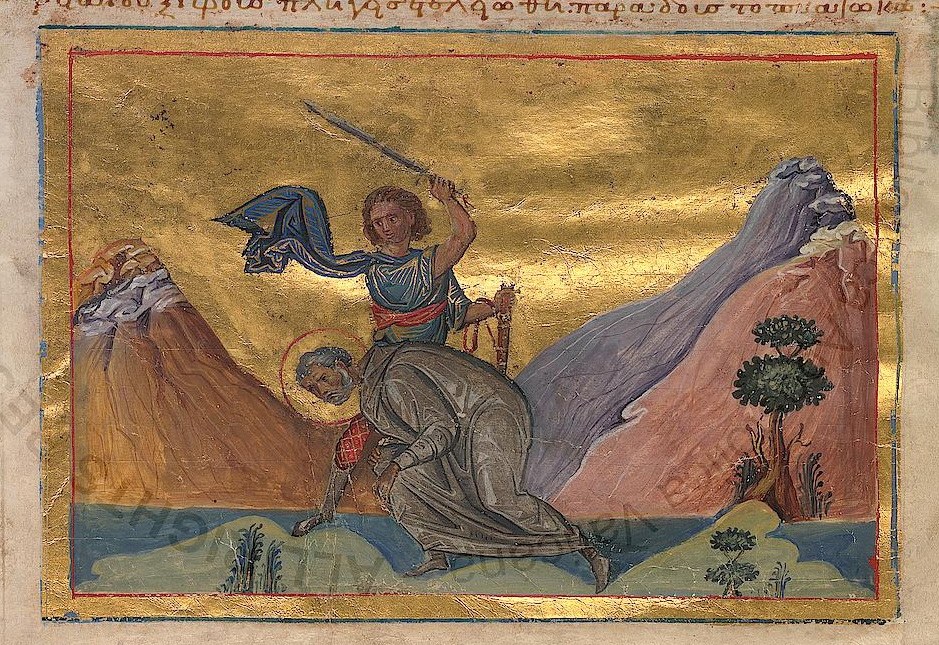

Martyrdom
The synaxaria place Eupsychius in Caesarea, the metropolis of Cappadocia, and one strand of the tradition makes him the son of a senator named Dionysius. In a persecution which the received account assigns to the reign of Hadrian (117–138), he was arrested for his confession of Christ, tortured, and thrown into prison, where — the account continues — an angel of God healed his wounds.
Set at liberty, Eupsychius used his freedom to strip himself of everything: he distributed his property to the poor, and gave a portion even to his enemies — the informers whose denunciation had brought him to torture — an act the hagiographers single out as the seal of his evangelical perfection. Under a new governor he was arrested a second time. Hung up, his body was raked with iron hooks; then his head was cut off with the sword — the death the Greek synaxarion fixes in its verse for him: "Eupsychius, good of soul (εὔψυχος), went to the sword rejoicing, for he offers his soul to the One who fashioned it." The Menologion of Basil II depicts the beheading. The martyrdom falls, on the Hadrianic dating, around the year 130.
Feast and commemoration
September 7 (church date; Old Calendar civil September 20), within the forefeast of the Nativity of the Theotokos, together with the martyr Sozon and the apostles Evodus and Onesiphorus. The commemoration is carried by the Greek and Slavic synaxaria and the OCA calendar; his own service is covered by the common of a martyr, with a proper kontakion surviving in the Slavonic Menaion.
Hymns
Troparion — Tone 4
Thy martyr Eupsychius, O Lord, in his contest received the crown of incorruption from thee, our God; for possessing thy strength he cast down the tyrants and broke the feeble insolence of the demons. By his prayers, O Christ God, save our souls.
Original translation from the Greek
Kontakion — Tone 2
Thou didst appear to the world as a bright and undeceiving star, heralding Christ the Sun by thy radiance, O sufferer for Christ Eupsychius; and thou didst quench all delusion, and dost give light to us, praying unceasingly for us all.
Original translation from the Slavonic
Iconography
Eupsychius is painted as a martyr with the cross, a man of mature years in the tunic and mantle of the martyrs; the scene of his beheading is the subject of his miniature in the Menologion of Basil II, which is the stored image: the executioner raises the sword over the kneeling, haloed martyr between the hills of Cappadocia (Constantinople, c. 985; Vatican Library, Vat. gr. 1613, p. 21). The April 9 Eupsychius has a separate iconography (often a young man, sometimes shown with the ruined temple); images of the two are easily confused, and only the Menologion miniature — which belongs to the September half-year the manuscript covers — can be assigned to this saint with confidence.
Disputed questions
- The two Eupsychii of Caesarea. The Church commemorates on April 9 another and more celebrated martyr Eupsychius of the same Caesarea in Cappadocia — a young married nobleman who destroyed the pagan temple of Fortuna and was executed under Julian the Apostate in 362, and whose memory Basil the Great himself kept. The identity of city and name has bred confusion since Byzantine times: some notices transfer the Julian-era circumstances to the September saint or vice versa, and some scholars have suspected that a single martyr lies behind both entries. The calendars keep two persons — a martyr under Hadrian on September 7 and a martyr under Julian on April 9 — and this collection follows them. Not to be confused with that April 9 Eupsychius.
- The emperor. The Hadrianic dating rests on the synaxarion notices; Hadrian's reign saw no general persecution, and local proceedings of the kind described are plausible but undatable. A minority of notices name other reigns; the September tradition as received (and as followed by the OCA) says Hadrian, and that is kept here.
- Parentage. The senatorial father Dionysius appears only in part of the synaxarion tradition.