
Eutychius of Constantinople
Our Father among the Saints Eutychius, Patriarch of Constantinople
Patriarch · Bishop · Confessor · b. c. 512 — d. 582
Commemorated 6 April — Repose of the Patriarch of Constantinople
Eutychius (c. 512–582) was twice Patriarch of Constantinople, presiding at the Fifth Ecumenical Council (Constantinople II, 553) which condemned the "Three Chapters" and confirmed the Christology of Chalcedon against the Nestorianizing tendency. For resisting the aged emperor Justinian's late adoption of the heresy of Aphthartodocetism (that the Lord's body was incorruptible and impassible even before the Resurrection) he was deposed and exiled, and lived twelve years as a monk before being restored to his throne under Justin II. He is honoured as a confessor and a defender of the Orthodox faith.
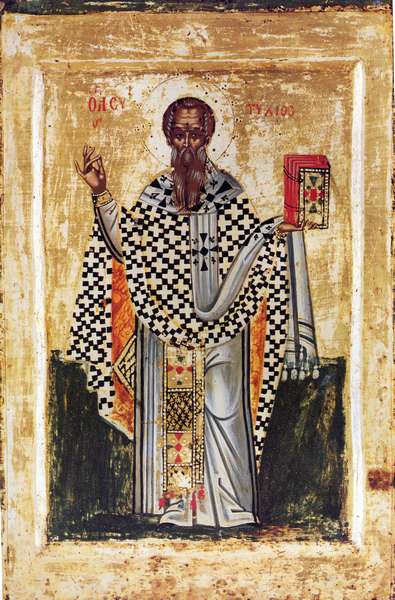

Eutychius was born about 512 in Phrygia and became a monk at Amasea; his learning and holiness brought him to Constantinople as the representative (apocrisiarius) of his metropolitan. When the patriarchal throne fell vacant in 552, the emperor Justinian — guided, the tradition says, by a revelation — chose Eutychius, and he was consecrated Patriarch of the imperial city.
In the following year (553) he presided over the Fifth Ecumenical Council, at which the Fathers condemned the writings known as the "Three Chapters" (certain works of Theodore of Mopsuestia, Theodoret and Ibas that favoured Nestorianism) and reaffirmed the teaching of Chalcedon on the one person of Christ in two natures — the Council that completed the Church's answer both to Nestorius and to the Monophysites.
In his old age the emperor Justinian, ever fascinated by theology, fell into the error of the Aphthartodocetae, who held that the body of Christ was by nature incorruptible and incapable of suffering even before the Passion — a teaching that undercuts the reality of the Lord's saving sufferings. When Justinian sought to impose this on the Church, Eutychius refused, and for his resistance was deposed (565) and banished to a monastery, where he lived quietly for twelve years, working (the tradition adds) miracles of healing. After Justinian's death and the passing of his successor's favourites, Eutychius was recalled under Justin II (577) and restored to his throne, which he held until his peaceful repose in 582. He is numbered among the holy and confessing patriarchs of Constantinople.
Feast and commemoration
April 6 (church date; Old Calendar civil April 19), within Great Lent. He is kept universally among the holy patriarchs and defenders of the faith.
He is not to be confused with Eutychius of Melitene (May 28), the hieromartyr and bishop of the apostolic generation: the bare style "Saint Eutychius the bishop" is used of both, but the one is a patriarch of the sixth century who died in peace, the other a first-century bishop-martyr in Armenia Minor.
Hymns
Troparion — Tone 4 (common of a hierarch)
O God of our fathers, ever dealing with us according to Thy gentleness: take not Thy mercy from us, but by the prayers of Thy hierarch Eutychius guide our life in peace.
Original translation from the Greek
Iconography
Eutychius is shown as a patriarch in the polystavrion and omophorion, blessing or holding the Gospel. The stored image is a 16th-century icon of exactly this type — the patriarch full-length in the cross-patterned polystavrion phelonion and omophorion, blessing with his right hand and bearing the jewelled Gospel-book on his veiled left, the identifying inscription Ο ΑΓ(ΙΟΣ) ΕΥΤΥΧΙΟΣ flanking the halo.