
Flavian of Constantinople
Our Father among the Saints Flavian the Confessor, Archbishop of Constantinople
Confessor · Patriarch · Bishop · b. unknown, at Constantinople — d. 11 August 449, at Epipa (Hypaepa) in Lydia, of injuries received at the Robber Council of Ephesus
Commemorated 16 February — Commemoration of the confessor-patriarch who condemned Eutyches, 18 February — Commemoration kept in the OCA and Slavic calendars (Greek usage keeps 02-16)
Flavian (died 449) was Archbishop of Constantinople from 446, a defender of the apostolic faith against the heresy of the archimandrite Eutyches, who taught that in Christ there was but one nature after the Incarnation. At a synod in Constantinople in 448 Flavian condemned and deposed Eutyches; but at the "Robber Council" (Latrocinium) of Ephesus in 449 — dominated by Dioscorus of Alexandria and the emperor's officials — Eutyches was restored and Flavian himself anathematised, deposed, and so brutally handled that he died of his injuries a few days later, on the road into exile. Two years afterward the Fourth Ecumenical Council of Chalcedon (451) vindicated his faith, condemned Eutyches, received the Tome of Pope Leo, and acclaimed Flavian a saint and martyr. The Church keeps him as Flavian the Confessor.
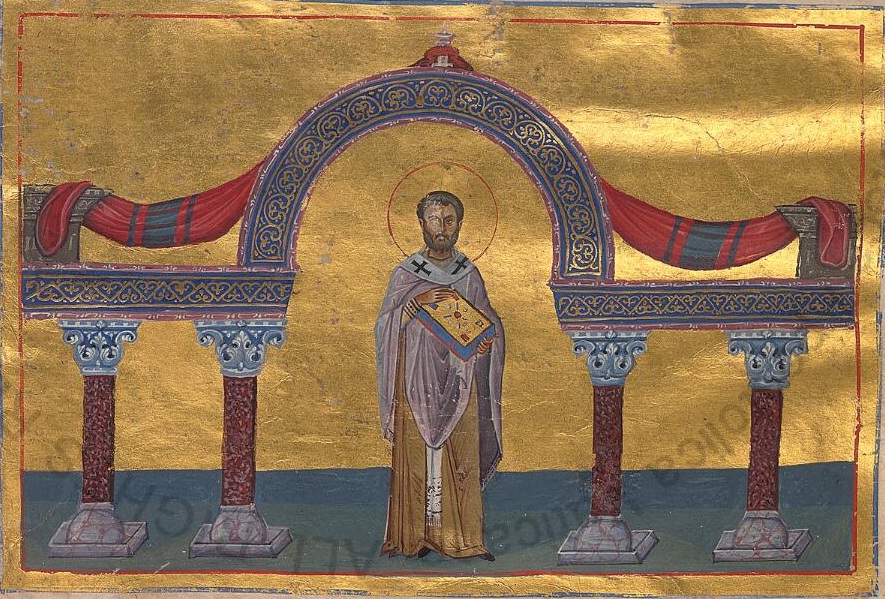

Priest and archbishop
Of Flavian's origins little is recorded; he was a presbyter and skeuophylax (keeper of the sacred vessels) of the Great Church of Constantinople before his elevation. On the death of Proclus he was chosen Archbishop of Constantinople in 446. He came to the throne of the capital in a difficult hour: the court of the emperor Theodosius II was swayed by the powerful eunuch Chrysaphius — Flavian's enemy from the first, having failed to extract from the new archbishop the customary "gift" on his accession — and the monasteries of the city held a party jealous for a christology that pressed the unity of Christ to the denial of his full and abiding manhood.
Eutyches and the Home Synod of 448
That party found its champion in Eutyches, the aged and influential archimandrite of a great monastery outside the walls, godfather to Chrysaphius and honoured for his long ascetic life. Reacting against Nestorius — whose error so divided Christ as to speak almost of two sons — Eutyches fell into the opposite extreme, teaching that after the union the Lord had but one nature, and that his flesh was not of one substance with ours. Denounced by Eusebius of Dorylaeum, Eutyches was summoned before the σύνοδος ἐνδημοῦσα, the standing "Home Synod" of bishops resident at Constantinople, which Flavian convened in November 448. There, after patient examination, Eutyches refused to confess that Christ is "in two natures" and "of one essence with us according to the manhood"; and Flavian, with the assembled bishops, condemned and deposed him, cutting him off from the priesthood and from communion.
The Robber Council of Ephesus, 449
Eutyches appealed — to the monks, to Chrysaphius, to the emperor, and to the great sees. Dioscorus of Alexandria took up his cause, and Theodosius II summoned a council to Ephesus in 449. It met in August under Dioscorus's presidency and the shadow of imperial soldiers and turbulent monks — among them the fierce Syrian abbot Barsaumas. Pope Leo of Rome had sent his legates bearing the Tome — his great letter to Flavian setting out the two natures of the one Christ — but the council would not so much as let it be read. Eutyches was declared orthodox and restored; Flavian and Eusebius of Dorylaeum were condemned, anathematised, and deposed. When Flavian appealed to Rome, the assembly fell upon him with such violence — the sources speak of blows and kicking, and lay the worst of it to Dioscorus and the monks of Barsaumas — that the archbishop was gravely injured. Pope Leo, hearing of it, gave the council its lasting name: not a concilium but a Latrocinium, a "robber-synod," a den of thieves.
Repose and vindication
Flavian was hurried away toward exile, but his injuries were mortal; he died within a few days, about 11 August 449, at a place in Lydia (named as Epipa or Hypaepa), a confessor fallen in defence of the faith. His enemies had their brief triumph. But in 450 Theodosius II died; his sister Pulcheria and her consort Marcian came to power, Chrysaphius fell, and the tide turned. Flavian's relics were brought back to Constantinople in a translation that, the historians say, more resembled a triumph than a funeral, and laid among the bishops in the Church of the Holy Apostles. In 451 the Fourth Ecumenical Council of Chalcedon met: it received Leo's Tome with the cry "Peter has spoken through Leo — this is the faith of Flavian"; it condemned Eutyches and deposed Dioscorus; it confessed the one Christ "in two natures, without confusion, without change, without division, without separation"; and it numbered Flavian among the saints, acclaiming him a martyr for the truth he had died to keep.
Feast and commemoration
Flavian the Confessor is kept on February 16 (church date; Old Calendar civil March 1) in the Greek Menaion, which names him "Flavian, Archbishop of Constantinople." A number of calendars — Slavic and Latin — keep him instead, or also, on February 18; the two dates are both traditional, and February 18 is the more common in the West. There is a divergence between jurisdictions on this day worth recording: the OCA synaxarion for February 16 commemorates not this Flavian but Flavian, Archbishop of Antioch (died c. 404), the contemporary of Chrysostom — a different saint of a different century, whose peaceful repose is unlike the confessor's violent death. The Greek tradition, and the Antiochian usage that follows the Byzantine Menaion, keep Flavian of Constantinople here; his condemnation of Eutyches and his vindication at Chalcedon make him a natural companion of the Sunday of Orthodoxy, near which his feast most often falls.
Hymns
Troparion — Tone 4
O guide of Orthodoxy, teacher of piety and holiness, luminary of the world, God-inspired adornment of hierarchs: by thy teaching thou hast enlightened all, O harp of the Spirit. O Father Flavian, intercede with Christ our God that our souls may be saved.
Original translation from the Greek
Kontakion — Tone 8
As a sacred hierarch and unshaken pillar of the true confession, thou didst shepherd the Church of Christ and, condemning the error of Eutyches, didst seal thy witness with thy blood; wherefore, crowned as a confessor, O Father Flavian, intercede for us all.
Original translation from the Greek
Iconography
Flavian is depicted as an archbishop of Constantinople in the settled hierarch type — vested in the phelonion or the cross-figured sakkos, wearing the omophorion and holding the Gospel-book — a middle-aged figure with a short rounded beard. Where his passion is shown, the narrative type depicts the violence at the Robber Council: the archbishop struck down amid the assembled bishops.
The stored image is the miniature for his commemoration from the Menologion of Basil II (Constantinople, c. 985; Vatican, Vat. gr. 1613), inscribed "Flavian the Confessor, Patriarch of Constantinople" (source, public domain, pd-old-work).
Disputed questions
- Confessor or hieromartyr? Flavian did not die by a sentence of execution for the faith, but of injuries received while confessing it; the Greek books therefore style him ὁμολογητής, Confessor, and this entry follows that lead. Yet Chalcedon itself acclaimed him a martyr, and some calendars and service texts accordingly call him hieromartyr. The divergence is one of emphasis on the same fact — a bishop done to death for the true confession — and both titles are found in the tradition.
- Not to be confused with Flavian I of Antioch (died c. 404), the archbishop of Antioch and contemporary of John Chrysostom who interceded with Theodosius the Great for the citizens of Antioch after the Riot of the Statues, and who died in peace. That Flavian is a distinct saint (not yet an entry in this collection); and it is he, not the confessor of Constantinople, whom the Orthodox Church in America's calendar names on February 16 (see Feast and commemoration). The Greek Menaion keeps the two apart, giving the confessor-patriarch of Constantinople on this day.