
Forty Virgin-Martyrs and Ammoun the Deacon
The Holy Forty Virgin-Martyrs and Ammoun the Deacon, their Teacher
Martyr · Virgin · Deacon · d. c. 321–323
Commemorated 1 September
The Forty Virgin-Martyrs were consecrated women of Thrace who, with the deacon Ammoun their teacher and spiritual father, suffered martyrdom under the emperor Licinius in the early 320s, in the persecution he raised against the Christians of the East in his final struggle with Constantine. Tortured at Heraclea in Thrace and dying by fire and the sword — the accounts associate their deaths with both Heraclea and Adrianople — they are commemorated together on September 1.
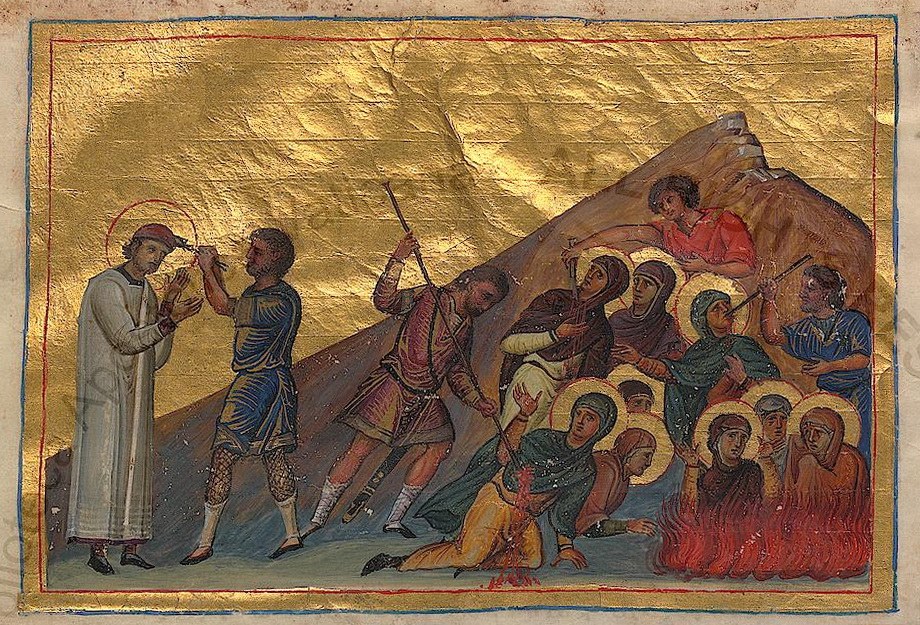

The synaxaria relate that these forty women, dedicated to virginity and gathered under the instruction of the deacon Ammoun, were seized at Heraclea in Thrace when Licinius, breaking with Constantine, turned on the Christians of his dominions (c. 321–323). Brought before the governor, they refused sacrifice; the accounts describe the governor's astonishment at their constancy under torture, Ammoun's own sufferings alongside his spiritual daughters — the traditions describe a heated helmet or plates applied to his head — and deaths inflicted in groups: some given to the sword, some to fire, others dying of their torments. The place of final execution is given variously as Heraclea itself or Adrianople, to which some of the company were taken.
The Greek synaxaria preserve lists of the virgins' names, but the lists vary between manuscripts and cannot be reduced to a single secure roll; for that reason no list is reproduced here as definitive.
Feast and commemoration
September 1 (church date; Old Calendar civil September 14). The company has no proper service in the received Menaion; the common of martyrs serves where their memory is kept liturgically.
Hymns
Troparion — Tone 4 (from the common of martyrs)
Thy martyrs, O Lord, in their contest received incorruptible crowns from Thee, our God; for possessing Thy strength they cast down the tyrants and shattered the feeble insolence of the demons. By their intercessions save our souls.
Original translation from the Greek
Iconography
The stored image is the miniature of the Menologion of Basil II (Constantinople, 985): the martyrdom of the company — Ammoun in the white sticharion of a deacon stands at the left as the torturer sets the burning helmet to his head, while the choir of veiled virgins is beaten, slain and given to the fire on the hillside beside him. In portrait icons the virgins would be shown as a choir of women in maphoria bearing martyrs' crosses, with Ammoun in a deacon's sticharion at their head.
Disputed questions
- Place and grouping. The tradition divides the deaths between Heraclea and Adrianople, and the manuscripts differ in how many suffered by each death; the year is fixed only by the general chronology of Licinius's persecution.