
Galacteon and Episteme
The Holy Martyrs Galacteon and Episteme of Emesa
Martyr · d. c. 253
Commemorated 5 November — Martyrdom at Emesa in Syria
Galacteon and Episteme were a young married couple of Emesa in Syria, martyred around the year 253 in the persecution under the governor Secundus. Betrothed by their parents, they chose after their marriage to live in continence and then to withdraw to the monastic settlements of Mount Publion, Galacteon among the monks and Episteme among the nuns. When persecution reached their mountain, Galacteon was seized while the others fled, and Episteme, unwilling to be parted from her husband and teacher, gave herself up to share his sufferings. Both endured mutilation and beheading together, and the Church keeps their joint memory on November 5 as an image of Christian marriage crowned in martyrdom.
_-_%D0%B8%D0%BA%D0%BE%D0%BD%D0%B0_03051_%D0%93%D0%B0%D0%BB%D0%B0%D0%BA%D1%82%D0%B8%D0%BE%D0%BD_%D0%B8_%D0%95%D0%BF%D0%B8%D1%81%D1%82%D0%B8%D0%BC%D0%B0.png)
Origins and early life
The saints belong to the Christian communities of third-century Syria, and their story is transmitted as a continuous family narrative. Galacteon was the son of a wealthy and distinguished couple of Emesa (the modern Homs), Kletophon and Leukippe, who had long been childless. According to the received Life, an aged monk-priest named Onuphrius, concealing his priesthood beneath a beggar's rags and going from house to house to preach Christ where he could, came to Leukippe's door; sensing her grief, he told her of the one true God who answers the prayer of those who turn to him in faith. Leukippe believed, received baptism, and was afterward granted a child — Galacteon — whom she and her now-converted husband raised in the Christian faith and gave a fine education.
Drawn from youth toward a life of solitude and prayer, Galacteon nevertheless did not resist when his father, on his coming of age, arranged his marriage to Episteme, a beautiful and well-born girl of the city who was still a pagan.
Marriage and ascetic struggle
The wedding, the tradition relates, was postponed for a season by the providence of God, and in the interval Galacteon gradually opened his faith to his betrothed. He won her to Christ and himself baptized her in secret, together with one of her servants, Eutolmius. The couple then resolved — this is the heart of their veneration — to keep their marriage in continence and to give themselves wholly to the monastic life. Leaving Emesa, they went up to Mount Publion, where two communities stood, one of men and one of women; Galacteon entered the former and Episteme the latter. Because the inhabitants of both houses were aged and infirm, the young couple took on the heavy labour of the settlements, and for several years they lived in work, fasting, and prayer. During this time Episteme saw in a dream that she and Galacteon stood in a radiant palace before a King who set golden crowns upon them — a vision the hagiographers read as a prefiguring of the martyrdom to come.
Martyrdom
The persecution of Christians in Syria, pressed by the governor Secundus — a man whom the Life remembers for parading the instruments of torture in the streets of Emesa to terrify the faithful — at length reached the mountain. A detachment of soldiers was sent against the monasteries. The monks and nuns escaped into the hills, but Galacteon would not flee; he remained in his cell reading the Scriptures and was taken and led away in chains. Seeing him carried off, Episteme implored the abbess to let her follow, that she might suffer for Christ together with the husband who had been her teacher in the faith; the abbess, weeping, blessed her to go. The two were tortured together — the account has their hands and feet struck off and their tongues cut out — and were at last beheaded, glorifying Christ to the end. Their servant Eutolmius is remembered as the witness who buried them and preserved their story.
Feast and commemoration
November 5 (church date; Old Calendar civil November 18). The couple are kept together on this day throughout the Byzantine rite; the day's proper service in the Greek Menaion is theirs, the apostles of the Seventy commemorated on the same date sharing the day without a proper office. Some synaxaria place the martyrdom under Decius (c. 250–251), others a little later, whence the conventional date of about 253.
Hymns
Troparion — Tone 4
Your Martyrs, O Lord, in their struggle received crowns of incorruption from you, our God; for possessing your strength, they cast down their persecutors and shattered the powerless boldness of the demons. By their intercessions, O Christ God, save our souls.
Original translation from the Greek
Kontakion — Tone 2
You were numbered among the companies of the Martyrs of Christ, having contended in splendour through steadfast struggles, O glorious Galacteon, together with Episteme, your honoured wife and fellow-athlete; and together you both make intercession to the only God on behalf of us all.
Original translation from the Greek
Oikos
Let us praise in songs and hymns Galacteon, the valiant one among the Martyrs, together with his all-glorious wife, the aptly-named Episteme; for these two cast down the arrogance of the enemy, refuted the godlessness of the idols, and proclaimed the faith of Christ. Wherefore, having received from him in splendour the crowns of incorruption, they intercede unceasingly on behalf of us all.
Iconography
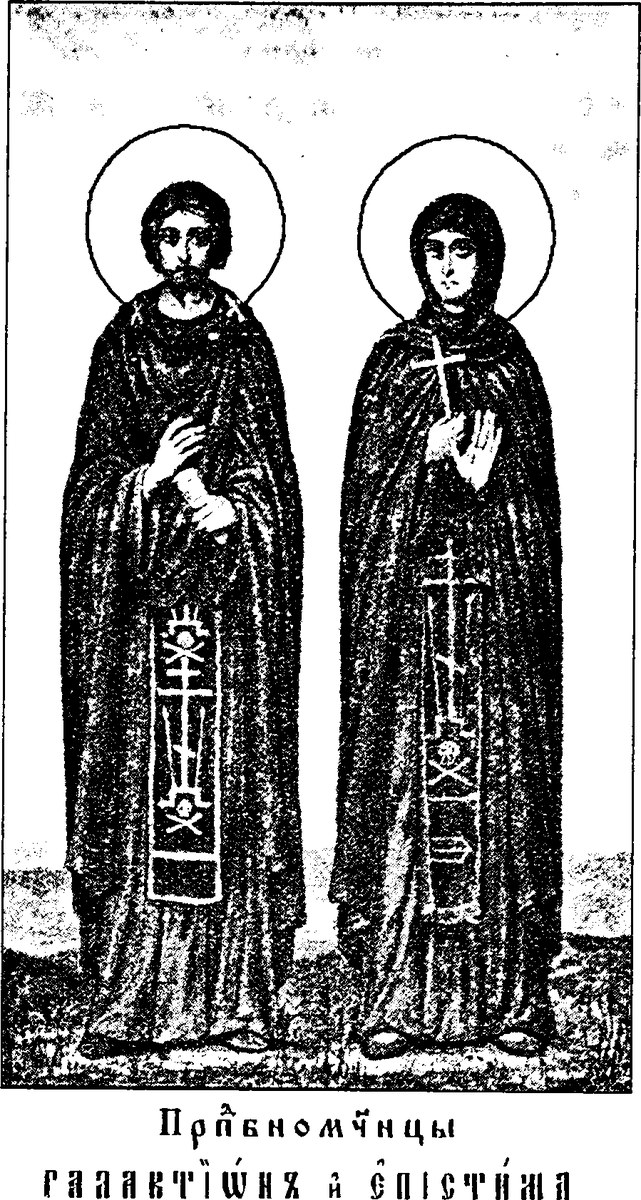
Galacteon and Episteme are shown together as a married pair of martyrs, most often young and richly or simply dressed, each holding the martyr's cross; Episteme is sometimes veiled as a nun and Galacteon habited as a monk, marking their withdrawal to Mount Publion before their deaths. The stored image, an engraving from the Russian synodal Lives of the Saints (1903–1911), ranges the two side by side, each named, holding crosses.
Disputed questions
- Not to be confused with the martyr Galacteon commemorated on June 22 with Juliana and Saturninus — a martyr of Constantinople drowned in the sea, of whom the synaxarion transmits nothing but the manner of his death. The shared name has repeatedly caused the two commemorations to be run together in secondary lists; they have no other point of contact.