
Gemellus of Paphlagonia
The Holy Martyr Gemellus of Paphlagonia
Martyr · d. c. 361
Commemorated 10 December — Martyrdom at Edessa under Julian the Apostate
Gemellus was a Christian of Paphlagonia who, about the year 361, openly rebuked the emperor Julian the Apostate for his renunciation of Christ, and for this confession was seized and cruelly tortured. A red-hot iron belt was fastened about his waist, and he was compelled to follow the emperor on his march eastward; at Edessa in Mesopotamia he was racked, pierced with stakes, and mangled, yet went on reviling the impiety of Julian. Released half-dead, he found a priest and was baptized, whereupon his wounds were healed. Learning of the miracle, Julian ordered him crucified, and so he gave up his soul to God. He is commemorated on December 10.
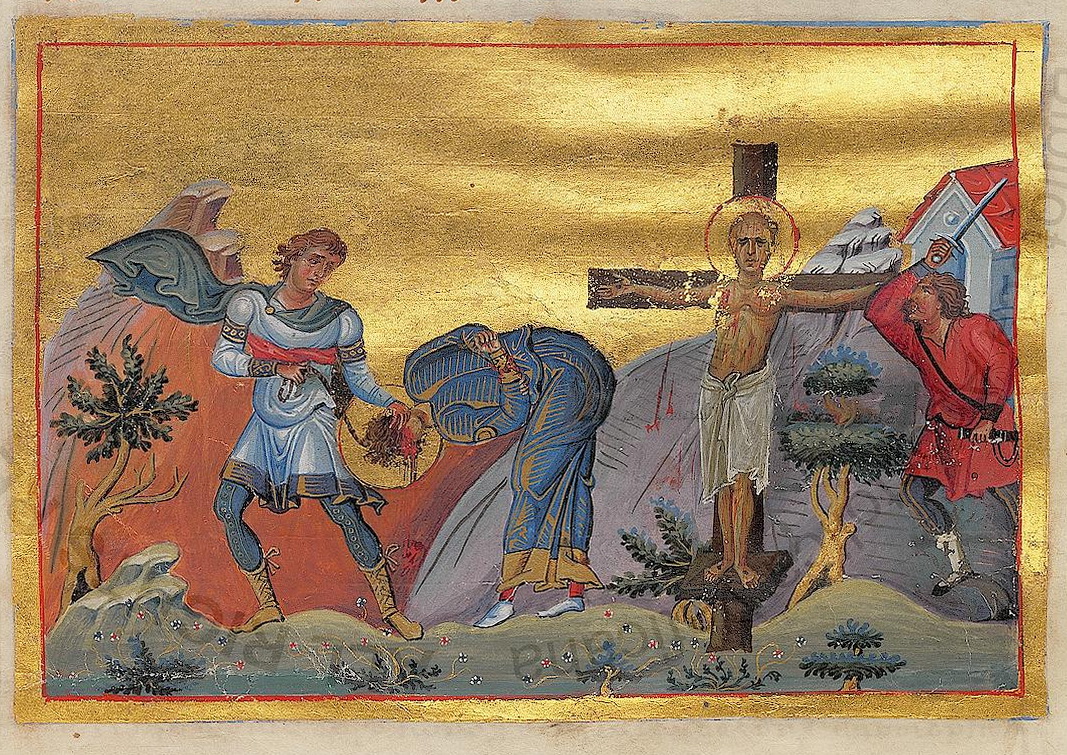

Gemellus was a native of Paphlagonia, the Black Sea province of northern Asia Minor. His martyrdom belongs to the brief pagan restoration under the emperor Julian (361–363), the nephew of Constantine who abandoned the Christian faith of his upbringing and set himself to revive the worship of the old gods. When Julian passed through the region — the earliest scene of the contest is placed at Ancyra in Galatia — Gemellus stood forth and denounced him to his face for his apostasy.
He was arrested and put to the torture. A belt of iron was heated red-hot and bound about his body, and he was then ordered to accompany the emperor on his journey. When the imperial progress reached Edessa in Mesopotamia, the martyr was stretched upon the ground and his limbs driven through with wooden stakes, after which he was hung upon a post and his flesh torn; and through it all he did not cease to reproach the emperor for his ungodliness. Subjected to still harsher torments, he was at length let go, and though grievously wounded he was able to walk and to speak. On his way he fell in with a priest, whom he begged to baptize him; and coming up out of the water he found his wounds every one made whole. When this became known, Julian, enraged that the God of the Christians had glorified his servant, commanded that Gemellus be crucified. So the martyr, hanging upon the cross in imitation of his Lord, surrendered his soul; and Christians took his body down secretly by night and buried it.
Feast and commemoration
December 10 (church date; Old Calendar civil December 23), within the Nativity Fast. His commemoration falls on the same day as the martyrs Menas Kallikelados, Hermogenes and Eugraphus, with whom he is listed in the synaxaria of the day. The memory of Gemellus is kept in the Byzantine synaxarion tradition.
Hymns
Troparion — Tone 4
Thy martyr Gemellus, O Lord, in his contest received an incorruptible crown from Thee our God; for possessed of Thy strength, he cast down the tyrant and broke the feeble insolence of demons. By his prayers, O Christ God, save our souls.
Original translation from the Greek
Iconography
Gemellus appears in the Menologion of Basil II (c. 1000), in the miniature for his commemoration (Vat. gr. 1613, folio 235), which shows the martyr suffering under torture — the received scene of his passion at Edessa. The stored image is that miniature.