
George the New of Sofia
The Holy New Martyr George of Sofia, the New
New Martyr · b. c. 1497, at Kratovo — d. 11 February 1515, at Sofia (Sredets)
Commemorated 11 February — Martyrdom by fire at Sofia under the Ottomans, 26 May — Second commemoration in Bulgarian and Russian usage
George the New (c. 1497 – 1515), called also George of Kratovo, was a young Christian goldsmith burned alive at Sofia (the Byzantine Sredets) in the early years of Ottoman rule, one of the most celebrated new-martyrs of the Balkan Slavs. Born at Kratovo, a mining town of the central Balkans, to a devout Christian family, and skilled in the working of gold and silver, he came as a youth of about eighteen to Sofia, where his beauty and gifts drew the notice of the Turks. Pressed to renounce Christ and embrace Islam, he refused with constancy; brought before the judge and offered wealth and honour to apostatise, he confessed his faith the more boldly, and was condemned to the fire and burned alive on 11 February 1515. His Life, written soon afterward by the priest Peyo of Sofia, is a landmark of South Slavic literature, and his memory is kept with honour by the Bulgarian, Serbian, and Russian Churches, both of the first two peoples claiming him as their own.

Kratovo and Sofia
George was born about the year 1497 at Kratovo, a town famed for its mines and its metalworkers in the central Balkans (in the modern Republic of North Macedonia), the son of Christian parents — named in the tradition Dimitri and Sara — who raised him in the faith and in letters. He learned the craft of the goldsmith, the working of gold and silver, and was still a young man, about eighteen years of age, when he came to Sofia — the old Sredets, then a chief city of the Ottoman Balkans — to follow his trade.
Confession and martyrdom
George's youth, comeliness, and skill made him conspicuous, and the Turks of the city sought to win so promising a youth to Islam. When persuasion failed, and he answered every inducement with the confession of Christ, he was seized and brought before the judge (the qadi). There, the Life relates, he was offered riches, station, and marriage if he would deny his faith, and threatened with a cruel death if he would not; but the youth, strengthened from above, refused to apostatise and confessed Christ before the tribunal and the assembled crowd. He was tortured, and then, unmoved, condemned to be burned alive. A pyre was raised in the city, and George was cast into the flames, giving up his soul in the confession of Christ on 11 February 1515, in the eighteenth or nineteenth year of his age. His remains were gathered by the Christians of Sofia and buried with reverence in the church of the city.
The Life by Peyo, and the cultus
Very soon after the martyrdom, the priest Peyo (Pop Peyo) of Sofia composed a Life and Passion of the New Martyr George, and a liturgical service was written for his feast; these works are among the earliest and finest monuments of Bulgarian literature under the Ottoman yoke, and they carried the young martyr's fame quickly through the Slavic Orthodox world. His cult spread from Sofia to Serbia, to the Romanian lands, and to Russia, where his Life was translated and his feast entered the calendars; he became a pattern and a comfort for the Christians of the Balkans in the long centuries of the Turkish yoke, when the temptation to save life and fortune by apostasy pressed on every generation.
Which George — a note on the martyrs of Sofia
Sofia gave the Church three new-martyrs named George within a century, and they are easily confused:
- George the New (of Kratovo) — this saint, the young goldsmith burned alive in 1515, whose Life was written by Peyo, kept on February 11 (and, in some calendars, on May 26).
- George the Newest of Sofia — a later martyr of the same city (traditionally †1530).
- George the Elder (Old) of Sofia — an earlier neomartyr (traditionally †1437).
He is also to be distinguished from the city's other great new-martyr, Nicholas of Sofia the shoemaker (†1555, May 17), whose Life was written by Matthew the Grammarian as this saint's was written by Pop Peyo — the two works standing together at the head of the sixteenth-century Sofia Literary School, and the two martyrs being regularly painted as a pair in Bulgarian church art.
This entry is the New Martyr of 1515, George of Kratovo. His origin at Kratovo is constant in the sources; his ethnic identity — whether Bulgarian or Serbian — has been claimed by both peoples, and the Church of each keeps him as its own; the disagreement is recorded here rather than resolved.
Feast and commemoration
George the New of Sofia is commemorated on February 11 (church date; Old Calendar civil February 24), the day of his martyrdom by fire, kept by the Bulgarian, Serbian, and Russian Churches and listed by the Orthodox Church in America as "George, New Martyr of Sofia." Some traditions keep his memory also on May 26. His is a post-Byzantine, Ottoman-era commemoration, not a feast of the universal fixed calendar of the first millennium.
Iconography
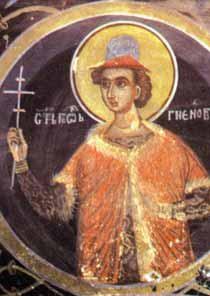
George the New is shown in the type of the youthful lay new-martyr: a beardless young man in the dress of a townsman or in the red cloak of martyrdom, holding the small cross of the martyrs, and often set against or amid the flames of his death by fire — the sign proper to him, distinguishing his passion from the sword or the noose of other neomartyrs. In Bulgarian and Serbian church painting he appears among the new-martyrs of the Turkish period, and narrative scenes show his trial before the judge and his burning at Sofia.
The identification problem the entry once recorded — telling this George from the many others of his name — is settled by the stored fresco's own inscription.
The stored image is a 17th-century fresco from the monastery of St Athanasius at Žurče, inscribed for the young martyr in his fur-trimmed cap, cross in hand — the received type of the new-martyr of Sofia. The reproduction is small; a larger scan is listed among the upgrade-wanted icons.