
Gerasimus of Boldino
Our Venerable Father Gerasimus, Abbot of Boldino
Venerable · b. 1490, at Pereslavl-Zalessky — d. 1 May 1554
Commemorated 1 May — Repose at the Boldino monastery
Gerasimus (1490–1554) was the great monastic coloniser of the Smolensk lands. Born at Pereslavl-Zalessky, he attached himself at thirteen to Saint Daniel of Pereyaslavl and spent some twenty-six years under him, becoming known in Moscow as an ascetic of the strictest kind; then, seeking obscurity, he went west into the wild forest near Dorogobuzh, settled beside a great oak at Boldino, was beaten and driven off by robbers, and stayed. Out of that solitude grew four monasteries — the Trinity at Boldino (1530), the Forerunner at Vyazma, the Entry of the Theotokos on the Zhizdra in the Bryansk forest, and a fourth house at Bryansk — and a school of disciples that included Anthony, later bishop of Vologda. He dictated a testament to his brethren, and reposed on 1 May 1554.

Origins and the years with Daniel of Pereyaslavl
He was born in 1490 at Pereslavl-Zalessky, north-east of Moscow, and baptised Gregory. As a boy he heard of the holy life of Daniel of Pereyaslavl — the ascetic who buried the unclaimed dead and afterwards founded the Trinity monastery there — and at thirteen came to him in tears begging to be received. Daniel took him, and in due course tonsured him with the name Gerasimus.
He remained with his elder for some twenty-six years, in an obedience of extreme severity: the Life records his fasting, his night vigils, his manual labour in the bakery and at the heavy work of the house, and the coarse patched clothing that he wore to the end. His reputation reached Moscow, and Grand Prince Vasily III is said to have known of him; and this was precisely what he could not bear. Seeking to be unknown, and with his elder's blessing, he left Pereyaslavl.
The oak at Boldino
He went far west, to the forests of the Dorogobuzh district in the Smolensk lands, then a frontier country recently recovered from Lithuania, thinly settled and lawless. About eight miles from Dorogobuzh, at a place called Boldino, he made his cell beside a great oak on the road, and lived there on roots and bark. The traffic of the road brought him trouble at once: robbers and local men beat him, drove him off, and threw him out more than once, taking him for a vagrant or a sorcerer. The Life dwells on the patience with which he returned each time, and on the conversion of some of his persecutors. He was arrested and taken before the governor as a suspicious person, and released when it appeared who he was.
Disciples began to gather, and in 1530 Gerasimus obtained from Grand Prince Vasily III and from the metropolitan the charter for a monastery: the Trinity monastery at Boldino, which grew rapidly and became the richest and most important house of the Smolensk region, with a great stone church raised later in the century. Gerasimus governed it as a strict cenobium, in the tradition of common property, common table, and constant labour that he had learned at Pereyaslavl.
Four foundations and a school of disciples
He did not stay to enjoy the settled house. In the years that followed he founded, or sent his disciples to found, three more monasteries: the monastery of Saint John the Forerunner at Vyazma; the monastery of the Entry of the Theotokos on the river Zhizdra, in the Bryansk forests; and a further house at Bryansk itself. The pattern — an ascetic settles in the waste, the waste becomes a monastery, the monastery becomes the centre of a settled Christian district — is the pattern of the whole Russian monastic colonisation, and Gerasimus is one of its most effective agents in the western lands.
Among the disciples he formed were Anthony, whom he sent as abbot to the Forerunner monastery at Vyazma and who afterwards became bishop of Vologda and himself a saint of the Russian calendar; and Arcadius, who left the community for the life of a hermit with his blessing. It was Anthony who, at Gerasimus's dictation, took down the elder's last instructions to the brethren, and who wrote the Life.
Repose
Feeling his end near, Gerasimus summoned the abbots and elders of all his houses, gave them his final counsel — on the keeping of the cenobitic rule, on hospitality, on obedience, and on not multiplying property beyond the community's need — and reposed on 1 May 1554, in his sixty-fourth year. He was buried in the Trinity monastery at Boldino. The monastery, suppressed in the Soviet period and its church blown up during the Second World War, has since been restored, and the relics of its founder were recovered and returned to it.
Feast and commemoration
May 1 (church date; New Calendar civil May 1, Old Calendar civil May 14) — the day of his repose. The feast is Russian, kept at Boldino, at Vyazma and in the Smolensk diocese, and appears on the American calendar; he is also commemorated among the Synaxis of the Saints of Smolensk. Where a service is needed the common of a venerable father is used.
Hymns
Troparion — Tone 8 (common of a venerable father)
In thee, O Father, was the divine image kept secure; for taking up thy cross thou didst follow Christ, and by thy deeds thou didst teach us to despise the flesh, for it passeth away, but to care for the soul, a thing immortal. Therefore doth thy spirit, O venerable Gerasimus, rejoice together with the angels.
Original translation from the Slavonic
Iconography
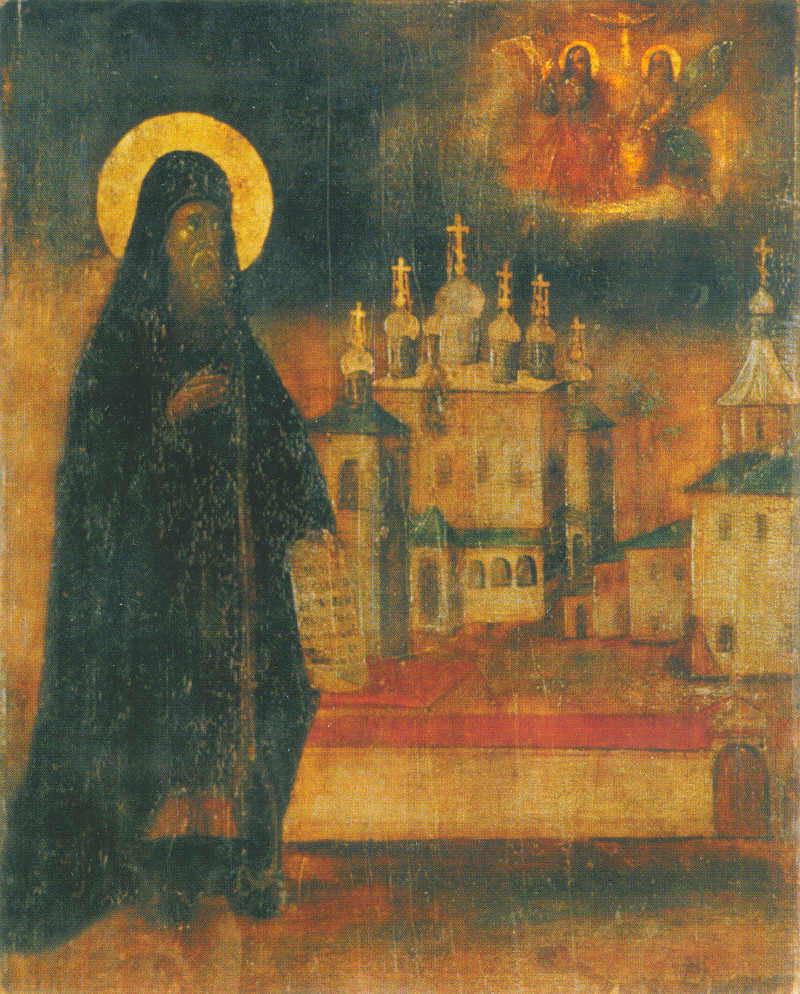
Gerasimus is painted as a Russian monastic founder: a bearded ascetic of middle years in the black mantle and cowl, in prayer or holding a scroll of his testament, with the Trinity monastery of Boldino shown behind or beside him. Two attributes are peculiar to him. The first is the great oak by which he made his first cell, which appears in the popular lithographs of the nineteenth century (he is shown standing or kneeling beneath it). The second is the appearance of the Holy Trinity or of Christ in glory in the upper corner of the panel, referring both to the dedication of his monastery and to the vision recounted in his Life.
The stored image is an eighteenth-century Russian icon: the saint stands at the left in the black schema, hand at his breast, with the many-domed white monastery of Boldino filling the right half of the panel and a heavenly appearance in the upper right. The photograph is not of high resolution and the inscription is not legible in it; the identification rests on the Russian icon-corpus description of the panel and on the unmistakable monastery view.
Disputed questions
- The number of his foundations. The Life and the later Russian literature give three or four monasteries according to whether the Bryansk house is counted as a separate foundation or as a dependency of the Zhizdra monastery. Four is the usual reckoning.
- The dates. The Life gives 1490 for his birth, 1530 for the Boldino charter and 1 May 1554 for his repose, and these are generally accepted; the "twenty-six years" with Daniel of Pereyaslavl fits them approximately but not exactly, and some accounts reduce the figure.
- Not to be confused with Gerasimus of the Jordan, Gerasimus of Cephalonia, Gerasim of Vologda, or Gerasimus of Perm, all of whom the calendar keeps on other days; the Vologda connection is easily muddled, since it was Gerasimus of Boldino's disciple Anthony who became bishop of Vologda.