
Gertrude of Nivelles
Our Venerable Mother Gertrude, Abbess of Nivelles
Venerable · b. c. 626, in Austrasia — d. March 17, 659, at Nivelles
Commemorated 17 March — Repose at the Nivelles monastery
Gertrude of Nivelles (c. 626–659) was a Frankish abbess of the seventh century and a saint of the undivided Western Church, kept on March 17. Daughter of Pepin of Landen, the powerful mayor of the palace of Austrasia, she refused a noble marriage and, when her widowed mother Itta founded the double monastery of Nivelles in Brabant, became its first abbess while still very young. She was renowned for her hospitality to pilgrims and wandering Irish monks, for her deep knowledge of the Scriptures, and for an ascetic devotion that wore out her body by her early thirties; she resigned her office to prepare for death and reposed on March 17, 659, at the age of thirty-three. Long one of the most popular saints of the Low Countries — invoked by travellers, gardeners, and against plagues of mice — she is honoured among the Orthodox as a mother of the one Church before the schism.
.jpg)
Origins
Gertrude was born about 626 into the greatest family of the Frankish kingdom of Austrasia. Her father, Pepin of Landen (Pepin the Elder), was mayor of the palace — the chief minister and effective ruler under the Merovingian kings — and the ancestor of the line that would become the Carolingians; her mother was Itta (Iduberga), and her sister Begga would herself be venerated as a saint and become an ancestress of Charlemagne. The tradition preserves a scene from her girlhood: when King Dagobert proposed to betroth her to the son of a duke, the child Gertrude flatly refused, declaring that she would have no earthly bridegroom but Christ — a refusal so vehement that the suitor withdrew.
Abbess of Nivelles
On the death of Pepin (639), his widow Itta, counselled by the missionary bishop Amand of Maastricht, founded about the year 640 a double monastery (of monks and nuns under one rule) at Nivelles in Brabant, in the modern Belgium. To secure her daughter from the pressure of ambitious suitors, Itta is said to have cut off Gertrude's hair in the sign of the cross, consecrating her to God; and the young Gertrude — by the tradition still only in her teens — was made the first abbess of Nivelles, her mother governing the temporal affairs at her side until Itta's own death (652), after which Gertrude ruled alone.
Under her the monastery flourished as a house of prayer, learning, and charity. She was celebrated for her hospitality: pilgrims, the poor, and travelling monks found welcome and rest at Nivelles, and Gertrude gave especial support to the Irish monks then evangelising the continent — she received the brothers Foillan and Ultan (companions of Saint Fursey), gave Foillan land at Fosses for a monastery, and drew from them the learning and the relics and books they carried. She was said to have known the whole of the Scriptures by heart and to have gathered relics and holy books from Rome and beyond for her community. Her personal life was one of severe asceticism — long vigils, little sleep, and much fasting — which the tradition blames for the breaking of her health while she was still young.
Repose
Worn out by her austerities, and (the Vita says) forewarned of the day of her death, Gertrude resigned the abbacy about 656 to her niece Wulfetrude, and gave her last years wholly to prayer and preparation for the end. She sent to Fosses to ask the aged Ultan when she should die, and received the answer that she would depart on the next day, the feast of Saint Patrick; and so it proved. She died on March 17, 659, at the age of about thirty-three, and was buried at Nivelles in the habit and with the hair-cloth she had asked for, refusing any finer shroud. Her tomb at once became a place of pilgrimage and healing, and the monastery of Nivelles her lasting monument.
Veneration and later cultus
Gertrude became one of the best-loved saints of the Low Countries and the Rhineland. Her Vita (written soon after her death) and the popular devotion that grew around her made her a patroness of travellers — pilgrims prayed for "the draught of Saint Gertrude" before a journey — and, by a later development of her legend, a protectress against mice and rats (and so a patroness of gardens and fields against vermin), with which she is constantly shown in art; the association drew after it the modern folk-patronage of cats. Her feast on March 17 was kept across the medieval West, and her relics were honoured at Nivelles until the destruction of her great shrine in the twentieth century. As a saint of the seventh century — three hundred years and more before the estrangement of East and West — she is received in the Orthodox Church among the saints of the undivided Western Church, and kept on her ancient day by those Orthodox who honour them.
Feast and commemoration
Gertrude is commemorated on March 17 (church date; Old Calendar civil March 30), the day of her repose, which she shares with the great Patrick of Ireland — a coincidence her own Vita marks, since she was told she would die on Patrick's feast. Because the day falls within Great Lent, whose bounds are movable, any Orthodox commemoration is kept within the Lenten office. Hers is chiefly a Western commemoration, kept among the Orthodox by the jurisdictions and Western-rite communities that honour the pre-Schism saints of the West.
Iconography
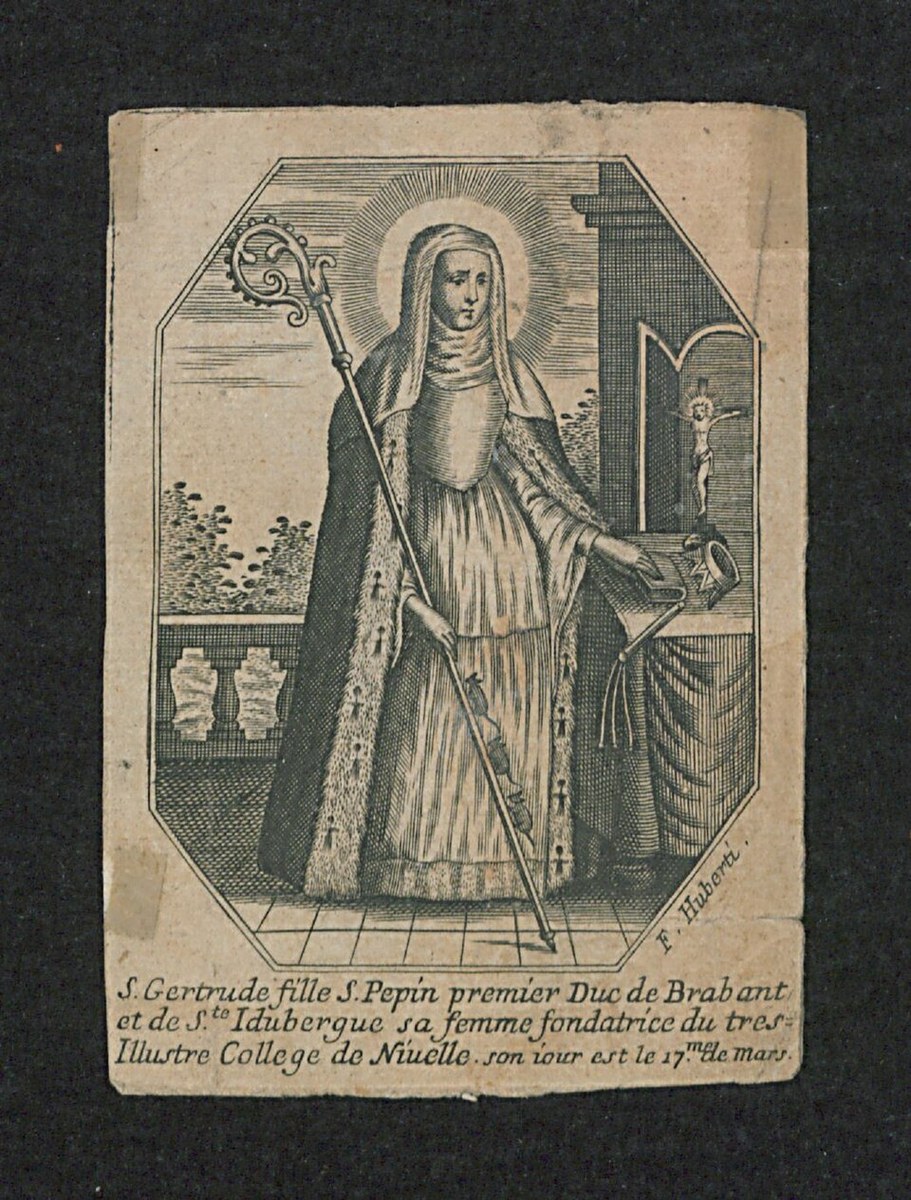
Gertrude is imaged as an abbess — veiled, in the monastic or Benedictine habit, holding an abbatial crosier (staff) and often a book — with her unmistakable attribute, mice or rats, running up her staff or about her feet, or a spindle; sometimes she is shown receiving pilgrims, or with a cat, the later folk-emblem of her patronage against vermin. These are the conventions of Western religious art; she was never written in the Byzantine icon-manner, and modern Orthodox icons of her are the works of living iconographers.
The stored image is a 1656 Flemish engraving of the saint from the Thijs Collection of the University of Antwerp — Gertrude as an abbess with her staff (source, a pre-1900 work, the scan released into the public domain, pd-old-work).