
Glyceria of Heraclea
The Holy Virgin-Martyr Glyceria of Trajanopolis, who suffered at Heraclea in Thrace
Virgin · Martyr · d. c. 177
Commemorated 13 May — Martyrdom by the beasts at Heraclea in Thrace
Glyceria was a young noblewoman of Trajanopolis in Thrace, daughter of a man named Macarius who had held the rank of consul, who came to the public sacrifice with the sign of the Cross traced upon her forehead instead of a garland, and at whose prayer the statue of Zeus fell from its pedestal and shattered. Stoned, hung up and flayed at the head, sealed alive into a prison and fed there by an angel, cast into a furnace and left unhurt, she was carried at last to Heraclea and thrown to the beasts, and died about the year 177 when a lioness laid her down without tearing her. Her jailer Laodicius was converted by the miracle of her healing and beheaded with her. Her tomb at Heraclea streamed healing myrrh, and her memory is kept throughout the Orthodox world on May 13.

Origins in Trajanopolis
The passion places Glyceria in Trajanopolis, the Thracian city on the Hebrus founded by Trajan, in the second century. Her father, Macarius, is described as a Roman of high station — the Greek synaxaristes says he "had been consul" (ὕπατος), which in the usage of these texts means simply a magistrate of the first rank rather than one of the eponymous consuls of the year. The family was of the governing class of the province, and Glyceria was left an orphan, or at least without her father's protection, while still young. She had embraced Christ in childhood and, the Greek notice adds, was already conspicuous for teaching and catechising others — a girl of the aristocracy openly instructing her neighbours in the faith. She lived in continence, and the Church numbers her among the virgins.
The idol of Zeus
An imperial edict required the citizens to offer sacrifice, and the governor Sabinus appointed a day on which the whole city was to come to the temple and worship Zeus. Glyceria came with them. Where the other women wore garlands she had traced on her forehead the sign of the Cross, and when Sabinus asked where her lamp and her sacrifice were she answered that she carried her lamp in her heart and her sacrifice was prayer. Bidden to worship, she prayed aloud to the true God to show which of the two was Lord; and — the passion relates — thunder was heard, the great statue of Zeus was thrown from its base and broken into fragments, and the pagan priests, robbed of their god, fell upon her with stones. The stones, it is said, did not touch her.
The prison, the angel and the furnace
Sabinus had her hung up and her hair torn away with the skin of her scalp, then thrown into prison; and lest anyone bring her food he sealed the door with his own ring. There, the passion says, an angel ministered to her, and she was found on the appointed day not dead of hunger but whole, her wounds healed and her body shining. The governor's seal was unbroken, and it was at this point that her keeper, the jailer Laodicius, believing that she had escaped and that he would answer for it with his life, was stopped by the saint herself, learned from her what had happened, and confessed Christ before the tribunal — for which he was beheaded.
Glyceria was then bound to a wheel, and cast into a heated furnace; she came out of it unburnt. The account also gives her a miracle of mercy in prison: at her prayer water was given to those shut up and thirsting with her.
Martyrdom at Heraclea
Unable to break her, Sabinus sent her under guard to Heraclea on the Propontis, where she was condemned to the beasts. Two lionesses were loosed in the arena. The first, the passion says, ran to her and lay down at her feet, doing her no harm; the second struck her once and she gave up her spirit — killed, but her body left whole and untorn, so that the Church could receive it entire. Her death is placed about the year 177.
Relics and the myrrh
The bishop of Heraclea, named Dometius, with the Christians of the city took up her body and buried it honourably. Her grave became one of the myrrh-streaming tombs of Thrace: a fragrant myrrh was said to flow from it, and healings were worked there. In later centuries her name was attached to a small island off the Bithynian coast opposite Nicetiaton (the modern Tuzla), the island of Saint Glyceria, where a monastery of the Most Holy Theotokos Pantanassa stood; that house was still in being in 1158, when the emperor Manuel Comnenus issued a chrysobull in its favour, and the Greek synaxaria keep the consecration of its church on this same day, May 13 — a commemoration of the church, not of the martyr, though the two are listed together.
Feast and commemoration
May 13 (church date; New Calendar civil May 13, Old Calendar civil May 26). Glyceria is a commemoration of the whole Orthodox world and heads the day in every tradition — Greek, Antiochian and Slavic alike — the Menaion appointing her the day's proper service, with Laodicius joined to her. Depending on the date of Pascha the day may fall in the Paschal season or after Pentecost, so no fixed seasonal note belongs to it. In the Greek books the day carries with her the consecration of the church of the Theotokos Pantanassa on the island that bears her name.
Hymns
Apolytikion — Tone 4
Thy lamb, O Jesus, crieth with a loud voice: Thee, my Bridegroom, do I love, and seeking Thee I strive in contest; I am crucified and buried together with Thee in Thy baptism, and I suffer for Thy sake that I may reign with Thee; I die for Thee that I may also live in Thee. Receive me as a spotless sacrifice, offered unto Thee in love. By her intercessions, as Thou art merciful, save our souls.
Kontakion — Tone 2
A virgin of noble birth, thou didst cast down the graven image by thy prayer, and being torn, sealed up and given to the beasts, thou wast not overcome; wherefore, O all-praised Glyceria, thou pourest forth myrrh and healing upon them that honour thee.
Original translation from the Greek
Iconography
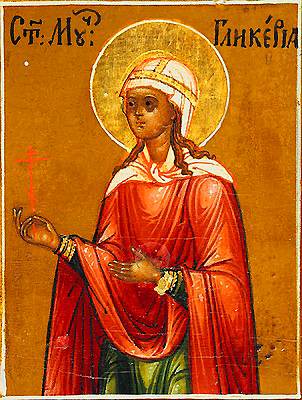
Glyceria is painted as a young woman in the prime of youth, uncovered or lightly veiled, in the red mantle of the martyrs over a green or blue tunic, holding the small cross of confession in her right hand with the left open in acceptance; her hair is loose or braided, as befits a virgin. Where narrative scenes are given her, the two signs of her passion appear: the broken statue of Zeus at her feet, and the lioness couched before her in the arena; occasionally the sealed prison door and the flask of her myrrh are added. Because her feast falls in May she is not to be looked for in the Menologion of Basil II, which covers only September to February. The stored image is a late-nineteenth-century Russian fragment from the icon "Sophia the Wisdom of God with the Saints" in the Church-Archaeological Cabinet of the Moscow Theological Academy, inscribed СТ. МЦ. ГЛИКЕРІА — "Holy Martyr Glyceria" — showing her bust-length in a red mantle with the red cross in her raised hand; the inscription's "martyr" makes plain that it is the ancient Glyceria and not her Novgorod namesake. A widely circulated modern Athonite panel of the saint was examined and rejected as a living artist's copyrighted work.
Disputed questions
- The reign. The synaxaria set her passion under Antoninus Pius (138–161), while the same notices — and the Slavic lives after them — date her death to about 177, which falls in the reign of Marcus Aurelius. The two statements cannot both stand; the discrepancy is transmitted, not resolved, in the sources, and it is recorded here as it stands. Nothing in the passion depends on which emperor is meant, and both dates place her firmly in the second century.
- Trajanopolis or Heraclea. The Greek tradition names her from Trajanopolis, where she was arrested and tortured; the Slavic and English calendars call her "Glyceria at Heraclea," from the place of her death. Both are the same saint, and the two epithets belong to the two halves of one passion.
- Not to be confused with the Russian Glykeria of Novgorod, the righteous virgin who reposed in 1522 and whose incorrupt relics were found in 1572; the Slavic calendars keep her on this same day, May 13, immediately after the ancient martyr whose name she bore.