
Gregory of Decapolis
Our Venerable Father Gregory the Decapolite
Venerable · b. c. 780 — d. c. 842
Commemorated 20 November — Repose at Constantinople
Gregory the Decapolite (c. 780–c. 842) was one of the great wandering ascetics of the age of the second iconoclasm, a monk of the Decapolis of Isauria who spent his life on the roads of the Byzantine world — Ephesus and Constantinople, Rome and Corinth, Sicily and Thessalonica — preaching the veneration of the holy icons and confirming the persecuted Orthodox. Gifted, his Life relates, with prophecy and healing, he reposed at Constantinople shortly before the Triumph of Orthodoxy. His incorrupt relics, carried out of the fallen capital and bought in 1498 by the Ban of Wallachia, rest to this day at the Bistrița Monastery in Romania, where he is among the most beloved of saints. He is commemorated on November 20.
.jpg)
Origins and early life
Gregory was born about the year 780 in the region called the Decapolis — the "ten cities" — of Isauria, in the rugged uplands of southern Asia Minor, from which he takes his surname the Decapolite. His Life, composed within a generation of his death by Ignatius the Deacon (the same Constantinopolitan man of letters who wrote the lives of the patriarchs Tarasius and Nicephorus), presents a boy who loved the church and the Scriptures from infancy and read them, it says, with unwearying reverence. When his parents arranged a marriage for him he refused it and left home for the monastic life, entering a monastery of which, in some accounts, his own brother was superior. From the first his biographer marks him out as an ascetic of exceptional severity and prayer.
Ascetic struggle and wandering
The defining feature of Gregory's life was that it had no fixed place. Where the great fathers of the desert are known by a single mountain or cell, Gregory is the saint of the road: his Life is a long itinerary across the whole Byzantine world and its margins. He is found on the Bithynian Mount Olympus, the monastic heartland of the age; at Ephesus; in Constantinople; sailing to the West, to Rome, where he lived for a time; to Corinth; into Sicily and the Greek south of Italy — Syracuse, Naples, Otranto — then back across to the mainland; and at last for a long stay near Thessalonica, at the monastery of Saint Menas, from which he made his final journey to the capital. He travelled by ship and on foot, through territories harried by Arab and Slav raiders and by brigands, and the Life records the ordinary perils of such a life — shipwreck threatened, robbers met on the road, and each danger turned aside by his prayer.
This restlessness was not aimless. Gregory lived through the second period of Byzantine iconoclasm, reopened under the emperor Leo V the Armenian in 815 and prosecuted by his successors down to 843, when the icons were restored. In those years the confessors of Orthodoxy were deprived, exiled, imprisoned, and scourged, and Gregory's wandering was in part the freedom of a man who would not be pinned down by a hostile administration. Everywhere he went, his biographer says, he preached the word of God, denounced the iconoclast heresy openly, and strengthened the faith and courage of the Orthodox who were being persecuted. Through his long ascetic labour he was granted, the Life relates, the gifts of prophecy and of working miracles; having subdued the passions and climbed to the height of virtue, he was accounted worthy on one occasion to hear the angelic hosts singing the praise of the Holy Trinity.
Around Gregory gathered disciples who would themselves be reckoned among the saints. The most celebrated is Joseph the Hymnographer (commemorated April 3 or 4), the future master of the Byzantine canon, who attached himself to Gregory at Thessalonica, accompanied him to Constantinople, and was sent by him on the embassy toward Rome during which he was captured by pirates — the beginning of Joseph's own remarkable story. The link binds two of the ninth century's luminaries: the wandering confessor and the greatest hymnographer of the later Church.
Repose
Gregory left the monastery of Saint Menas near Thessalonica and went up once more to Constantinople to contend against the iconoclasts. There, in the capital, a grave illness broke his strength, and he reposed and gave his soul to the Lord. The year is disputed (see below); the weight of scholarship places his death about 842, on the very eve of the restoration of the icons that he had spent his life defending. He was buried in a monastery of the city, and many miracles were reported at his tomb.
Relics and translations
The wonders worked at his grave moved the monks to raise Gregory's body, and they found it incorrupt; the relics were enshrined where the faithful could venerate them, and they became one of the treasured relics of Constantinople. When the city fell to the Ottomans in 1453 the relics were carried off toward the Danube by a Turkish official. In 1498 Barbu Craiovescu, the Ban of Wallachia, hearing of the miracles worked by them, purchased the holy relics for a great sum and enshrined them in the principal church of the Dormition Monastery of Bistrița, which he had founded at Râmnicu Vâlcea, on the Olt in Wallachia. There they remain to the present day, incorrupt and wonderworking, and Gregory the Decapolite has become one of the most venerated saints of Romania — his shrine a place of pilgrimage, and the record of the healings worked through him kept and retold (a booklet of his Romanian miracles was compiled in the twentieth century by the abbess Olga Gologan of Bistrița, who reposed in 1972).
Feast and commemoration
November 20 (church date; Old Calendar civil December 3), kept universally in the Byzantine rite. In the Menaion his service is joined to that of Proclus of Constantinople and sung under the Forefeast of the Entry of the Theotokos into the Temple, which governs the day; his proper canon (the second of the day) is ascribed in the books to the hymnographer Joseph — fittingly, his own disciple. In Romania, where his relics rest at Bistrița, his feast is kept with especial solemnity.
Hymns
Troparion — Tone 4
O God of our Fathers, who ever dealest with us according to Thy forbearance: take not Thy mercy from us, but by their supplications govern our life in peace.
Original translation from the Greek
Kontakion — Tone 3
As a radiant sun the Church knoweth thee, O favourite of Christ, who enlightenest all by the beauty of thy virtues and the rays of thy healings. Therefore we keep thy honoured memory and venerate thy struggles, O all-blessed and most-wise father Gregory.
Original translation from the Slavonic
Iconography
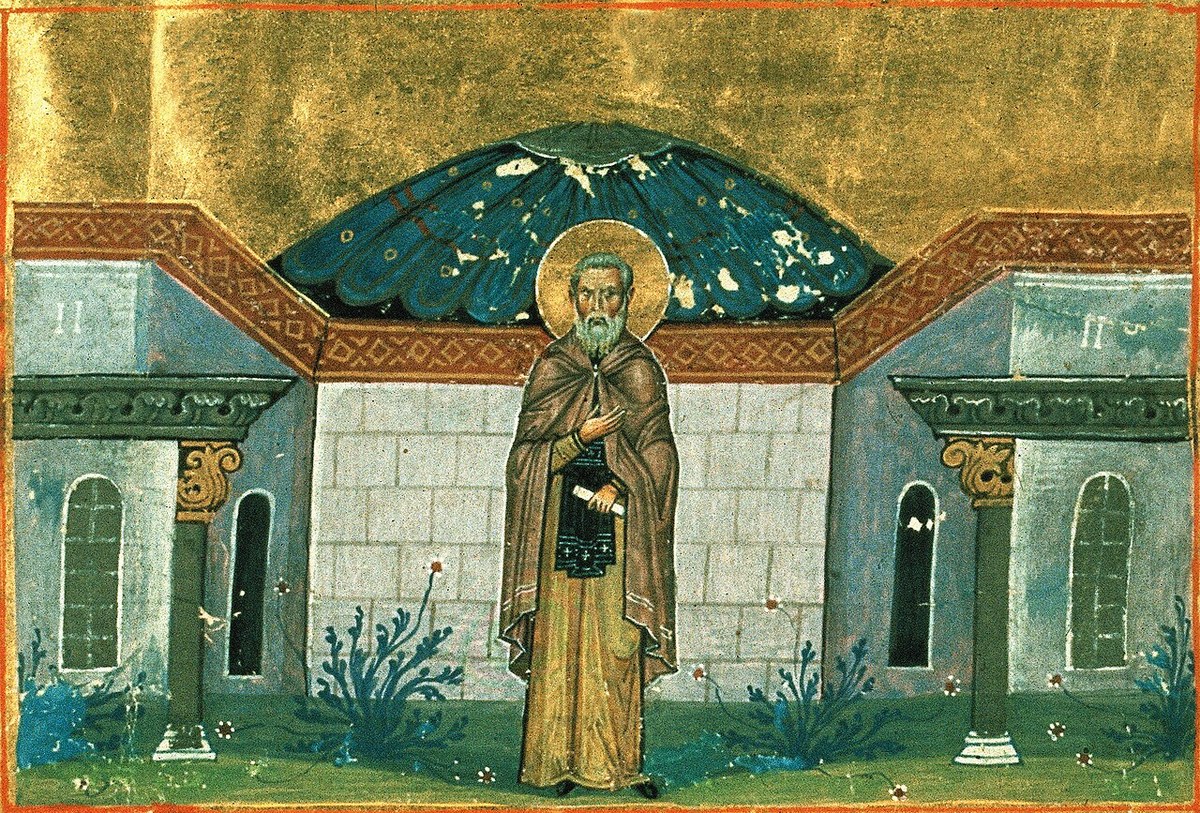
Gregory is depicted as a monk and ascetic father: an aged, bearded figure in the dark monastic mantle over the tunic, often holding a scroll, his right hand raised in blessing or prayer. The stored image is his miniature from the Menologion of Basil II (c. 1000): the saint stands nimbed before a domed building, in a brown mantle over an ochre tunic, a small scroll in his hand, amid the flowering greenery with which the Menologion's painters set their standing saints — the standard portrait of a venerable father, without narrative attribute.
Disputed questions
- Year of repose. The date is not fixed by the sources. The Greek and Slavonic calendars give about 842, which agrees with the modern critical study of his Life (Dvornik) and with the whole shape of his career under the second iconoclasm (815–843); this is the date followed here. The Orthodox Church in America's synaxarion, by contrast, places his death in 816. The later date is to be preferred, since a repose in 816 would fall at the very outset of the persecution he is said to have opposed through a long life.
- The city of his birth. Some notices (including the OCA's) speak of "the city of Decapolis," but the Decapolis of Isauria is a region — a group of ten cities — not a single town; Gregory's home city within it is variously given (Irenopolis is often named).