
Gregory V of Constantinople
Our Father among the Saints Gregory V, Patriarch of Constantinople, Hieromartyr
New Martyr · Hieromartyr · Patriarch · d. 1821
Commemorated 10 April — Martyrdom by hanging at the gate of the Patriarchate on Pascha
Gregory V (1746–1821) was Ecumenical Patriarch of Constantinople three times over, a reforming and deeply pastoral hierarch, and — at the outbreak of the Greek War of Independence — the great ethnomartyr of the Orthodox nation. On the very morning of Pascha, April 10, 1821 (Old Style), Ottoman authorities, holding him answerable for the uprising he had in fact anathematised, hanged him in his vestments from the central gate of the Patriarchate at the Phanar in Constantinople. He is honoured by the Church as a hieromartyr, and his relics rest in the Metropolitan Cathedral of Athens.

Origin and monastic beginnings
He was born George Angelopoulos about the year 1746 at Dimitsana, a town of the mountainous Peloponnese renowned for its schools. Educated in his native place and at Athens, Smyrna and on the island of Patmos — at the celebrated Patmiad school — he was tonsured a monk with the name Gregory and ordained. He entered the service of the metropolis of Smyrna, one of the greatest sees of the Greek Church, and there his gifts of learning, administration and pastoral zeal marked him out; on the death of the metropolitan he was chosen to succeed him, and as Metropolitan of Smyrna he laboured for the churches, schools and charities of that flourishing city.
Ecumenical Patriarch — three tenures
In the disturbed politics of the late Ottoman Church, where the Patriarch held office at the will of the Porte and the intrigues of the Phanar, Gregory was raised to the Ecumenical Throne three separate times:
- First patriarchate, 1797–1798.
- Second patriarchate, 1806–1808.
- Third patriarchate, from 1818 to his martyrdom in 1821.
Twice deposed and exiled — chiefly to the monasteries of Mount Athos, where he lived as a simple monk in the intervals of his rule — he used each tenure for the good of the Church. He was a reformer of clerical discipline and of the finances of the Patriarchate; a builder and restorer, who renewed the patriarchal church of St George at the Phanar; a promoter of Greek letters and schools, supporting the printing of books and the reorganisation of education; and a patron of the translation and printing of the Fathers. At the same time he was a firm guardian of Orthodoxy against Western missionary proselytism and against the rationalism then entering Greek learning from Europe.
The uprising and the martyrdom
When the Greek War of Independence broke out in the spring of 1821, the Patriarch's position became mortally dangerous. Under the Ottoman system he was the civil head — the ethnarch — of the Orthodox Christians of the empire, and answerable with his life for their conduct. To protect his flock, and under compulsion of the Porte, Gregory publicly anathematised the insurrection and its leaders; yet the government neither believed his sincerity nor cared, holding the head of the nation responsible for the revolt of the nation.
On the morning of Pascha, 10 April 1821, Gregory celebrated the Paschal Liturgy in the patriarchal cathedral. As he left the church he was seized by Ottoman soldiers, and, still in his episcopal vesture, was hanged from the central gate of the Patriarchate. His body was left suspended for three days in mockery, then given to a mob and cast into the sea. It was recovered by Greek sailors and carried to Odessa, where it was buried with honour; and in 1871, the fiftieth anniversary of his death, his relics were translated to Athens and enshrined in the Metropolitan Cathedral, where they remain. The central gate of the Patriarchate has been kept welded shut from that day to this, in perpetual memory of the martyred Patriarch.
Feast and commemoration
April 10 (church date; Old Calendar civil April 23), the day of his martyrdom — which in 1821 fell on Great and Holy Pascha itself. He is commemorated as a hieromartyr and ethnomartyr especially in the Church of Greece and the Ecumenical Patriarchate, and throughout the Orthodox world. His glorification as a saint was proclaimed by the Church of Greece.
Hymns
Apolytikion — Tone 4
Thou didst shepherd the Church of Christ in a time of trial, and with thy blood as a hierarch thou didst seal thy confession, O Gregory, adornment of patriarchs and glory of martyrs; entreat Christ God, who crowned thee, that our souls may be saved.
Kontakion — Tone 3
Thou wast offered as a Paschal victim upon the very feast of the Resurrection, O hierarch Gregory; hanged for the flock thou didst not abandon, thou hast joined the choir of the martyrs, and dost intercede unceasingly for those who honour thee.
Original translation from the Greek
Iconography
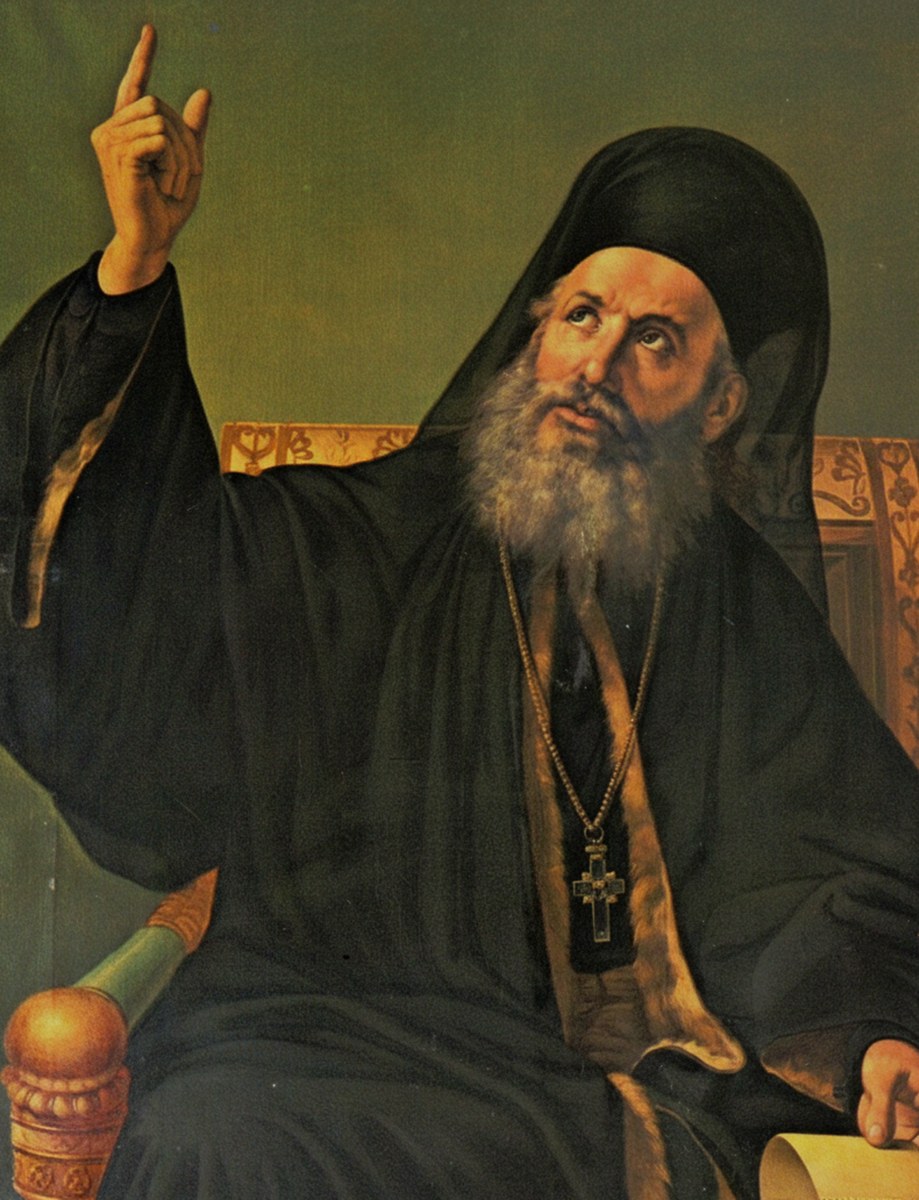
Gregory V is painted as an aged, white-bearded hierarch in the full patriarchal sakkos, omophorion and mitre, holding the Gospel; as a martyr he bears the cross, and he is very often shown hanged in his vestments from the arch of the sealed gate of the Patriarchate — the scene by which he is universally recognised. The stored image is exactly one of those nineteenth-century Greek portraits, now securely public domain: the oil painting of Dionysios Tsokos (1861), the patriarch enthroned in the black monastic veil, right hand lifted heavenward and the scroll in his left — the standard portrait of the hieromartyr of 1821.