
Gurias, Samonas and Abibus
The Holy Martyrs and Confessors Gurias, Samonas and Abibus of Edessa
Martyr · Confessor · Deacon · d. c. 306 (Gurias and Samonas); c. 322 (Abibus)
Commemorated 15 November — Martyrdom at Edessa; guarantors of oaths and patrons of marriage
Gurias, Samonas and Abibus are the three great martyr-confessors of Edessa in Syria (Mesopotamia), venerated together though they died sixteen years apart: the laymen Gurias and Samonas, preachers of the word, were tortured and beheaded about 306 in the persecution of Diocletian and Maximian, while Abibus, a deacon of the same city, was burned alive about 322 under Licinius. Buried in one tomb, they became the patrons of Edessa. The most famous of their posthumous wonders — the deliverance of the maiden Euphemia, betrayed by a Gothic soldier who had sworn faithfulness to her over their graves — made the three the guardians of oaths and the heavenly patrons of honourable marriage, under which title they are invoked to this day.
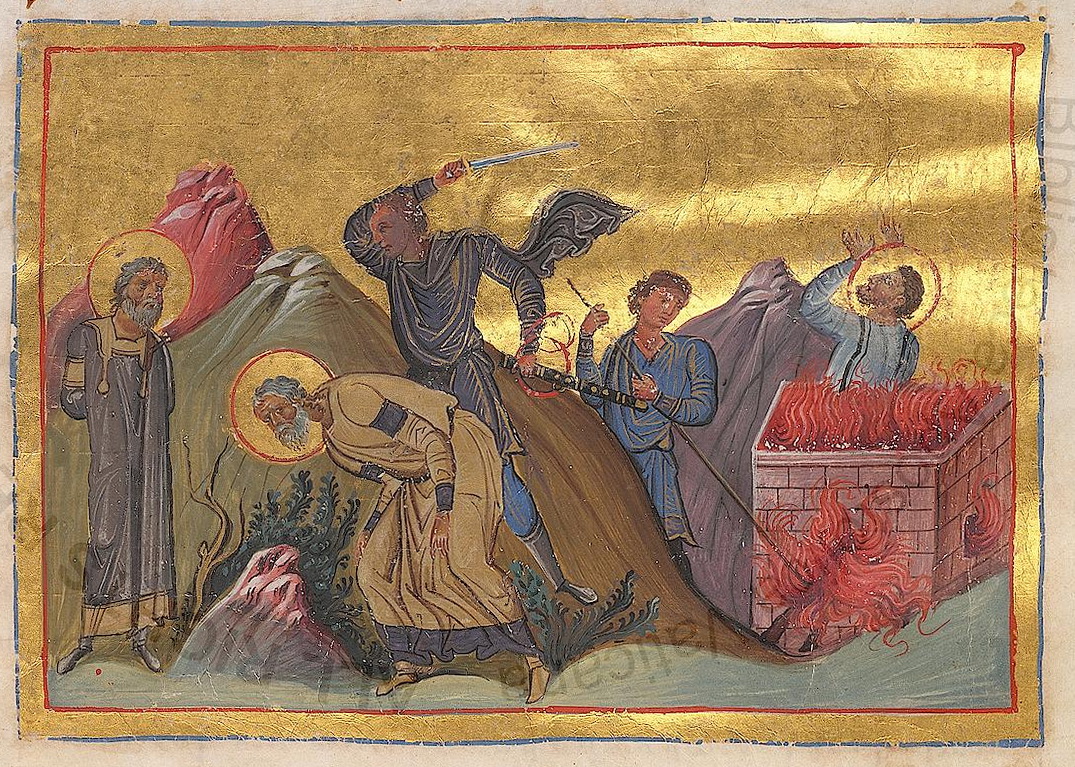
.jpg)
Origins and confession
Edessa (Syriac Urhāy, modern Şanlıurfa), a chief city of Christian Mesopotamia and an early centre of Syriac Christianity, is the setting of the whole story. Gurias and Samonas were natives of its territory, men of piety who in the years of the Great Persecution went openly through the city and its villages strengthening the faithful and urging them not to sacrifice to the idols. Under the edicts of Diocletian (284–305) and his colleague Maximian they were arrested, brought before the governor, and ordered to offer incense to the gods. They refused, confessing Christ boldly, and were subjected to a long sequence of tortures: beaten, suspended by one hand with weights bound to their feet, and shut up for a great while in a dark and stifling prison, where they were left to waste with hunger and thirst in the hope that they would relent.
The Syriac Acts, which are early and detailed, preserve a prayer said to have been uttered by Samonas in the prison and taken down by a witness — a plea that God, "against whose will not one sparrow falls into the snare," who made room for David in his distress, shut the mouths of the lions for Daniel, and preserved the Three Children in the furnace, would keep the unquenchable light of his commandments burning in them and not let the enemy tear away the work of his hands. Unbroken, the two were at last led out of the city by night and beheaded, about the year 306. Christians recovered the bodies and buried them with honour in a common grave outside Edessa.
Abibus the deacon
Some sixteen years later, under Licinius (308–324) — who in the last phase of his rivalry with Constantine turned against the Christians of the East — a new persecution reached Edessa. Abibus (in the Syriac tradition Habib), a deacon of the Edessene church, was singled out for the zeal with which he taught and gathered the faithful. Learning that officers had been sent to seize him, he would not let others be endangered on his account or seem to flee: he presented himself voluntarily to those who were searching for him and confessed his faith. Condemned to death by fire, he walked willingly into the flames and gave up his soul in prayer. The account relates that when the fire had died down his mother and kinsfolk found the body unharmed by the flames; they buried him beside Gurias and Samonas, so that the three confessors of Edessa lay together in one tomb.
The miracle of Euphemia and the Goth
The wonder that fixed the three saints in the devotion of the whole Church belongs to a later generation, when Gothic federate troops were quartered at Edessa (the fifth century). One of these soldiers lodged with a widow named Sophia and her daughter, the virgin Euphemia, and sought the girl in marriage. The mother, fearing both his foreign faith and the impermanence of a soldier's promises, consented only after he had sworn a solemn oath at the tomb of Gurias, Samonas and Abibus that he would keep Euphemia as his lawful wife, do her no harm, and never treat her as a servant — the martyrs themselves taken as witnesses and guarantors of his word.
He broke every clause of it. Carrying Euphemia off to his own country when his service ended, he revealed that he already had a wife there and reduced Euphemia to slavery in his household, threatening her with death if she told anyone they had been married. When she bore him a son, his jealous first wife poisoned the child. In her extremity Euphemia called on the three martyrs who had heard the oath, and — in the miracle as the tradition transmits it — she was carried back by their power to Edessa and to her mother. When the Goth was later posted again to Edessa, his crime came to light through Sophia's accusation; convicted, he was executed by the city's governor. The saints who had been invoked as witnesses had themselves brought about the vindication.
Veneration and later cultus
The three were the special patrons of Edessa, their relics resting in a shrine that became a goal of pilgrimage. The story of Euphemia — recounted by the Edessene notary who wrote her Acts, and reworked in Greek by Symeon Metaphrastes — gave the martyrs their enduring character across the whole Byzantine world: they are the guarantors of sworn faith and the guardians of marriage, invoked against domestic discord, marital cruelty, and the unjust hatred of one spouse for the other. An akathist addresses them, "Rejoice, Gurias, Samonas and Abibus, heavenly patrons of honourable marriage." Churches were dedicated to them widely in the Slavic lands — notably at Smolensk — where Aviv, Samon and Gury (as their names are rendered in Slavonic) are kept as helpers of the married and of those wronged within a family.
Feast and commemoration
November 15 (church date; Old Calendar civil November 28). The three are kept together on this day throughout the Byzantine rite. Their feast falls on the first day of the Nativity Fast, so that the fast to the Nativity opens under the patronage of the confessors of Edessa. In the Slavic churches especially they are invoked at weddings and for the healing of troubled marriages.
Hymns
Troparion — Tone 5
Having granted us the wonders of Thy holy Martyrs as an unassailable wall, O Christ God, by their entreaties scatter the counsels of the heathen and strengthen Thy holy Church, for Thou alone art good and the Lover of mankind.
Original translation from the Greek
Kontakion — Tone 2
Having received grace from on high, O all-praised and wise ones, ye stand by those who are in trials; wherefore ye delivered a maiden from a bitter death. For ye are in truth the glory of Edessa and the joy of the world.
Original translation from the Greek
Iconography
The three are shown together as a standing row of martyrs, each holding the cross of confession: Gurias and Samonas as laymen or youths, and Abibus distinguished as a deacon by the orarion over his shoulder and often a censer or Gospel-book. The stored image is the miniature for November 15 in the Menologion of Basil II (Constantinople, c. 985; Vatican Library, MS Vat. gr. 1613), showing the martyrdom of the three. In Russian icons they frequently appear against the background of Edessa, and the scene of Euphemia rescued from the Goth is sometimes added.
Disputed questions
- Dates of martyrdom. The Acts and the calendars place Gurias and Samonas in the persecution of Diocletian and Maximian (c. 299–306) and Abibus under Licinius (c. 316–322); the exact years vary between witnesses, and some sources give Gurias and Samonas as late as 306 and Abibus as c. 322. All keep the three on a single feast.
- Names and language. The saints were Syriac-speakers of Edessa — Gurya, Shmona and Habib in Syriac — and are known in the West and in Antiochian usage as Gurias, Samonas and Abibus, in Slavonic as Gury, Samon and Aviv, and in the OCA's usage as Gurias, Samonas and Habibus.