
Haralambos of Magnesia
The Holy Hieromartyr and Wonderworker Charalampus, Bishop of Magnesia
Hieromartyr · Priest · b. c. 89 — d. c. 202, at Magnesia
Commemorated 10 February — Martyrdom at Magnesia by beheading
Haralambos, or Charalampus, "the Wonderworker" (c. 89 – c. 202), is one of the most beloved and widely venerated saints of the Greek world — the aged bishop-priest of Magnesia who was martyred at about a hundred and thirteen years of age during the persecution of Septimius Severus. Denounced as the leader of the Christians of his city, he endured prolonged tortures — his flesh torn from his body with iron hooks — with such serene endurance that his very tormentors, the soldiers Porphyrius and Baptus, and three women who watched, confessed Christ and were themselves put to death. When even fire and the sword seemed to have no power over him and miracles multiplied around him, he was at last condemned to be beheaded, but gave up his soul to God before the sword could fall. He is invoked across the Orthodox world as a mighty intercessor against plague and pestilence and as a protector of crops, flocks, and the fruitfulness of the land; his relics, chiefly his venerable head, are treasured at the Meteora and in countless Greek churches that bear his name.
.jpg)
Origins and episcopate
Charalampus belongs to the sub-apostolic and early-persecution age of the Church, and the fixed points of his memory are few and firmly held: that he was a priest — in the Greek tradition a bishop-priest, in the Slavonic tradition styled outright a bishop — of Magnesia; that he lived to a great age, reckoned by the tradition at a hundred and thirteen years; and that he sealed a long life of preaching Christ with martyrdom under the persecuting edicts of the emperor Septimius Severus, about the year 202. His very name — Chará-lampos, "shining with joy" or "joy-radiant" — was read by the hymnographers as a prophecy of the man: one who shone in the world through his martyrdom and went to his death rejoicing.
The which Magnesia is itself a small disputed question (see below): the common Greek tradition places him at Magnesia in Thessaly, near Mount Pelion, while the Orthodox Church in America and some Greek sources locate him at Magnesia in Asia Minor. Wherever the see stood, the account agrees that he had governed and taught his flock for many years, an old man revered by the Christians and known to the pagan authorities as the head of the local church, when the persecution reached his city.
Arrest and interrogation
Under the imperial edicts, Charalampus was seized and brought before the provincial magistrate — named in the tradition Lucian — and the military commander Lucius, who pressed him to renounce Christ and sacrifice to the gods. The bishop answered with the boldness the hymns celebrate: he confessed Christ openly, refused the sacrifice, and declared the idols powerless. His great age moved neither judge nor soldier to pity; rather, his fearless liberty enraged them, and he was given over to torture.
The tortures and the conversions
The instruments of his passion are dwelt on by the tradition: his aged body was flayed with iron hooks, the flesh torn from him in strips, and he bore it without complaint, giving thanks. The account has him miraculously unharmed at the core of his sufferings — the wounds closing, the fire failing to consume him, the very executioners' fury turning to wonder. It was this serene, unbreakable endurance, and the signs that accompanied it, that worked the conversions for which the day is remembered: the two soldiers Porphyrius and Baptus, set to torment him, confessed Christ themselves and were beheaded; and three women among the onlookers, moved by what they saw, likewise glorified God aloud and received the martyr's crown. To these the tradition adds the conversion of Galina — in some accounts a woman of the city, in others the daughter of the emperor himself — who interceded for the saint, broke the idols of the temple, and was counted among his spiritual children.
The tradition further clothes his passion in wonders: the paralysed healed and the dead raised at his word; a demon cast out; and the persecutors, and even (the legend says) the emperor, briefly awed into acknowledging the power of the God of Charalampus. These marvels are why the calendars name him not merely martyr but Wonderworker (Thaumatourgos), and they are the root of his enduring reputation as a healer and protector invoked in every kind of bodily and earthly need.
Martyrdom
When neither torture nor time could shake him and the signs only multiplied, the sentence was fixed: Charalampus was condemned to be beheaded. But as he was led out and knelt, giving thanks and praying for the world — that God would keep from plague and famine every place that kept his memory — he surrendered his soul to God before the sword fell, so that (the account says) the executioner's blow found a body already at rest. His death is placed on February 10, about the year 202, at the great age the tradition gives him. Galina, and the faithful of his city, took up his body and buried it with honour.
Relics and later cultus
Charalampus became, and has remained, one of the most popular saints of the Greek Orthodox world, his feast kept with special solemnity and his name borne by innumerable churches, monasteries, and men. His relics were dispersed as treasures across the Orthodox lands: his venerable head is enshrined at the Monastery of Saint Stephen at the Meteora in Thessaly, its chief relic; portions are kept at Mount Athos, on Mount Sinai, and in Greek churches without number — a fragment, for instance, translated in 1922 to the church of Saint George at Iraklitsa. Wherever they rest, the relics of Charalampus are resorted to above all in two needs.
Patron against plague, and protector of the land
The first is plague and pestilence. On the strength of his dying prayer — that God would preserve from deadly disease and famine every place that honoured him — Charalampus became, across the Greek and Balkan world, the saint invoked against epidemic and contagion; his intercession was sought in the great plagues, and his icon and relics carried in procession when sickness threatened a town. The second is the fruitfulness of the earth: he is the protector of crops and flocks, guardian of the fields against blight, locust, and murrain, so that in the villages his February feast — falling as the agricultural year turns — carries prayers for a fruitful season. The two patronages spring from the one root: the wonderworking old man who prayed, as he died, for the health and plenty of all who would keep his memory.
Feast and commemoration
Charalampus is kept universally on February 10 (church date; Old Calendar civil February 23), his feast one of the most beloved of the Greek liturgical year and observed with particular splendour wherever his relics or a church of his name are found. The Greek Menaion gives him a full festal office — Little and Great Vespers with proper stichera, an apolytikion, a proper kontakion and oikos, and a canon — and the synaxarion of the day commemorates with him the soldiers Porphyrius and Baptus and the three anonymous women martyrs converted at his passion. In the Slavonic tradition the same day keeps him as bishop of Magnesia and adds the Righteous Galina. His popularity has made his feast a day of processions with his icon and relics against sickness and for the blessing of the fields.
Hymns
Troparion — Tone 4
As an unshaken pillar of the Church of Christ and an ever-shining lamp of the whole world, thou wast revealed, O wise Charalampus; thou didst shine forth in the world through thy martyrdom, and didst dispel the dark gloom of idolatry, O blessed one. Wherefore, in boldness intercede with Christ our God that our souls may be saved.
Original translation from the Greek
Kontakion — Tone 4
A precious treasure hath the Church acquired in thy holy head, O hieromartyr and champion Charalampus, thou bearer of the trophy of victory; wherefore she rejoiceth, glorifying the Creator.
Original translation from the Greek
Iconography
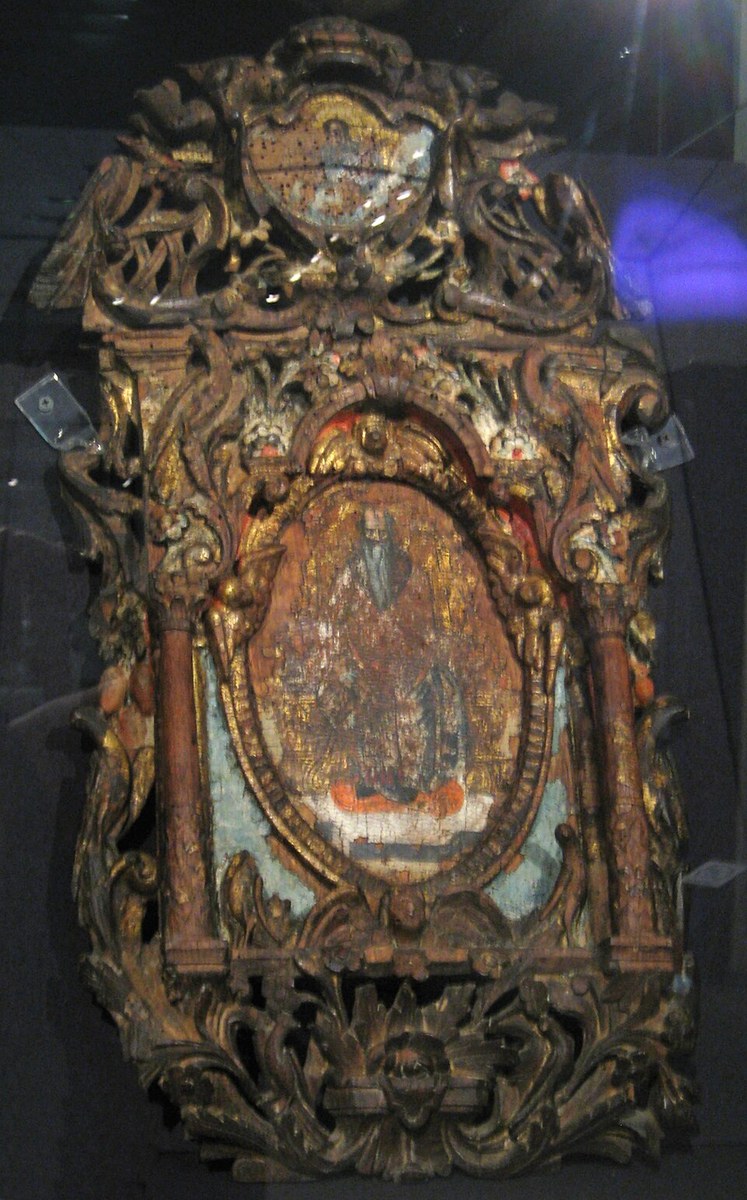
Charalampus is depicted as a very old man, of great age, with a long white beard flowing to his breast — the visual sign of the hundred-and-thirteen years the tradition gives him — vested as a priest (or, in Slavic images, as a bishop), holding a Gospel-book or a scroll and raising his hand in blessing or bearing a cross of martyrdom. Because he is so widely a protector against plague and for the land, his icons are among the most common in Greek homes and churches. A distinctive narrative type shows the saint treading a small black devil underfoot or holding a bound demon on a chain — the visual form of the tradition that he cast out and mastered the spirit of pestilence — sometimes with scenes of his tortures ranged around the border.
The stored image is an 18th-century Greek icon of the saint (A. G. Makris collection): Charalampus the aged priest, white-bearded, in priestly vesture, blessing and holding the Gospel (source, faithful reproduction of a pre-1900 icon, pd-old-work).
Disputed questions
- Priest or bishop; and which Magnesia. The Greek tradition and hymnography most often style Charalampus a priest (ἱερεύς) of Magnesia — "a most venerable priest," as his kontakion-oikos calls him — while the Slavonic and Russian calendars, and the OCA, style him outright bishop of Magnesia. The entry types him [hieromartyr, priest] after the Greek usage, recording the episcopal styling as a real jurisdictional divergence rather than an error. In parallel, the location of his Magnesia divides the sources: the common Greek tradition places it in Thessaly (near Pelion), the OCA and others in Asia Minor. Neither divergence touches the substance of his passion.
- The emperor and the year. The received tradition sets the martyrdom under Septimius Severus (193–211), about 202 — the reading followed here. Some later accounts (and OrthodoxWiki) instead name Alexander Severus (222–235); the earlier Severus and the date 202 are the mainstream Greek reckoning.
- Galina. Her identity varies — a converted woman of Magnesia in some accounts, the emperor's own daughter in others — and she is separately commemorated as the Righteous Galina on this same day in the Slavonic calendars.