
Herman of Alaska
Our Venerable Father Herman of Alaska, Wonderworker of All America
Venerable · b. c. 1756 — d. 1837
Commemorated 9 August — Glorification (1970), 13 December — Repose on Spruce Island (New Valaam)
Herman of Alaska (c. 1756–1837) was a simple Russian monk of Valaam who became the great missionary and protector of the native peoples of Alaska and, in 1970, the first saint of the Orthodox Church in America to be glorified. Sent in 1793 with the first mission to Russian America, he outlived all his companions and withdrew to Spruce Island near Kodiak, which he called New Valaam, where for over forty years he lived in prayer and extreme asceticism, taught and fed the Aleut and Kodiak natives, cared for orphans, and stood fearlessly between the people and the abuses of the Russian-American Company. Reposing on December 13, 1837, he is venerated as the "North Star of Christ's Church" and the heavenly protector of America; his glorification is kept on August 9 and his repose on December 13.
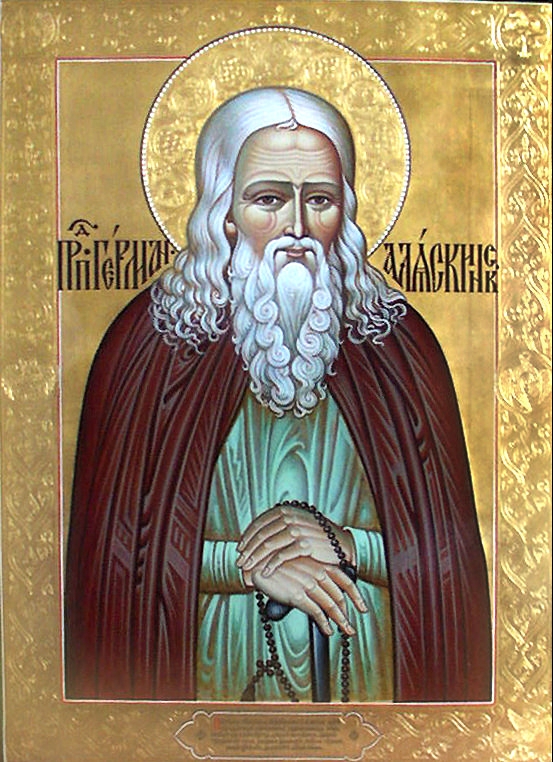

Origins and monastic beginnings
Herman came from a merchant family of Serpukhov, in the Moscow diocese; his baptismal and family names are not recorded with certainty, though a tradition gives his baptismal name as Gerasimus. Drawn to piety from childhood, he entered monastic life about the age of sixteen — around 1772 — at the Trinity–Sergius Hermitage near St Petersburg, on the Gulf of Finland. There, gravely ill with a disfiguring abscess of the throat and awaiting death, he prayed all night before an icon of the Mother of God and was healed without surgery, a wonder the physicians could not explain. After some years he transferred to the celebrated monastery of Valaam on Lake Ladoga, whose elder and superior, Nazarius, became his spiritual father. Herman loved Valaam above all places, dwelt for a time as a hermit in the forest at a spot still called "Herman's," and would return to the monastery on feasts to sing in the choir, the tears running from his eyes.
The mission to America
In the later eighteenth century Russian merchants opened the Aleutian Islands and the coasts of Alaska, and the need arose to bring the Gospel to the native peoples now under Russian sway. With the blessing of the Holy Synod, Metropolitan Gabriel of St Petersburg charged the elder Nazarius to choose capable monks from Valaam, and in 1793 a mission of ten set out under the archimandrite Joseph (Bolotov); the monk Herman was among them. The mission at first bore rich fruit, several thousand natives being baptised and a church and school raised on Kodiak. But it was soon broken by disaster: the newly consecrated bishop Joasaph (Bolotov) was drowned with his party when the ship Phoenix went down; the hieromonk Juvenal was martyred in the interior; and one after another the rest died, until Herman alone remained.
New Valaam on Spruce Island
Herman withdrew to Spruce Island, a small forested island a mile and a quarter across the strait from Kodiak, which he named New Valaam after his beloved monastery. He dug a cave with his own hands and lived his first summer in it, afterwards in a small cell beside it, with a wooden chapel, a guesthouse and schoolhouse, and a garden he tended himself, planting potatoes and vegetables and gathering seaweed for manure. His asceticism was extreme — he wore chains and a few poor garments, slept little on a bench with a brick for a pillow, fasted severely, and kept unceasing prayer — yet his manner was full of warmth and disarming simplicity. He was never ordained, remaining a simple monk to the end.
Father and protector of the Aleuts
Herman became the father of the native people of the region. He taught the children their letters and the faith, established an orphanage and a school on the island, nursed the sick through an epidemic when others fled, and drew the Aleuts and Kodiak islanders to himself by his love. He did not hesitate to defend them against the cruelty and greed of the officials of the Russian-American Company, writing in their behalf and enduring the enmity of powerful men for it; he was, in a famous phrase of his own, a servant appointed to their care. When asked once by visiting naval officers how a man could live alone in such a place, he answered that he was never alone, for God was present and the angels near, and put to them the question whether they loved God above all — a conversation long remembered.
Repose and glorification
Herman foretold the manner and circumstances of his death, that he would die without a priest present and that the island would afterwards be neglected for a time. He reposed on Spruce Island on December 13, 1837, and was buried by his disciples in the cave that had been his first dwelling; the tradition relates that a pillar of light was seen over the island on the night of his death and that his face shone. His memory was kept by the native people through the following century. On August 9, 1970, he was solemnly glorified — the first saint canonised on the American continent — jointly proclaimed by the Orthodox Church in America and honoured by the Russian Church and the wider Orthodox world, and hailed as the "North Star of Christ's Church" and wonderworker of all America. His relics rest on Kodiak.
Feast and commemoration
December 13 (church date; Old Calendar civil December 26) is the day of his repose and his principal feast; his glorification is kept on August 9 (Old Calendar civil August 22). His veneration is proper to the Orthodox Church in America and to the Russian Church and the jurisdictions descended from it, and he is honoured throughout American Orthodoxy as its first-glorified saint. In American practice the glorification of August 9 is the more festally celebrated day — the summer pilgrimage to his relics on Spruce Island and Kodiak falls then — while December 13 keeps the anniversary of his falling-asleep; both days carry his proper service. December, coming first in the liturgical year, is where this entry ranks his principal (repose) feast.
Hymns
Troparion — Tone 7
O most radiant star of the Church of Christ, shining forth in the north and guiding all toward the heavenly Kingdom; teacher and apostle of the true faith, intercessor and defender of the persecuted, and surpassing adornment of the holy Church in America: O venerable father Herman of Alaska, pray to the Lord our Saviour, that our souls may be saved.
Original translation from the Slavonic
Kontakion — Tone 3
The eternal Light of Christ our Saviour guided thee upon the path of the Gospel to America, to proclaim the good tidings of peace. Standing today before the throne of glory, pray for thy land and its people, for the peace of the whole world, and for the salvation of our souls.
Original translation from the Slavonic
Appointed readings
Epistle — Galatians 5:22–6:2
22But the fruit of the Spirit is love, joy, peace, longsuffering, gentleness, goodness, faith, 23Meekness, temperance: against such there is no law. 24And they that are Christ’s have crucified the flesh with the affections and lusts. 25If we live in the Spirit, let us also walk in the Spirit. 26Let us not be desirous of vain glory, provoking one another, envying one another. 1Brethren, if a man be overtaken in a fault, ye which are spiritual, restore such an one in the spirit of meekness; considering thyself, lest thou also be tempted. 2Bear ye one another’s burdens, and so fulfil the law of Christ.
Gospel — Luke 6:17–23
17And he came down with them, and stood in the plain, and the company of his disciples, and a great multitude of people out of all Judæa and Jerusalem, and from the sea coast of Tyre and Sidon, which came to hear him, and to be healed of their diseases; 18And they that were vexed with unclean spirits: and they were healed. 19And the whole multitude sought to touch him: for there went virtue out of him, and healed them all. 20And he lifted up his eyes on his disciples, and said, Blessed be ye poor: for yours is the kingdom of God. 21Blessed are ye that hunger now: for ye shall be filled. Blessed are ye that weep now: for ye shall laugh. 22Blessed are ye, when men shall hate you, and when they shall separate you from their company, and shall reproach you, and cast out your name as evil, for the Son of man’s sake. 23Rejoice ye in that day, and leap for joy: for, behold, your reward is great in heaven: for in the like manner did their fathers unto the prophets.
Iconography
Herman is depicted as an aged monk of humble mien, in the simple mantle and skufia or the schema, with a long grey beard, often holding a scroll or a cross and set against his island hermitage of New Valaam, the fir-clad shore and the sea behind him; his face is drawn from the memory of those who knew him rather than from any portrait taken in life. His images belong entirely to the period after his glorification in 1970 and are the work of living iconographers; no pre-modern, freely licensed icon of him exists to be stored, and he is listed among the wanted icons.
Disputed questions
- Year of birth. The sources give either 1756 or 1760 for his birth; c. 1756 is the more usual reckoning, consistent with his entering monastic life about 1772.
- Date of repose. The Church keeps his repose on December 13, 1837, and this is the date of his principal commemoration. Some accounts, resting on the island's own records, place his death on November 15, 1836; the discrepancy is noted without resolving it, the calendars keeping December 13.
- Not to be confused with the several other Russian saints named Herman: Herman of Kazan, the sixteenth-century archbishop; Herman of Solovki (†1479), co-founder of the Solovetsky monastery (July 30); and Herman of Valaam, the ancient founder — this Herman is the missionary of Alaska, who came from Valaam but is a distinct saint.