
Hermenegild
The Holy Martyr Hermenegild, Prince of the Goths in Spain
Martyr · Prince · d. 585 or 586
Commemorated 1 November — Martyred at Tarragona for refusing Arian communion
Hermenegild (†585/586) was a prince of the Visigoths in Spain, elder son of the Arian king Leovigild, who forsook the Arianism of his people for the Orthodox faith and died for it. Imprisoned by his father and pressed to return to the heresy, he refused on Pascha to receive communion from an Arian bishop, was given the Holy Mysteries in secret by an Orthodox priest, and was beheaded at his father's command. The tradition, following St Gregory the Great's Dialogues, relates that angels were heard singing over his relics, that his father repented of the deed, and that through Bishop Leander the king's surviving son Reccared brought the whole Gothic nation to Orthodoxy. A pre-schism saint of the West, he is commemorated in the Orthodox calendar on November 1.

A prince between two faiths
Hermenegild was the elder son of Leovigild, king of the Visigoths in Spain and, like his people, a professing Arian — that is, a heretic who denied the full divinity of the Son of God. The prince, however, embraced the Orthodox (Catholic) confession of the consubstantial Trinity. Neither his father's flattery nor his threats could move him back to the Arianism of the court; and when persuasion failed, Leovigild gave orders to throw his son into prison and load him with fetters.
Confession and martyrdom
The decisive trial came at Pascha. As Hermenegild lay chained in his cell, the king sent an Arian bishop to him, offering to free the prince and restore him to his former honour if he would receive communion from the heretic's hand. Hermenegild drove the Arian bishop away, rebuking him for his heresy; and an Orthodox priest, coming secretly to the prison, gave him instead the life-giving Mysteries of Christ. When the rejected bishop reported the prince's words, Leovigild ordered his execution, and Hermenegild was beheaded — a death he received rather than betray the confession of Christ's divinity. After the beheading, the tradition says, angels were heard singing over his holy relics, and the faithful glorified God.
Aftermath
The martyrdom bore fruit in the house that had shed his blood. Leovigild repented of the killing; and although he did not himself accept Orthodoxy, he permitted the holy bishop Leander of Seville to instruct his other son and successor, Reccared, in the true faith. Reccared, once king, confessed Orthodoxy and led the Visigothic nation with him — the conversion sealed at the Third Council of Toledo in 589, when Arian Spain became Orthodox. The Church has therefore honoured Hermenegild as a martyr whose death opened the way for the conversion of a whole people.
Feast and commemoration
November 1 in the Orthodox calendar (Old Calendar civil November 14), as kept by the Orthodox Church in America among the pre-schism saints of the West. Hermenegild lived and died before the Great Schism (1054), and his cult is therefore common ground between the Orthodox and Roman traditions; the Roman Martyrology commemorates him on April 13, and the divergence of days is recorded here. He has no proper Byzantine hymnography.
Iconography
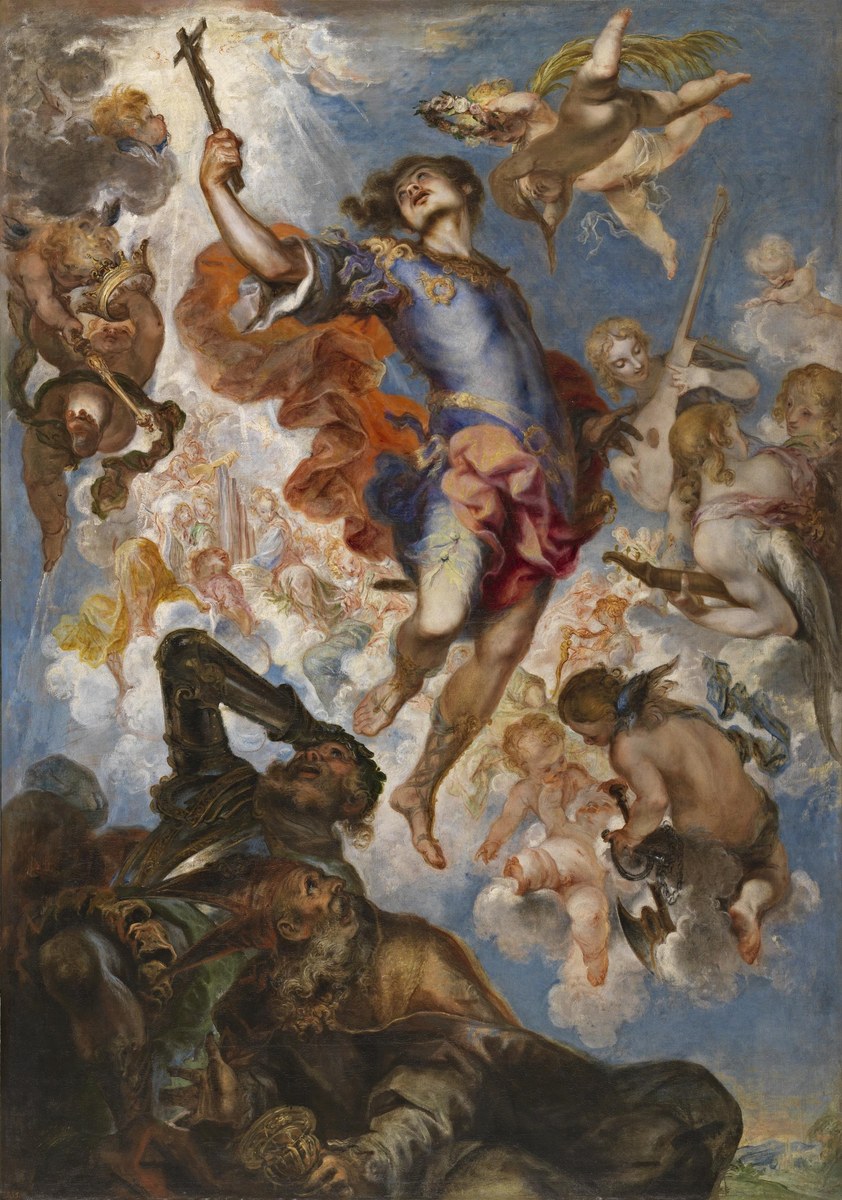
No pre-modern Orthodox icon of Hermenegild has been identified. He belongs iconographically to the Latin West, where he was a favourite subject of Spanish Counter-Reformation painters — Francisco de Herrera the Elder and the Younger both painted his apotheosis (Prado, Seville) — who show him as a young prince in armour or royal robes, crowned, holding the cross and palm of martyrdom, sometimes with the broken fetters of his prison. An Orthodox icon would render him likewise as a princely martyr with cross and palm.
The stored image is a Western work per §34: Herrera the Younger's Triumph of Saint Hermenegild (1654, Prado), the Visigoth prince-martyr borne up in glory with the chains of his prison. An Eastern image remains wanted and is listed among the upgrade-wanted icons.
Disputed questions
- Martyrdom or politics. Hermenegild's revolt against his father (from about 579) had an unmistakable political dimension, and some historians — noting that even Gregory of Tours reports the rebellion in secular terms — have questioned whether he died strictly for the faith. The hagiographic tradition, following Gregory the Great, presents the cause of his death as his refusal of Arian communion, and it is as a martyr for Orthodoxy that both the Eastern and the Western calendars venerate him.
- Date. The sources give 585 or 586 for his death (Wikidata records 585); he was killed at Tarragona.