
The Holy Innocents
The Fourteen Thousand Holy Innocents slain by Herod at Bethlehem
Child Martyr · Martyr · d. c. 2 BC / c. 1, at Bethlehem
Commemorated 29 December — The 14,000 Innocents slain by Herod; within the afterfeast of the Nativity
The Holy Innocents are the male children of Bethlehem and its districts, two years old and under, whom Herod the Great ordered killed after the Magi failed to return and disclose to him the newborn King (Matthew 2:16–18). Deceived and enraged, the tyrant sought to destroy the one Child by destroying many; the Christ-child himself was already borne into Egypt at the angel's warning, and so the slain infants died in his place and for his sake. Though they could not confess Christ in words, the Church honours them as her first martyrs — "baptised in their own blood," the buds of the martyr-host cut down before they could flower. Matthew reads over them the prophecy of Jeremiah, "Rachel weeping for her children." Byzantine tradition numbers them fourteen thousand. They are kept on December 29, within the afterfeast of the Nativity, and in the West on December 28 (Childermas).

The Gospel account
The Innocents are known from a single passage of the Gospel of Matthew (2:1–18), set within the narrative of the Nativity and the coming of the Magi. Wise men "from the East," following the star, came to Jerusalem seeking "he that is born King of the Jews," and their inquiry troubled Herod and all Jerusalem with him. Learning from the chief priests and scribes that the Christ was to be born in Bethlehem of Judea (Micah 5:2), Herod sent the Magi on to Bethlehem with a feigned piety — "go and search diligently for the young child; and when ye have found him, bring me word again, that I may come and worship him also" — intending in fact to destroy the rival he feared for his throne. The Magi found the Child, offered their gifts, and, "warned of God in a dream that they should not return to Herod, departed into their own country another way" (Matthew 2:12).
Meanwhile an angel warned Joseph: "Arise, and take the young child and his mother, and flee into Egypt, and be thou there until I bring thee word: for Herod will seek the young child to destroy him" (2:13). The Holy Family departed by night for Egypt — the connected event the tradition never separates from the massacre (see below). "Then Herod, when he saw that he was mocked of the wise men, was exceeding wroth, and sent forth, and slew all the children that were in Bethlehem, and in all the coasts thereof, from two years old and under, according to the time which he had diligently enquired of the wise men" (2:16). The two-year limit fixes the outer bound of the slaughter to the interval the Magi had reported for the star's appearing; it does not mean the Child was two years old, but that Herod, to be certain, killed generously beyond his estimate.
"Rachel weeping for her children"
Matthew seals the account with a prophecy: "Then was fulfilled that which was spoken by Jeremy the prophet, saying, In Rama was there a voice heard, lamentation, and weeping, and great mourning, Rachel weeping for her children, and would not be comforted, because they are not" (2:17–18, citing Jeremiah 31:15). The resonance is deliberate and layered. Rachel, the beloved wife of the patriarch Jacob, died in giving birth to Benjamin and was buried "in the way to Ephrath, which is Bethlehem" (Genesis 35:19); her tomb stood by the road near the town whose infants now perished, so that the mother of Israel is imagined rising from her grave to weep over the children of her place. In Jeremiah the verse laments the exile of the northern tribes carried past Ramah into captivity — a grief the prophet immediately turns to hope, "Refrain thy voice from weeping… thy children shall come again to their own border" (Jeremiah 31:16–17). Matthew hears in Bethlehem's mourning the same voice, and the Church hears with him the same consolation: the tears of the mothers are gathered into the joy of the Nativity, and the "children who are not" are the first to be with the Child who is.
The traditional number, fourteen thousand
Scripture gives no number. Bethlehem in the age of Herod was a small town, and modern historians reckon the male infants under two at any one time in so small a place at a few dozen at most; the massacre, terrible in a village, would have left little mark on the wider chronicles, and indeed no source outside Matthew records it — an omission that fits both the town's smallness and the ordinary brutality of Herod's reign, of which far larger cruelties are attested. The fourteen thousand of the Byzantine tradition (μυριάδες in some renderings, "fourteen thousand" in the synaxaria) is therefore not a body-count but a liturgical number — a figure of fullness and of the whole company these few represent, the total army of the innocent slain for Christ across all the Herods of history. Other traditions give other numbers: the Syriac churches have counted sixty-four thousand, and a Western strand, drawing on the vision of Revelation, has spoken of the one hundred and forty-four thousand who "follow the Lamb whithersoever he goeth… and in their mouth was found no guile: for they are without fault before the throne of God" (Revelation 14:1–5) — a text the Church has long read of the Innocents, the guileless who could not so much as speak a lie. The disagreement of the numbers is itself the sign that the Church counts here not corpses but glory.
The theology of infant martyrdom
The Innocents pose in the sharpest form the question the Church answers by naming them saints. They did not choose to die; they did not know for whom they died; they could not confess with their lips the Name for which they perished. Yet the tradition, with one voice, calls them martyrs — the first martyrs of the New Covenant, dying for Christ before Christ had yet spoken a word or worked a sign. Augustine gave the paradox its enduring image: they are the flores martyrum, "the flowers of the martyrs," whom "the frost of persecution cut off in the very budding of their life" — and, he adds, "they confessed him not by speaking but by dying." The Byzantine hymnography presses the same mystery: these infants, who could not yet cry "Abba," were made a choir of witnesses; unable to fight, they were crowned; unbaptised in water, they were baptised in their own blood. The paradox turns on a substitution. Herod's sword sought the one Christ; the many died in his stead — and so, in the providence the Church confesses, the King who came to give his life for the world gave these little ones, before all others, the grace of giving their lives for him. What looks like the most meaningless of deaths — infants slaughtered for a tyrant's fear — the Church reads as the first fruits of the Cross, the earliest share in the Passion of the Child they died to protect.
The Fathers who preach the feast do not evade its horror or its theodicy. John Chrysostom, expounding Matthew (Homily 9), meets head-on the objection that the infants were wronged — that God, who saved his own Son, might have saved them too. He answers that the children were not injured but honoured: the evil was Herod's, and the crowns were theirs; those whom the world pitied as robbed of life were in truth advanced to a better life, "as if some wrestler, called before his time, were carried straight to the prize." The suffering is real and is laid wholly to the tyrant's account; the loss is turned, in the economy of God, to the children's gain.
The flight into Egypt
The flight into Egypt (Matthew 2:13–15) is the event the massacre is bound to and must not be prised from. While the infants of Bethlehem perished, the Child they died for was already on the road to Egypt in his mother's arms, guarded by Joseph — "that it might be fulfilled which was spoken of the Lord by the prophet, saying, Out of Egypt have I called my son" (Hosea 11:1). The tradition adorns the journey with much: the idols of Egypt falling as the true God entered the land (a reading of Isaiah 19:1, "the idols of Egypt shall be moved at his presence"); the sojourn until the death of Herod and the angel's second word, "Arise, and take the young child and his mother, and go into the land of Israel: for they are dead which sought the young child's life" (Matthew 2:20); the return and the settling at Nazareth. The Church keeps the flight and return within this same afterfeast, and it is the burden of the Sunday after the Nativity, which commemorates Joseph the Betrothed, David the King, and James the Brother of the Lord and recounts the escape into Egypt — a movable commemoration, kept on its own Sunday and authored under that rule, noted here only for its connection and not duplicated.
Herod's wider wrath, and his end
The tradition, drawing on the synaxaria and on Josephus, gathers around the massacre the whole savagery of Herod's last months. It tells that his rage reached beyond Bethlehem: that Zachariah, the father of John the Forerunner, was slain "between the temple and the altar" (a tradition attaching to the words of Matthew 23:35) for refusing to give up his son, whom Elizabeth had hidden in the wilderness; and that Simeon the God-receiver, who had proclaimed the Child in the Temple, fell under the tyrant's suspicion. These are traditions of the Church, held as such, not data of the Gospel. Of Herod's own death the sources agree it was hideous: struck, in the account the tradition loves to set against the innocents' peaceful crowns, with a rotting disease so that he "was eaten by worms while yet alive," and dying in agony and dread, having ordered — Josephus reports — the leading men of the Jews shut up to be killed at his death so that there should be mourning in the land, an order mercifully never carried out. Divine justice and the tyrant's despair are the dark frame the hymnography sets around the brightness of the children.
Relics and later veneration
Relics venerated as those of the Holy Innocents have been kept in several centres. Constantinople honoured a portion in the Church of Saint James; the Patriarchate of Jerusalem and, on the Holy Mountain, the Monastery of Pantokrator on Athos preserve relics of the Innocents; the West enshrined portions at Rome (Santa Maria Maggiore) and elsewhere. But the Innocents are venerated less through relics than through the feast and its hymns, and through the perennial image of the Massacre of the Innocents in Christian art, which has kept their memory vivid where words might have let it fade.
Feast and commemoration
The Innocents are kept on December 29 (church date; New Calendar civil December 29, Old Calendar civil January 11), the fourth day of the afterfeast of the Nativity of Christ. The placement is the feast's whole meaning: the Church that has just sung the birth of the Life-giver turns at once to the first who died for him, so that the cradle and the sword, the star and the slaughter, are held in a single week. The synaxarion of the day joins to the Innocents the righteous ascetics also commemorated — Marcellus of the Akoimetoi, Thaddeus the Confessor, and Benjamin of Nitria — but the day is led by the Innocents. The Western Church keeps the same martyrs a day earlier, on December 28 (the Holy Innocents, "Childermas"), within the octave of Christmas; the difference is one of calendar arrangement, not of veneration. The connected mystery of the flight into Egypt and the return is kept both in the hymns of this afterfeast and on the movable Sunday after the Nativity, and is not duplicated as a fixed commemoration here.
Hymns
Kontakion — Tone 4
A star sent the Magi to the newborn Child, and Herod sent forth an unjust army in vain, imagining that he could slay the One who lay within the manger.
Original translation from the Greek
Appointed readings
Gospel — Matthew 2:13–23
13And when they were departed, behold, the angel of the Lord appeareth to Joseph in a dream, saying, Arise, and take the young child and his mother, and flee into Egypt, and be thou there until I bring thee word: for Herod will seek the young child to destroy him. 14When he arose, he took the young child and his mother by night, and departed into Egypt: 15And was there until the death of Herod: that it might be fulfilled which was spoken of the Lord by the prophet, saying, Out of Egypt have I called my son. 16Then Herod, when he saw that he was mocked of the wise men, was exceeding wroth, and sent forth, and slew all the children that were in Bethlehem, and in all the coasts thereof, from two years old and under, according to the time which he had diligently enquired of the wise men. 17Then was fulfilled that which was spoken by Jeremy the prophet, saying, 18In Rama was there a voice heard, lamentation, and weeping, and great mourning, Rachel weeping for her children, and would not be comforted, because they are not. 19But when Herod was dead, behold, an angel of the Lord appeareth in a dream to Joseph in Egypt, 20Saying, Arise, and take the young child and his mother, and go into the land of Israel: for they are dead which sought the young child’s life. 21And he arose, and took the young child and his mother, and came into the land of Israel. 22But when he heard that Archelaus did reign in Judaea in the room of his father Herod, he was afraid to go thither: notwithstanding, being warned of God in a dream, he turned aside into the parts of Galilee: 23And he came and dwelt in a city called Nazareth: that it might be fulfilled which was spoken by the prophets, He shall be called a Nazarene.
Iconography
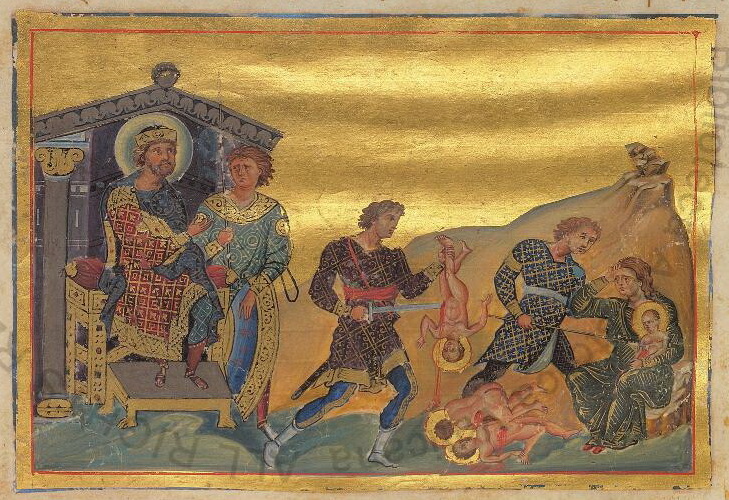
The martyrdom of the Innocents is among the most frequently depicted scenes of Byzantine and later Christian art, and it appears already in the earliest cycles of the Nativity. The developed type shows Herod enthroned at one side, gesturing the command; before him his soldiers seize the infants from their mothers and put them to the sword or dash them down, while the mothers — figured as Rachel — tear their hair and lift their hands in a grief the artists render with unsparing force; small bodies lie strewn at the soldiers' feet. In the fuller Nativity cycles the scene is set beside its opposite, the flight into Egypt, so that the eye passes from the slaughter to the Child carried to safety. The image is a fixed member of the festal iconography of the Nativity and of the calendar's December cycle.
The stored image is the miniature for December 29 from the Menologion of Basil II (Constantinople, c. 985; Vatican, Vat. gr. 1613): Herod's soldiers falling upon the children of Bethlehem before their lamenting mothers — the visual form of the day's commemoration (source, public domain, pd-old-work).