
Hypatius of Gangra
The Holy Hieromartyr Hypatius, Bishop of Gangra
Hieromartyr · Bishop · Wonderworker · d. c. 326
Commemorated 31 March — Martyrdom of the bishop of Gangra
Hypatius was bishop of Gangra in Paphlagonia and one of the Fathers of the First Ecumenical Council of Nicaea (325), a wonderworker famed for healing and for the casting-out of demons. Returning from Constantinople some years after the Council, he was set upon by a band of Novatian (or, in some accounts, Arian) heretics and stoned and clubbed to death; a woman who cast the final stone was afterward tormented until she repented at his tomb. He is honoured as a hieromartyr and a protector against serpents and the assaults of demons.
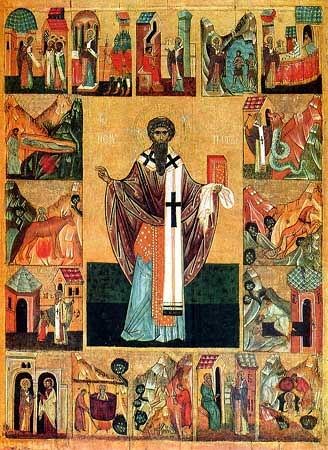

Hypatius governed the church of Gangra, the chief city of Paphlagonia, in the first decades of the fourth century, and was among the three hundred and eighteen Fathers who at Nicaea in 325 confessed the Son to be of one essence with the Father against the Arians. He was renowned for miracles: the healing of the sick, the driving-off of a great serpent (a detail that made him a patron invoked against snakes and against the "old serpent," the devil), and the deliverance of the demon-possessed. The emperor Constantine himself is said to have honoured him.
Some years after the Council, as Hypatius was returning from Constantinople to his see, he was ambushed in a lonely place by a party of heretics — the accounts name the followers of Novatian — who fell upon him with stones and staves and left him for dead in a marsh. As he lay dying he prayed, like the protomartyr Stephen, for his murderers. A woman among them, urged on by a demon, hurled a last stone; and afterward, the tradition says, she was seized by a frenzy, striking herself with the very stone, until she came to the bishop's tomb and there was healed and brought to repentance. Hypatius's relics were enshrined at Gangra and became a place of healings.
Feast and commemoration
March 31 (church date; Old Calendar civil April 13), within Great Lent. He is kept universally and is especially invoked against serpents and demonic assault.
Hymns
Troparion — Tone 4 (common of a hieromartyr)
And by thy manner of life thou didst attain unto the reward of the wise, O hieromartyr Hypatius: for by teaching well thou hast gained the talents entrusted to thee; thou wast not silent in the midst of trials, but didst offer thyself unto death for Christ. Wherefore, intercede with Him that our souls may be saved.
Original translation from the Greek
Iconography
Hypatius is shown as a bishop in the omophorion, blessing or holding the Gospel, sometimes trampling or holding a serpent. The stored image is an early 15th-century Novgorod vita icon (State Tretyakov Gallery): the hieromartyr full-length at the centre in polystavrion and omophorion, ringed by sixteen border scenes of his life and passion — the serpent of his great miracle among them — one of the finest medieval icons of him in existence.