
Ia of Persia
The Holy Martyr Ia of Persia and the Nine Thousand Martyrs with her
Martyr · d. c. 363
Commemorated 4 August — Second commemoration on this day, 11 September
Ia was a Christian woman — the Greek synaxarion remembers her as aged in years — who was seized with nine thousand fellow-Christians in the great fourth-century persecution of Shapur II of Persia and brought to the city of Bisada. Commanded by the chief of the magi to renounce Christ, she refused through repeated tortures and imprisonment, and was at last beheaded, around the year 363. The tradition relates that the sun was darkened at her death and the air filled with a sweet fragrance. She and the nine thousand with her are commemorated on September 11.
.jpg)
Ia's martyrdom belongs to the forty-year persecution that Shapur II (309–379) loosed on the Church of Persia from about 340, when the Christians of his empire fell under suspicion as friends of Christian Rome: a persecution whose victims the ancient historians counted in the tens of thousands, and whose martyrs fill the Syriac martyrologies.
According to the received account, Ia was arrested together with nine thousand Christians and brought with them to the Persian city of Bisada. There the chief of the magi — the Zoroastrian priesthood that drove the persecution — demanded that she renounce Christ. She refused and was tortured; unbroken, she was thrown into prison, brought out again to fresh torments, and finally beheaded. The tradition adds two signs at her death: the sun was darkened, and the air was filled with the fragrance of myrrh — the image the Greek synaxarion verse takes up, that the martyr Ia "breathed the scent of myrrh from her red-dyed, steaming blood." Her name, the Greek word for the violet, made the fragrance a hagiographer's emblem: the violet of Persia crushed and yielding its scent.
The Greek notice adds one personal detail: she was πρεσβῦτις, an old woman, when she made her confession.
Feast and commemoration
September 11 (church date; Old Calendar civil September 24), within the afterfeast of the Nativity of the Theotokos, in the Greek and Slavic calendars alike. Her miniature stands at the day in the Menologion of Basil II.
Hymns
Troparion — Tone 4 (from the common of a woman martyr)
Thy ewe-lamb Ia crieth to Thee with a great voice, O Jesus: Thee, my Bridegroom, do I love, and seeking Thee I contest, and am crucified and buried with Thee in Thy baptism, and suffer for Thee, that I may reign with Thee, and die for Thee, that I may live in Thee. Receive me then as a spotless sacrifice, slain for Thee with love. By her intercessions, O Merciful One, save our souls.
Original translation from the Greek
Iconography
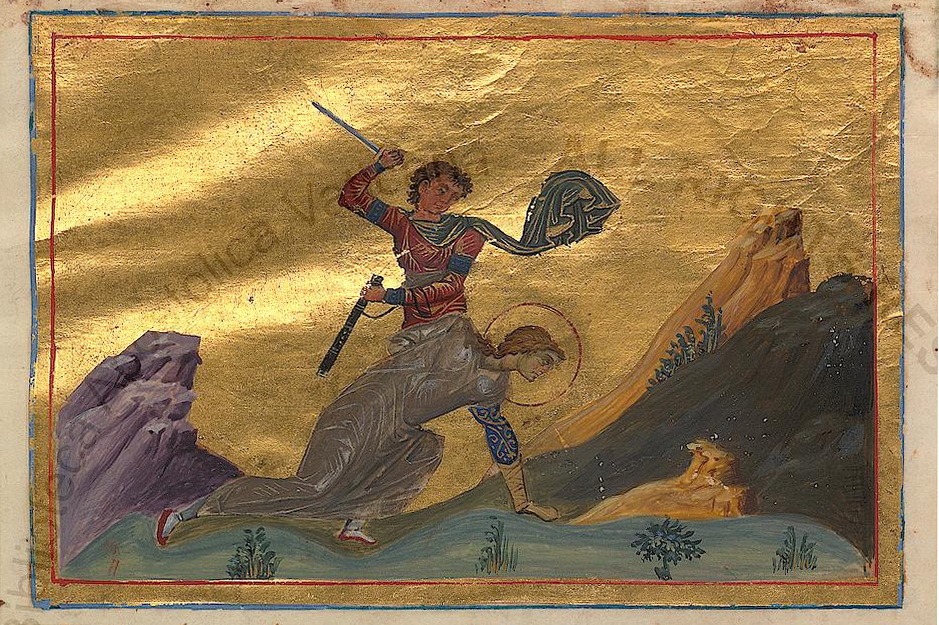
Ia is painted as a woman martyr in maphorion bearing the cross; the Menologion of Basil II gives her instead the scene of her end. The stored image is that miniature (Constantinople, c. 985, Vatican Library, Vat. gr. 1613, p. 50): the aged martyr, haloed, bends beneath the executioner's raised sword in a rocky landscape — the moment of her beheading.
Disputed questions
- "The Roman." The Russian tradition styles her "Ia (Eudocia) the Roman" (Ия Римляныня), marking her as a captive carried off from Roman territory — as multitudes were in Shapur's wars on the Mesopotamian frontier — and transmits Eudocia as a second name. Her death is commonly placed c. 362–364, in the years when Shapur's frontier conquests filled Persia with Christian deportees; the identification of the nine thousand with the population of a captured Roman frontier city is drawn by later accounts and is not asserted in the synaxarion itself.
- The company. The nine thousand are commemorated with her but are otherwise wholly anonymous; the Greek synaxarion notice names Ia alone.
- Western martyrologies commemorate a martyr Ia of Persia on August 4; the Byzantine calendar keeps September 11.