
Irenarchus of Sebaste and the Seven Women
The Holy Martyr Irenarchus of Sebaste and the Seven Holy Women with him
Martyr · d. c. 303
Commemorated 28 November — Martyrdom at Sebaste in Armenia
Irenarchus was a young man of Sebaste in Armenia who, during the persecution of Diocletian, served the imprisoned and tortured Christians and was moved to confess Christ himself when he saw seven women endure their torments without flinching. Baptised and made bold by grace, he passed through trials of fire and water and was beheaded together with the seven holy women about the year 303. He is commemorated on November 28 with the seven women who won him to the faith, and shares the day with the great iconodule Stephen the New.
.jpg)
Irenarchus — his Greek name means "ruler of peace," a play the hymns of his feast delight in — belonged to Sebaste (Sebastea, the modern Sivas) in Lesser Armenia, a city that gave the Church many martyrs, most famously the Forty Martyrs of a generation later. He lived under Diocletian (284–305), in the last and fiercest of the Roman persecutions, which reached the eastern provinces about 303.
While still a young man he was employed about the prisons and the place of torture, ministering to the confessors after they had been racked — in some tellings as a servant of the very officials who tormented them. There he witnessed the trial of seven Christian women who were being tortured to make them sacrifice. Their courage confounded him: that women, weak by nature and unschooled in the philosophers' fortitude, should stand unbroken before the tyrant struck him as proof of a power not their own. Illumined, as the account says, by divine grace, Irenarchus openly declared himself a Christian. He was baptised — the tradition names the presbyter Acacius, who was at hand among the prisoners — and gave himself up to share the martyrs' lot.
He was subjected first to ordeals by fire and by water, from which he came unhurt, and then, with the seven women whose constancy had converted him, he was beheaded. The martyrdom is placed about the year 303. The names of the seven women are not transmitted by the standard synaxaria, which honour them collectively as "the seven holy women who suffered with him"; Irenarchus, the named convert, leads the commemoration.
Feast and commemoration
Irenarchus and the seven women are commemorated on November 28 (church date; Old Calendar civil December 11), within the Nativity Fast and on the same day as Stephen the New, whose feast is the greater of the two. The Greek Menaion appoints a full complement of proper texts for the martyr — stichera addressing him as "contestant Irenarchus" and a whole canon (the second canon of the day, in Tone 6) — though it provides no proper apolytikion or kontakion, for which the common of a martyr is used.
Hymns
Troparion — Tone 4
Your martyr Irenarchus, O Lord, in his contest received the crown of incorruption from you, our God; for possessed of your strength, he cast down the tyrants and broke the feeble insolence of the demons. By his prayers save our souls.
Original translation from the Greek
Iconography
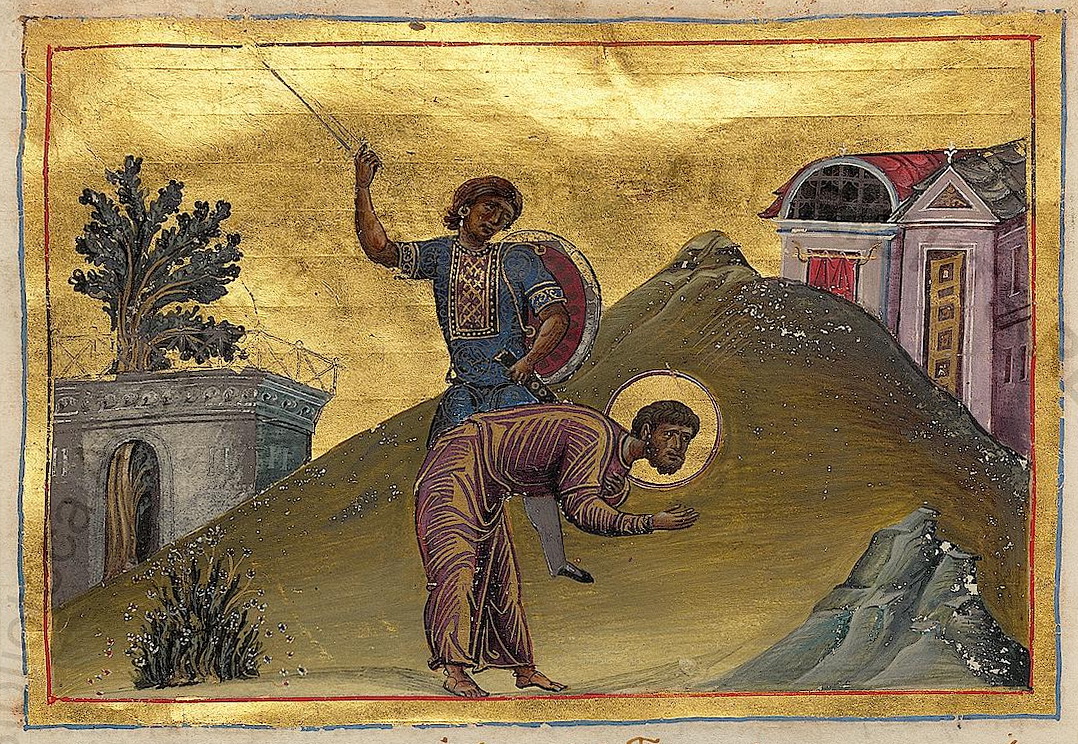
Irenarchus is depicted as a young beardless or lightly bearded man in the tunic of a layman, without the attributes of clerical or monastic rank, sometimes holding the martyr's cross. The scene proper to his feast is his beheading. The stored image is the miniature for his commemoration in the Menologion of Basil II (Constantinople, c. 985), which shows the executioner, sword raised, striking off the martyr's head outside the walls of Sebaste.
Disputed questions
- The seven women. The synaxarion and the service commemorate the seven women as a company without preserving their names; later collections that supply names do so without early warrant, and this entry keeps them anonymous with the tradition.
- Not to be confused with the several later Russian saints of the same name — Irenarchus the Recluse of Rostov (†1616, January 13) and Irenarchus of Solovki (†1628, July 17): this Irenarchus is the martyr of Sebaste under Diocletian.