
Joannicius the Great
Our Venerable and God-bearing Father Joannicius the Great
Venerable · Wonderworker · b. c. 752 — d. 846
Commemorated 4 November — Repose on Mount Olympus of Bithynia
Joannicius the Great (c. 752–846) was the foremost monastic saint of ninth-century Bithynia, an ascetic of Mount Olympus whose seventy years of solitary struggle, gift of prophecy, and abundant wonders made him the most celebrated holy man of the Byzantine world in the age of the second iconoclasm. A soldier of the imperial armies in his youth — and, in the tradition, once a sympathiser of the image-breakers — he was converted to the monastic life and to the fervent defence of the holy icons, foretelling the restoration of Orthodoxy that came in 843. He composed the short prayer to the Holy Trinity — "The Father is my hope, the Son my refuge, the Holy Spirit my protection" — still used by the Church. He reposed on November 4, 846, aged about ninety-four.
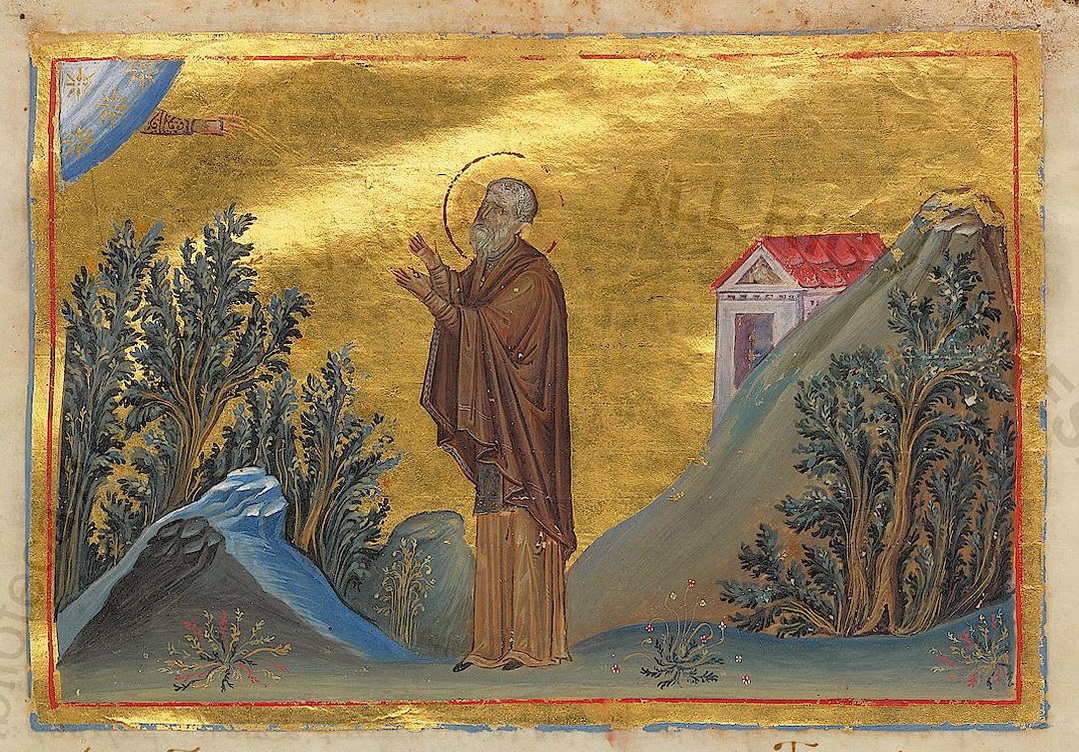
.jpg)
Origins and early life
Joannicius was born about the year 752 in the Bithynian village of Marykata (Marikat), near the great monastic massif of Mount Olympus in north-western Asia Minor — not the Olympus of Thessaly, but the Bithynian mountain that in his century became one of the chief centres of Byzantine monasticism. His parents were poor, and the boy's whole inheritance was the family's cattle, which he tended from childhood. The Lives remember him even then as a child of prayer: shielding the herd with the sign of the Cross, he would withdraw to a solitary place and pass the day in prayer, and neither beast nor thief came near the beasts left in his charge.
In the reign of the emperor Leo IV (775–780) the recruiting officers passed through the towns levying young men, and Joannicius was drafted into the imperial army, in which he served some six years. He proved a brave and formidable soldier — the accounts speak of his courage in the Byzantine wars against the Bulgars, and of rewards from his commanders and the emperor — but military life weighed on a soul that thirsted for solitude and prayer. The fuller tradition adds a note the later synaxarion notices pass over: that in his soldiering years Joannicius shared the image-breaking opinions then favoured at court, and that his conversion was as much a turning from iconoclasm to the veneration of the holy images as from the world to the desert. Whatever the exact colour of his early convictions, he emerged from his army years a fervent defender of the icons and remained one for the rest of his long life.
Ascetic struggle
Renouncing the world, Joannicius longed to go straight into the wilderness, but an experienced elder counselled him first to spend two years in a monastery, where he learned monastic obedience and rule, mastered his letters, and committed thirty of David's psalms to memory. Then, commanded (as the Lives say) by God to go up to the mountain, he withdrew into deep solitude on Mount Olympus. For three years he lived utterly alone, a shepherd bringing him a little bread and water once a month, and he passed day and night in prayer and psalmody. It was in these years that he formed the practice for which he is best remembered devotionally: after each verse of the Psalter he would add a short prayer of his own — "The Father is my hope, the Son my refuge, the Holy Spirit my protection: O Holy Trinity, glory to Thee" — a formula the Church has kept, in a slightly altered form, among her prayers to this day.
When some of his former comrades-in-arms chanced upon him, Joannicius fled deeper, to a place called Kountouria, to hide from all human company. Only after twelve years of ascetic labour did he receive the monastic tonsure, and he spent three further years in strict seclusion. He then sought out the great ascetic George at Chelidon (commemorated February 21), and the two lived together three years, in the course of which Joannicius learned the whole Psalter by heart. As he grew old he settled at the monastery of Antidion, where he dwelt in seclusion until his death. In all he spent some seventy years in the ascetic life and attained, in the judgement of his contemporaries, an exceptional height of spiritual perfection.
Defender of the holy icons
Joannicius's long life spanned the whole of the second iconoclast period. The image-breaking policy renewed by Leo V in 815 endured under Michael II and Theophilus until the regency of the empress Theodora restored the icons at the "Triumph of Orthodoxy" in 843 — three years before the saint's death. Throughout these decades Joannicius, from his mountain, was a rallying-point and encourager of the iconodule confessors, and the tradition credits him with prophesying the end of the persecution and the vindication of the holy images. His authority was such that hierarchs and monastics — including figures of the Studite party and the future patriarch Methodius, architect of the restoration — are remembered as seeking his counsel. That a onetime soldier of iconoclast sympathies should end as one of the mountain's great witnesses for the icons is among the details his hagiographers dwell upon.
Miracles and traditions
Joannicius was, in the calendars' own epithet, a wonderworker, and his Lives are unusually full of prodigies. Through the mercy of God he received the gift of prophecy, as his disciple Pachomius attested; he was seen to be raised from the ground as he prayed; and once he crossed a river swollen to flood. He could, the accounts say, make himself invisible, and hide others from sight as well: by this he is said to have led captive Christians out of prison under the very eyes of their guards. Poison and fire prepared for him by the envious did him no harm, and wild beasts would not touch him; he delivered the island of Thasos from a plague of snakes. The most celebrated of his wonders is one of spiritual substitution: a young nun on the point of abandoning her monastery to marry came to him in her torment, and Joannicius took her burning temptation upon himself, overcoming by fasting and prayer the assault of the passion so that the maiden was set free. The episode became a favourite of the hagiographers as an image of the ascetic's vicarious bearing of another's struggle.
Repose
Foreseeing his end, Joannicius fell asleep in the Lord on November 4, 846, at the age of about ninety-four, at the monastery of Antidion on Mount Olympus. His long life had made him a living link between the two iconoclast crises and the classic Bithynian monasticism that flowered around him — the same mountain and generation that produced Peter of Atroa, Theodore and Theophanes the Branded, and the restoration of the icons.
Feast and commemoration
November 4 (church date; Old Calendar civil November 17), his day of repose, kept universally in the Byzantine rite. The Greek Menaion gives him a full service, sung together with that of the hieromartyrs Nicander and Hermas; the Slavonic and OCA calendars keep the same day. He is styled "the Great" — Ἰωαννίκιος ὁ Μέγας — a title the tradition reserves for a small number of the desert's foremost fathers.
Hymns
Troparion — Tone 8
With the streams of thy tears thou didst cultivate the barrenness of the desert, and by thy sighing from the depths thou didst bear fruit a hundredfold in labours, and thou becamest a luminary, shining upon the whole world with miracles. O Joannicius our venerable father, intercede with Christ God that our souls may be saved.
Original translation from the Greek
Kontakion — Tone 8
Thou didst rise as an all-radiant star, enlightening the world and illumining those who sit in the darkness of the passions; a physician most mighty wast thou shown to be. Since therefore thou hast received the grace of healings, grant healing to those who ask of thee, that we may cry: Rejoice, O father Joannicius.
Original translation from the Greek
Iconography
Joannicius is depicted as an aged monastic — long, tapering grey beard, in the brown habit of a hermit — most characteristically standing at prayer in the wilderness of his mountain, an image drawn from his Life's account of prayer and levitation in solitude. The stored image is the miniature from the Menologion of Basil II (Constantinople, c. 985; Vatican, Vat. gr. 1613), which shows the saint standing among the rocks and trees of Mount Olympus with hands raised toward a ray of divine light descending from heaven, a small chapel on the height beside him; its identity is fixed by the manuscript's own inscription, "the holy Joannicius."