
Joel the Prophet
The Holy and Glorious Prophet Joel
Prophet
Commemorated 19 October
Joel son of Pethuel, whose name means "the LORD is God," is the second of the Twelve Minor Prophets and the author of the book that bears his name: the prophecy that turns a devastating locust plague into the trumpet-blast of the Day of the LORD, calls Israel to fasting with the words "rend your hearts and not your garments," and promises that God will pour out his Spirit upon all flesh. The apostle Peter opened the first Christian sermon, on the day of Pentecost, by declaring that promise fulfilled — "this is that which was spoken by the prophet Joel" — and the Church has read Joel as the prophet of Pentecost ever since. The traditional reckoning places him around 800 BC; he is commemorated on October 19.
.jpg)
The prophet and his book
Of Joel's life the Scriptures transmit a single fact: he was "the son of Pethuel" (Joel 1:1). No reigning king is named in his superscription — alone among the earlier prophets — and no place of birth is given, though the whole book breathes Jerusalem: the temple and its daily offerings, the priests "ministers of the LORD," the elders and the assembly summoned to the house of God. From this it has always been inferred that he prophesied in Judah and in Jerusalem itself. The traditional reckoning of the synaxaria, which the calendars still print, sets him about 800 years before Christ, in the early period of the kings, and the compilers of the Hebrew canon placed his book second among the Twelve, between Hosea and Amos.
The occasion of his prophecy was a natural catastrophe remembered as without precedent: wave upon wave of locusts — "that which the palmerworm hath left hath the locust eaten; and that which the locust hath left hath the cankerworm eaten; and that which the cankerworm hath left hath the caterpiller eaten" (1:4) — stripping vine and fig, cutting off the grain offering and the drink offering from the house of the LORD, followed by drought and fire. Joel reads the plague not as misfortune but as summons: the locust army with its "appearance of horses," darkening the land, is the vanguard of "the day of the LORD, for it is nigh at hand; a day of darkness and of gloominess, a day of clouds and of thick darkness" (2:1–2).
His response is the great call to repentance that the Church has never stopped sounding: "Sanctify ye a fast, call a solemn assembly, gather the elders" (1:14); "blow the trumpet in Zion... gather the people... let the bridegroom go forth of his chamber, and the bride out of her closet" (2:15–16); and above all, "Turn ye even to me with all your heart, and with fasting, and with weeping, and with mourning: and rend your heart, and not your garments, and turn unto the LORD your God: for he is gracious and merciful, slow to anger, and of great kindness" (2:12–13). The priests are to weep between the porch and the altar, saying, "Spare thy people, O LORD."
Then the book turns. The LORD answers with restoration — "I will restore to you the years that the locust hath eaten" (2:25) — and beyond restoration with the promise on which Joel's whole Christian veneration rests: "And it shall come to pass afterward, that I will pour out my spirit upon all flesh; and your sons and your daughters shall prophesy, your old men shall dream dreams, your young men shall see visions: and also upon the servants and upon the handmaids in those days will I pour out my spirit" (2:28–29). Signs in heaven and earth follow — blood, and fire, and pillars of smoke, the sun turned to darkness and the moon to blood — "and it shall come to pass, that whosoever shall call on the name of the LORD shall be delivered" (2:32). The closing chapter gathers the nations for judgment into the valley of Jehoshaphat — "the LORD's judgment" — where the harvest is ripe and the press full, "multitudes, multitudes in the valley of decision" (3:14), while Zion is promised a fountain flowing from the house of the LORD.
The prophecy fulfilled at Pentecost
When the Holy Spirit descended on the apostles at the third hour of Pentecost and the crowd supposed them drunk, Peter stood up with the Eleven and answered with Joel: "These are not drunken, as ye suppose... but this is that which was spoken by the prophet Joel: And it shall come to pass in the last days, saith God, I will pour out of my Spirit upon all flesh..." (Acts 2:15–21, quoting Joel 2:28–32). The first apostolic sermon thus opens with Joel's oracle recited entire, down to "whosoever shall call on the name of the Lord shall be saved" — the verse Paul takes up again in Romans 10:13 as the charter of the Gentiles' salvation. For the Church, Joel is therefore before all else the prophet of Pentecost: the one who saw that the gift of the Spirit would burst the bounds of prophet, priest and king and be poured on all flesh — sons and daughters, old and young, servants and handmaids. The Church seals this reading liturgically: Joel 2:23–32 is one of the three Old Testament lessons appointed at Great Vespers of Pentecost itself.
Joel in the Church's fast
Joel's summons to the fast made him equally the prophet of Great Lent. The Triodion appoints his two great penitential passages as the Old Testament lessons of Cheesefare Week, at Vespers of the Wednesday (Joel 2:12–26, "rend your hearts and not your garments") and the Friday (Joel 3:12–21) that stand at the very threshold of the Fast — the only prophetic readings of that week, sounding the trumpet in Zion before Lent begins. His insistence that the fast God seeks is of the heart, not the garment, is a fixed theme of the Lenten hymnography and of patristic preaching on fasting from Chrysostom onward.
The hymnographers heard him elsewhere too: the Praises for the Sunday after the Nativity apply Joel's "blood, and fire, and pillars of smoke" (2:30) to the mystery of Christmas itself — the blood the Incarnation, the fire the Divinity, the pillars of smoke the Holy Spirit.
Traditions and burial
The pseudo-Epiphanian Lives of the Prophets records the only extra-biblical tradition of the man: that Joel was of the territory of Reuben, of the country of Bethomoron (Beth-meon beyond the Jordan), and that he died in peace and was buried in his own land. Later tradition, both Jewish and Christian, has shown a tomb of Joel at Gush Halav (Giscala) in Upper Galilee, among other claims; none can be verified. The valley of Jehoshaphat of his prophecy was identified from early Christian times with the Kidron valley between Jerusalem and the Mount of Olives, which owes to Joel its enduring place in the imagery — and the burial customs — of the Last Judgment.
Feast and commemoration
October 19 on the church calendar (Old Calendar civil November 1), kept on the same day in the Greek and Slavic books alike — the OCA, the Greek Menaion, and the Russian calendar all agree, a unanimity not every prophet enjoys. In the Menaion he shares the day's service with the martyr Varus, the canon of the prophet (by Theophanes) standing first. The synaxarion distich plays on his book: having sung the tragedy of the earth's sufferings, Joel passed from earth to the place beyond suffering. His prophecy returns at the two poles of the liturgical year — the Cheesefare readings at the gate of Lent, and the third lesson of Pentecost Vespers.
Hymns
Troparion — Tone 2
Foreknowing the coming of God in the flesh and the descent of the Holy Spirit, and foretelling the judgment that is to come, O prophet Joel: save by thy prayers from every tribulation them that honour thee.
Original translation from the Slavonic
Kontakion — Tone 4
Enlightened by the Spirit, thy pure heart became a vessel of most radiant prophecy: for thou seest things far distant as though they were present. Wherefore we honour thee, O blessed and glorious prophet Joel.
Original translation from the Slavonic
Iconography
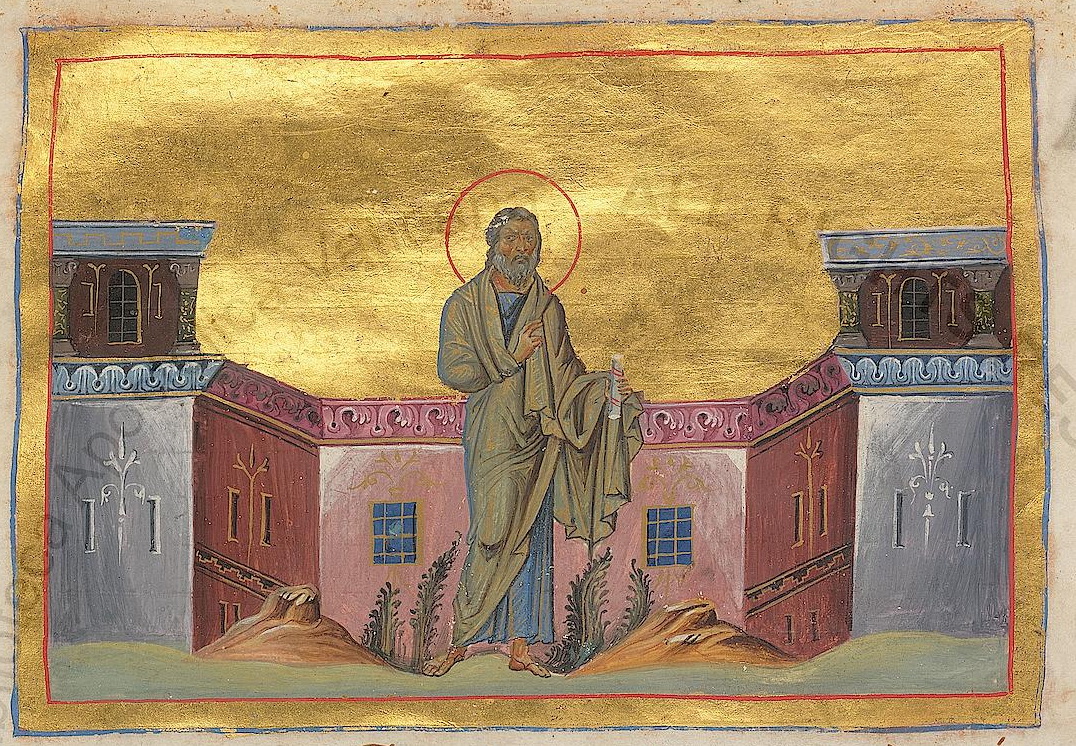
Joel appears wherever the prophet row of the iconostasis stands: an elderly, grey-bearded figure in chiton and himation, holding a scroll usually inscribed with "I will pour out my Spirit upon all flesh." In narrative and menologion cycles he stands alone in a landscape or before the walls of Jerusalem, and Byzantine psalters sometimes set him beside scenes of Pentecost, as the prophet whose word the feast fulfils. The stored image is the miniature of the Menologion of Basil II (Constantinople, c. 985; Vat. gr. 1613, p. 124), which shows the prophet standing between the towers of a walled court, scroll in hand. (The Commons file's pasted Russian description mislabels the miniature as John the Chozebite; the identification as Joel was verified for this collection against the Vatican manuscript itself, whose heading on p. 124 reads "memory of the holy and glorious prophet Joel.")
Disputed questions
- Date. The book carries no date, and modern scholarship is more divided over Joel than over almost any prophet: an early monarchic date (9th century BC, under the boy-king Joash) has been argued from the book's canonical position and from the enemies it names (Tyre, Sidon, Philistia, Egypt, Edom — with Assyria and Babylon absent), while the majority of modern critics place its composition after the Exile, when the temple stood but no king is mentioned. The Church's calendars print the received reckoning of about 800 BC, and this entry indexes him accordingly among the prophets of the ninth century BC; the question of the book's literary date is separate from the Church's veneration of the prophet and is left open here.
- The locusts. Whether chapters 1–2 describe a literal locust plague read as a figure of the Day of the LORD, or an invading army described as locusts, was already debated among the Fathers (Jerome inclined to the army; most moderns to the locusts). The liturgical use of the book does not depend on the answer.
- Not to be confused with the several other bearers of the name in the Old Testament (a son of Samuel among them), none of whom is the prophet.