
John Climacus
Our Venerable Father John Climacus, of the Ladder, Abbot of Sinai
Venerable · b. c. 579 — d. c. 649
Commemorated 30 March — Commemoration of the abbot of Sinai and author of the Ladder
John Climacus (c. 579 – c. 649) — "John of the Ladder" — was a monk of Mount Sinai who, after forty years of hidden ascetic labour, was made abbot of the great monastery there, and who at the request of another abbot composed the Ladder of Divine Ascent (Greek Klimax), the most influential handbook of Orthodox ascetic and monastic life. Its thirty "steps," one for each year of the Lord's hidden life, lead the soul from the renunciation of the world through the struggle against the passions to the summit of dispassion and love. The Church keeps his memory on March 30 and, above all, on the Fourth Sunday of Great Lent, setting him before the faithful as a guide in the ascent of the Fast.

Of John's origins little is certain; the by-name "Scholasticus" suggests a good early education. At about the age of sixteen he came to Mount Sinai and placed himself under an elder named Martyrius, to whom he gave perfect obedience; at his tonsure, it is said, the holy Anastasius of Sinai and John the Sabbaite foretold that a great luminary of the Church had been given to Sinai. After his elder's death John withdrew to a hermitage at a place called Tholas, some miles from the main monastery, and there lived for about forty years in solitude, prayer, fasting and the study of the Scriptures and the fathers, guarding above all the memory of death and the gift of tears. He was neither showy in his abstinence nor idle; visitors found him gentle, hidden, and free of the vainglory that apes virtue.
His fame for discernment drew disciples and inquirers, and against his will he was at length chosen abbot of the monastery of Sinai. It was then that John, Abbot of the neighbouring monastery of Raithu, wrote asking him to set down for the brethren a rule of ascetic life; and John composed the work that has carried his name through the centuries.
The Ladder of Divine Ascent
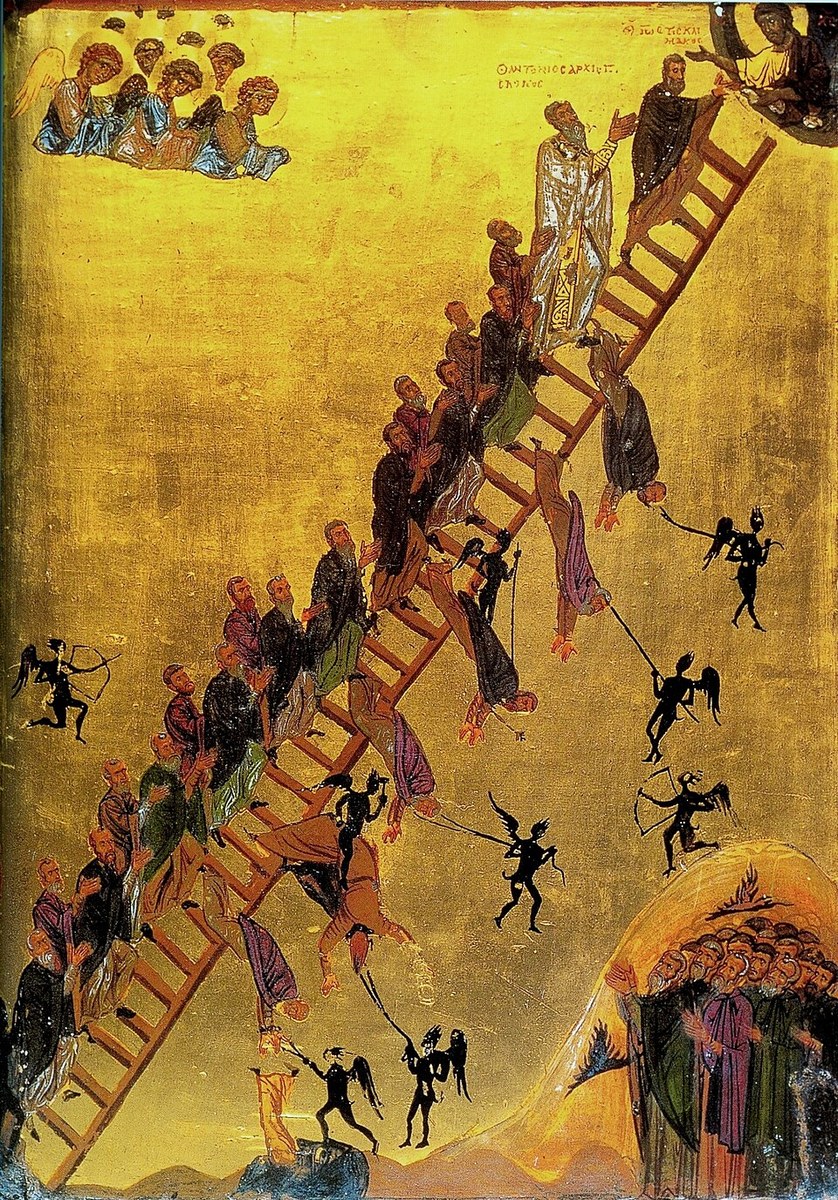
The Ladder (Klimax) is arranged as thirty rungs, from the renunciation of the world (Step 1) to the crown of faith, hope and love (Step 30). Between them lie the great themes of the spiritual life: exile and obedience, repentance and the "joyful sorrow" of tears, the struggle against anger, remembrance of wrongs, slander, talk- ativeness, falsehood, despondency (akēdia), gluttony, lust, avarice, and the subtler passions of vainglory and pride; then the higher steps of simplicity, humility, discernment, stillness (hesychia), unceasing prayer, dispassion (apatheia), and love. Written with wit, hard-won realism and a physician's eye for the diseases of the soul, it became at once the classic of Eastern monastic formation, read aloud in the refectories of monasteries through Great Lent to this day, and beloved far beyond the cloister.
John governed Sinai for a few years, then, longing again for stillness, gave over the abbacy to his brother George and returned to his solitude, where he reposed about 649. His Ladder is his enduring monument.
Feast and commemoration
March 30 (church date; Old Calendar civil April 12). His principal commemoration, however, is the movable Fourth Sunday of Great Lent, on which the Church holds him up as the pattern of the ascetic ascent that Lent is (the movable rule 21 days before Pascha; the project's constitution makes the Pascha-offset the only canonical form for a Pascha-relative day).
Hymns
Troparion — Tone 8 (common of a venerable, proper to Sinai)
With the streams of thy tears thou didst cultivate the barren desert, and by thy deep sighings thou didst bear fruit a hundredfold in labours; and thou becamest a luminary, shining upon the world by miracles, O John our venerable father. Intercede with Christ God that our souls may be saved.
Original translation from the Greek
Kontakion — Tone 4
On the height of true abstinence the Lord established thee as a true and unerring star, giving light to the ends of the earth, O John our guide and father.
Original translation from the Greek
Iconography
John is shown as an aged monk in the schema, holding a scroll — often inscribed with a maxim of the Ladder — or the book itself. The most famous image bound to his name is the great Sinai icon of the Ladder of Divine Ascent: monks climb a ladder of thirty rungs toward Christ who receives them at the top, while demons with bows and hooks drag some from the rungs into the jaws of a dragon below, and angels encourage the ascent. The twelfth-century Sinai panel of that subject is stored here.