
John of Rila
Our Venerable and God-bearing Father John, Wonderworker of Rila
Venerable · b. c. 876 — d. 946
Commemorated 1 July — Return of his relics from Tarnovo to the Rila Monastery (1469), 18 August — Repose (946), 19 October — Chief feast; anciently the translation of his relics to Tarnovo
John of Rila (c. 876–946) is the greatest of the Bulgarian saints: the shepherd of Skrino who fled into the Rila wilderness, lived in a hollow oak and a bare cave on herbs and wild chickpeas, refused the visit of Tsar Peter while returning his gold, gathered the disciples who became the Rila Monastery, and left them a Testament of poverty, prayer and freedom from kings. His relics travelled for five centuries — Sredets, Esztergom, Tarnovo, and home to Rila in 1469 — and his monastery became the ark of Bulgarian faith and letters through the Ottoman night. Heavenly protector of the Bulgarian people, he is celebrated above all on October 19, with further feasts on August 18 (his repose) and July 1 (the return of his relics).

Origins and early life
John was born about 876 in the village of Skrino on the river Struma, in the Sofia region of the newly baptized Bulgaria — he was a child when Boris the Baptizer still lived, and Bulgaria's conversion was younger than his parents. His family were poor peasants, and John herded the village flocks. The Lives tell of the boy's first miracles among the herds — a stray heifer and calf found across the swollen river, which he crossed dry-shod — and of the mockery of neighbours that early taught him the world's price for holiness. Orphaned and unremarkable in the world's eyes, on reaching manhood he gave what he had to the poor and entered the monastery of St. Demetrius beneath the Ruen mountain above his native valley. There he received the tonsure, and there — for the coenobium possessed books — he learned his letters and was formed in the Psalter and the Fathers.
Ascetic struggle: from the cave to the Rila wilderness
The monastery could not hold him long. Seeking the desert after the pattern of Antony, whose Egypt was now beyond reach, John went out into the mountains of his own land — the first of the South Slavs to carry the full weight of the hermit vocation, which is why the Bulgarians call him their "heavenly man and earthly angel." He lived first in a hut of brushwood on a bare height, where robbers beat him and drove him off; then in a deep cave, where his young nephew Luke, fleeing his father's house, joined him as a disciple. The boy's father dragged Luke home; the child died of a serpent's bite on the road, and the grieving father returned to beg the hermit's forgiveness; John buried the boy at a place still shown as "Luke's grave" — the one purely human sorrow his Lives allow him.
After some twelve years in the cave John withdrew deeper, into the granite wilderness of Rila, the highest massif of the Balkans. There he passed the legendary years of his sternest asceticism: living in the hollow of a great oak, later on a high crag, eating herbs and the wild chickpeas which — the folk Life says — God caused to spring up for him, sleeping little, praying without ceasing, and fighting the demons who beat him and scattered his poor sustenance. Shepherds chasing strayed flocks stumbled on the emaciated hermit and carried the report down the valleys; the sick began to climb to him, and the Lives record healings and the casting out of unclean spirits at his prayer. Disciples followed and would not be turned away, and around his crag and cave there grew up cells, then a church, then a monastery with John — against all his desire — as its first abbot and father.
The hermit and the tsar
The fame of the hermit reached Tsar Peter (927–969), son of Symeon the Great, in his capital. The Lives tell that Peter came with a great retinue into the Rila as far as the mountain called thereafter Tsarev Vrah, "the Tsar's Peak," but the wild gorges would not let the court reach the hermit's crag; the tsar sent men begging John to come to him, and John refused — "tell the tsar that he seeks what cannot profit him: let him not see my poverty, nor I his glory." Peter sent gifts: food, and a cup of gold filled with gold pieces. John kept the food, blessed the cup as a keepsake of the giver, and sent back every coin — a hermit has no use for gold, he wrote, and a tsar has great use for it: let him spend it on the poor and on his armies' peace. The letter of John to Peter which the tradition preserves — counsel to a Christian king from a man who wanted nothing from him — became a foundational text of the Slavic political conscience: the crown bows to the cave, and the cave asks nothing of the crown. The Bulgarians have never forgotten that their greatest saint refused their greatest tsar.
The Testament and repose
Near the end of his life, in 941 by its own dating, John gave his disciples the Testament (Zavet) that stands with the letter to Peter as his literary legacy: they were to keep the faith of the Fathers whole, to flee the love of money as the root of all evil, to hold no property beyond need, to receive strangers, to shun the courts of princes, and to remain — as he had lived — free men of God in the wilderness. He appointed a successor, withdrew again to his cave for his last years, and died there on August 18, 946, about seventy years old. His disciples buried him by the church he had never wanted built for him.
Relics and translations
The relics of John were found incorrupt and wonderworking, and their subsequent journey is a history of the Balkans in miniature. Translated first from Rila to Sredets (Sofia) — by the later 11th century they lay in a church of the city, and the Byzantine governor's circle knew them well (George Skylitzes wrote a Greek Life and service at Sredets in the 12th century). In 1183 the Hungarian king Béla III, taking Sredets in war, carried the relics to Esztergom; the tradition relates that the archbishop there, who doubted the sanctity of the Bulgarian hermit, was struck dumb until he did the relics honour, and in 1187 the king returned them to Sredets with gifts. In 1195 the tsar Ivan Asen I, having restored the Bulgarian realm, translated them in state to his capital Tarnovo, where Patriarch Basil laid them in a church built for them — the translation the Byzantine-rite calendars fixed on October 19 (the Russian synaxaria carry the variant date 1238 for this translation; see Disputed questions). Under the Ottomans, Tarnovo fallen and the Bulgarian patriarchate extinguished, the monks of Rila sought their father back: in 1469, with the intercession of Mara Branković — the Serbian widow of Sultan Murad II, protectress of Athonite and Balkan monasticism — the relics were granted to the monastery and carried across the enslaved land in a slow procession that the whole people came out to meet, an event described by the eyewitness Vladislav the Grammarian and commemorated ever since on July 1. The relics rest in the Rila Monastery to this day.
The monastery and the nation
The Rila Monastery, refounded in 1335 on its present site by the protosebastos Hrelyo (whose defensive tower still stands), burned and rebuilt more than once, grew into the greatest monastery of Bulgaria and one of the greatest of the Slavic world: through five Ottoman centuries it was the ark in which Bulgarian faith, letters, and identity survived, its monks walking the villages as confessors and its scriptorium feeding the manuscript culture of the whole Slavic south. The National Revival rebuilt it in splendour in the 19th century; UNESCO inscribed it in 1983. John himself was canonized by veneration almost immediately after his death; his Lives run from the anonymous folk Life and the Greek Life by Skylitzes to the great Life by Patriarch Euthymius of Tarnovo (14th century), and his cultus spread with the Slavic books to Serbia and Russia. He is invoked as the heavenly protector of the Bulgarian people, and the day of his chief feast, October 19, is kept in Bulgaria with national solemnity.
Feast and commemoration
John of Rila carries three feasts, and this collection's ranking follows the weight the calendars themselves give them. October 19 (Old Calendar civil November 1) is ranked primary: anciently the commemoration of the translation of the relics to Tarnovo, it has become the saint's chief feast — in Bulgaria the great national celebration of "St. Ivan Rilski the Wonderworker," at the Rila Monastery the principal panegyris, and in the Russian books the day with the fullest proper service (canons and an akathist are appointed to him on this day). August 18, the day of his repose in 946, is ranked secondary; the OCA places its principal Life of the saint there and treats October 19 as the relics-feast — a divergence of emphasis recorded honestly here. July 1, the return of the relics from Tarnovo to Rila in 1469, is ranked translation-of-relics. The Greek synaxarion of October 19 also carries a notice of "our venerable father John the Wonderworker, who lived in ascesis on the mountain of Rila and built the monastery there" — so the saint is not unknown to the Greek books — but the full liturgical cultus is Bulgarian, Slavic, and OCA, and the jurisdictions field records that.
Hymns
Troparion — Tone 1
Foundation of repentance, pattern of compunction, image of consolation and of spiritual perfection was thy life, equal to the angels, O venerable one: for thou didst abide in prayers and fastings and in tears. O father John, intercede with Christ God for our souls.
Original translation from the Slavonic
Kontakion — Tone 8
Emulating the angelic life, O venerable one, thou didst forsake all earthly things and run to Christ; and fenced about with his commandments, thou wast shown forth a pillar unshaken by the assaults of the enemy. Wherefore we cry to thee: Rejoice, father John, most radiant beacon.
Original translation from the Slavonic
Troparion
By the return of thy relics thy monastery is enriched; thy church, receiving them, is illumined, and adorned with beauty she calls the faithful with gladness to keep in radiance thy light-bearing day, saying: Come, and receive the gifts of grace.
Original translation from the Slavonic
Kontakion
With steadfast mind and unceasing prayers thou didst wrestle down utterly the all-destroying power of the striving enemy, and wast worthily glorified by Christ, O all-blessed John; wherefore today, keeping in gladness the bright feast of the return of thy relics, we cry to thee with one voice: to thy flock and to thy people thou art with God, O venerable father, their boast and their stronghold.
Original translation from the Slavonic
Iconography
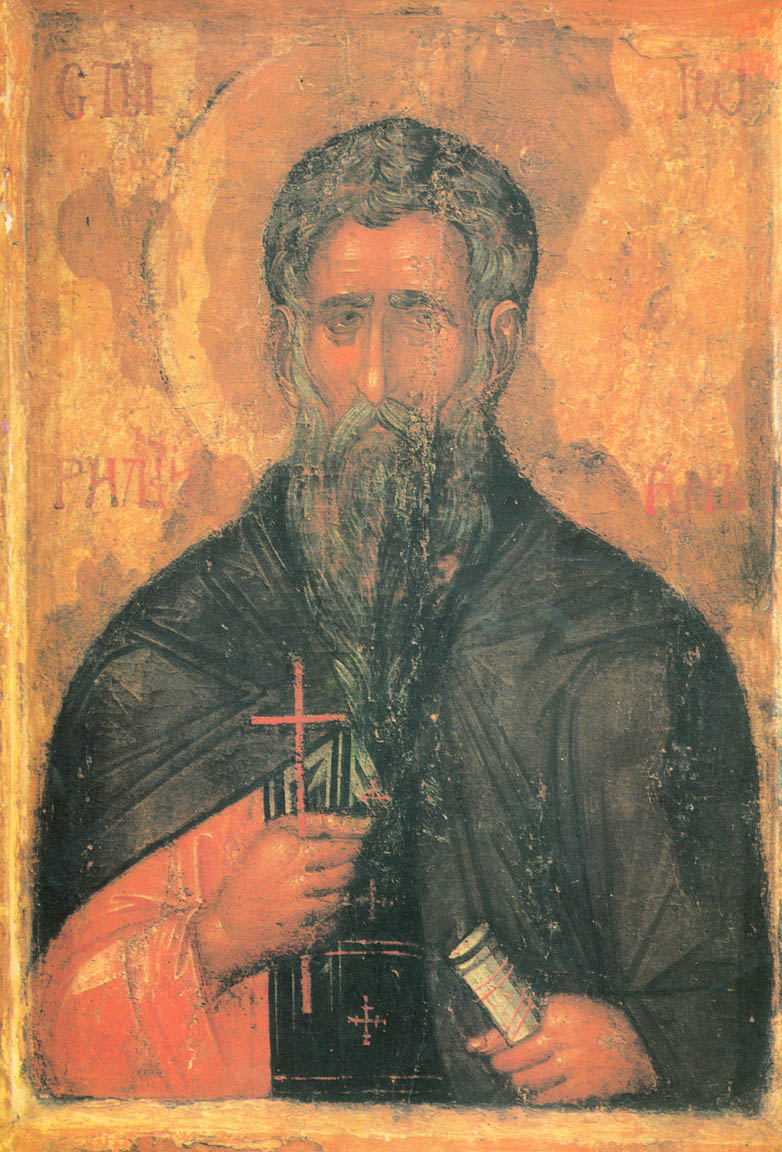
John of Rila is painted as a spare, long-bearded elder in the monastic schema, most often holding an open scroll with words from his Testament or a cross; the oldest surviving portrait tradition is preserved at Rila itself. Vita icons surround him with the shepherds' discovery, the tsar's embassy and the returned gold, the demons' assaults, and the translations of the relics; in Bulgarian church art he stands as national patron opposite the image of the Theotokos. The stored icon is the celebrated 14th-century portrait icon from the National Museum of the Rila Monastery — the saint in dark schema, cross and scroll in hand, with the Cyrillic inscription "Saint John of Rila" flanking the halo.
Disputed questions
- The date of the Tarnovo translation. Bulgarian historiography, on the contemporary evidence, dates the translation from Sredets to Tarnovo to 1195, under Ivan Asen I; the Russian synaxarion tradition — followed by the OCA's October 19 notice — gives 1238, under Ivan Asen II. The discrepancy is recorded here and not harmonised; the October 19 feast itself is the fixed point.
- The Testament. The Zavet survives only in copies of the 19th century, and scholars divide over whether it is the hermit's own dictation of 941, a later medieval compilation of his authentic teaching, or a Revival-era reconstruction; the monastery holds it as his. Its content is in any case the tradition's own summary of his teaching, and it is cited here as such.
- The letter of Peter. The correspondence of tsar and hermit is transmitted in the later Lives, not in a 10th-century witness; its substance — the refused meeting, the returned gold — belongs to the earliest stratum of the tradition.