
John the Almsgiver
Our Father among the Saints John the Merciful, Patriarch of Alexandria
Patriarch · Bishop · b. c. 550 — d. c. 620
Commemorated 12 November — Repose at Amathus in Cyprus
John the Almsgiver (c. 550–620), also called John the Merciful, was Greek Patriarch of Alexandria in the last decade of his life and the most celebrated almsgiver among the Church's hierarchs. A widowed Cypriot nobleman raised to the throne of Saint Mark around 610, he made the relief of the poor the whole programme of his patriarchate: he called the destitute of the city "my lords and masters," enrolled and fed thousands of them, poured the wealth of the great see into hospitals, hostels and refugee-relief, and reformed the commercial life of Alexandria in their favour. His Life, written by Leontios of Neapolis, preserves a vivid gallery of his charity. He is commemorated on November 12.

Origins and early life
John was born on Cyprus, at Amathus near the modern Limassol, around the middle of the sixth century, into a family of the island's aristocracy: his father Epiphanius held high rank in the imperial administration of Cyprus. In deference to his parents John married and had children. When his wife and children died within a short space of years he did not remarry but gave himself wholly to a life of asceticism and charity in the world, so that his reputation for piety and open-handedness spread well beyond Cyprus.
Patriarch of Alexandria
That reputation reached Alexandria at a moment of need. The see of Saint Mark — second in honour in the Eastern Church, and immensely wealthy — had been troubled by the long Monophysite schism that divided the Egyptian church, and its Chalcedonian ("Melkite") community sought a patriarch of proven holiness. Around 610, with the support of the emperor Heraclius and of the Cypriot general Nicetas, John was chosen and, though a layman and reluctant, was consecrated patriarch.
He set the tone of his episcopate on his first days in office. Summoning the stewards of the church, he ordered them to go through the whole of Alexandria and make a register of "my lords and masters" — and when they asked whom he meant, he answered: those whom you call beggars and paupers, for they are truly lords and masters, in that they have the power to help us into the kingdom of heaven. The count came to some seven and a half thousand, and John charged himself with their daily support.
His almsgiving was systematic as well as spontaneous. He forbade the church's officers to turn any petitioner away; he sat in the open twice a week before the church to hear grievances and settle disputes, holding that a bishop who left the wronged without a hearing was no true shepherd; he reformed the weights and measures of the market to protect the poor from short measure; he founded hospitals, maternity hostels for poor women, and houses for travellers and refugees. When the Persians under Chosroes II sacked Jerusalem in 614 and a flood of destitute refugees and ransomed captives poured into Egypt, John received them, fed and housed them, and sent lavish relief — money, grain, wine, oil, and labourers — to the ruined city and to Modestus, who was rebuilding its churches.
The Life of Leontios records his charity in a series of memorable scenes: how he gave away a costly bed-covering pressed on him by a rich admirer, so that it might be sold and sold again to clothe the poor; how he received back into favour, with tears, a nephew who had been publicly insulted, teaching him to bless rather than curse; how he gave repeatedly to a beggar who returned in changed clothes to deceive him, saying that it might be Christ himself come to test him; and how, recalling the Gospel word, he refused to let the sun set on any quarrel, once waiting at the church door until a bishop he had offended was reconciled to him. He resisted simony and the interference of the civil power in the affairs of the Church, and though austere with himself he was never harsh with others.
Repose
In 619 the Persian armies overran Egypt itself. John withdrew from Alexandria in the company of the general Nicetas, intending to travel to Constantinople; but falling ill on the way he turned aside to his native Amathus in Cyprus, where he died around the year 620. He had, it was said, given away so completely that at his death almost nothing remained of the vast fortune of his see — the outcome he had most desired.
Relics and translations
His body was buried at Amathus. His relics were later translated to Constantinople, and after the Ottoman conquest a large portion was given by the sultan to King Matthias Corvinus of Hungary in the fifteenth century; they were enshrined at Buda and afterwards at Pressburg, and rest today in the Cathedral of Saint Martin in Bratislava. Other relics are venerated on Cyprus and elsewhere.
Veneration and later cultus
John's epithet — ho Eleēmōn, "the Merciful," or in the older English usage "the Almsgiver" — fixed him in the memory of the whole Church as the pattern of episcopal charity, and his Life became one of the most widely read of Byzantine hagiographies, translated into Latin, Syriac, Arabic, Slavonic and other tongues. The Knights Hospitaller of Saint John long claimed him among their patrons, and he is invoked as a helper of the poor and a model for those in office over the goods of the Church.
Feast and commemoration
November 12 (church date; Old Calendar civil November 25), the day of his repose, kept universally in the Byzantine rite. On Cyprus, his homeland, his memory is observed with particular solemnity. He is not to be confused with the Russian fool-for-christ John "the Hairy" of Rostov (†1580), who is also surnamed "the Merciful" and is likewise commemorated on November 12 in the Slavic calendars — a different saint of a different age and land.
Hymns
Troparion — Tone 8
In patience you won your reward, venerable father: persevering unceasingly in prayer, loving the poor and providing for their need. Intercede with Christ our God, blessed John the Merciful, that our souls may be saved.
Original translation from the Greek
Kontakion — Tone 2
You scattered your wealth abroad to the poor, and now have received in exchange the wealth of heaven, all-wise John; therefore we all honour you, keeping the memory of you who bear the very name of mercy.
Original translation from the Greek
Iconography
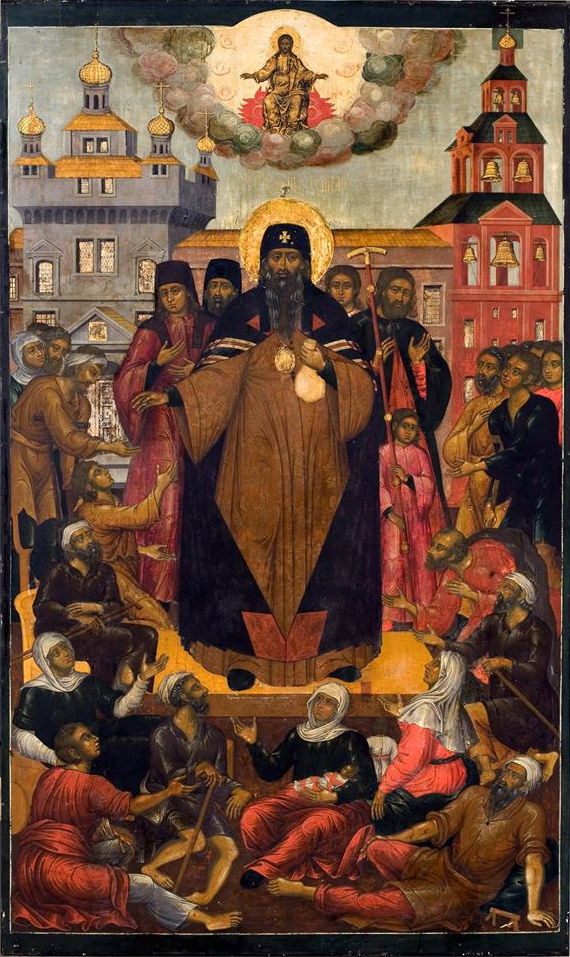
John is shown as a hierarch — in the omophorion, with the Gospel or a scroll, his right hand raised in blessing — and is often depicted in the act of giving alms, handing a coin or bread to a beggar at his feet, the visual signature of his cult. The stored image is a Russian icon of 1704 by Kirill Ulanov, from the Andrei Rublev Museum in Moscow, showing the patriarch full-length in episcopal vesture.