
John the Faster
Our Father among the Saints John IV the Faster, Patriarch of Constantinople
Patriarch · Bishop · d. 595
Commemorated 30 August — Kept with Alexander and Paul the New among the patriarchs of Constantinople (Slavonic and OCA usage), 2 September — Repose at Constantinople
John IV the Faster (†595) was Patriarch of Constantinople from 582 to 595: a goldsmith of the capital who rose through the diaconate of Hagia Sophia to the patriarchal throne, and whose fasting, vigil and almsgiving earned him the surname Nesteutes, "the Faster." Under him the title "Ecumenical Patriarch" came into formal synodal use, provoking the celebrated protest of Gregory the Great; yet when John died he was found to own nothing but a wooden bed, a linen shirt and a worn cloak. The penitential canons that shaped later Orthodox confessional practice are transmitted under his name. He is commemorated on September 2.
.jpg)
Origins and early life
John was born in Constantinople, of humble station, and practised the craft of a goldsmith. From his youth he was drawn to the ascetic life, and his private discipline — a continence and abstinence remarkable even by monastic standards — became known in the city. Under the Patriarch John III Scholasticus (565–577) he was ordained deacon of the Great Church of Hagia Sophia, and he served the church of the capital in offices of trust, including the care of its almsgiving; the Lives dwell on his mercy to the poor as the twin of his fasting.
Patriarchate
On the death of the Patriarch Eutychius, John was elected to the see of Constantinople in April 582, in the last months of the emperor Tiberius II, and he accepted the throne with genuine reluctance, yielding only to the insistence of emperor, synod and people. He served under the emperor Maurice for the thirteen years of his patriarchate.
As patriarch he changed nothing of his rule of life: the fasting that named him continued on the throne, and with it a proverbial personal poverty and an open hand to the poor. The tradition credits him with gifts of healing and clairvoyance, and the Lives record miracles worked through his prayer both in life and after death; his contemporaries treated him as a living saint, and the emperor Maurice held him in awe.
His name is attached to one of the enduring controversies of church history. At the great synod held at Constantinople in 587/588 concerning Gregory, Patriarch of Antioch, John was styled "Ecumenical Patriarch" (οἰκουμενικὸς πατριάρχης) — a title of honour that Constantinopolitan usage had applied to its archbishops before him, but whose formal synodal use now drew protest from Rome. Pope Pelagius II rejected the title, and Gregory the Great, his successor, conducted a long and vehement correspondence against it with John himself, with Maurice, and with the other Eastern patriarchs, styling himself by contrast "servant of the servants of God." The sources on both sides agree on the personal humility of John, who neither invented the title nor, so far as the record shows, ever pressed a claim of universal jurisdiction from it; he simply declined to abandon what the usage of his church had conferred. The dispute outlived him and was never resolved; the title remains that of the Patriarchs of Constantinople to this day.
Repose
John died on September 2, 595. The story told at his death became the seal of his sanctity: the patriarch of the imperial city was found to possess nothing but a hard wooden bed, a linen shirt, and an old garment. The emperor Maurice took these poor relics as a blessing, and — the tradition adds — slept on the patriarch's bed in penitence. John was buried in the Church of the Holy Apostles, the burial place of the patriarchs and emperors.
Literary legacy
Under John's name the manuscript tradition transmits a body of penitential literature — above all the kanonarion or "Penitential of John the Faster," a graded scale of penances for confessed sins notably milder than the ancient canons, tempered to the strength of the penitent. This corpus decisively shaped the practice of confession and penance in the later Greek and Slavic churches. Scholarship, however, regards the attribution as uncertain: the penitential in its surviving forms is generally dated well after the sixth century, and it bears John's name as the patron of fasting and repentance rather than as its verifiable author. Homilies on repentance and on false prophets are likewise transmitted under his name with disputed attribution.
Feast and commemoration
September 2 (church date; Old Calendar civil September 15), the day of his repose, joined in the Menaion with the service of the great-martyr Mamas. The feast is kept throughout the Byzantine rite. On the question of a second commemoration on August 30, see Disputed questions above.
Hymns
Troparion — Tone 4
A rule of faith and an image of meekness, a teacher of temperance — so did the truth of things reveal thee to thy flock. Therefore by humility thou didst acquire the things that are high, by poverty the things that are rich. O Father John, venerable one, intercede with Christ God that our souls may be saved.
Original translation from the Greek
Iconography
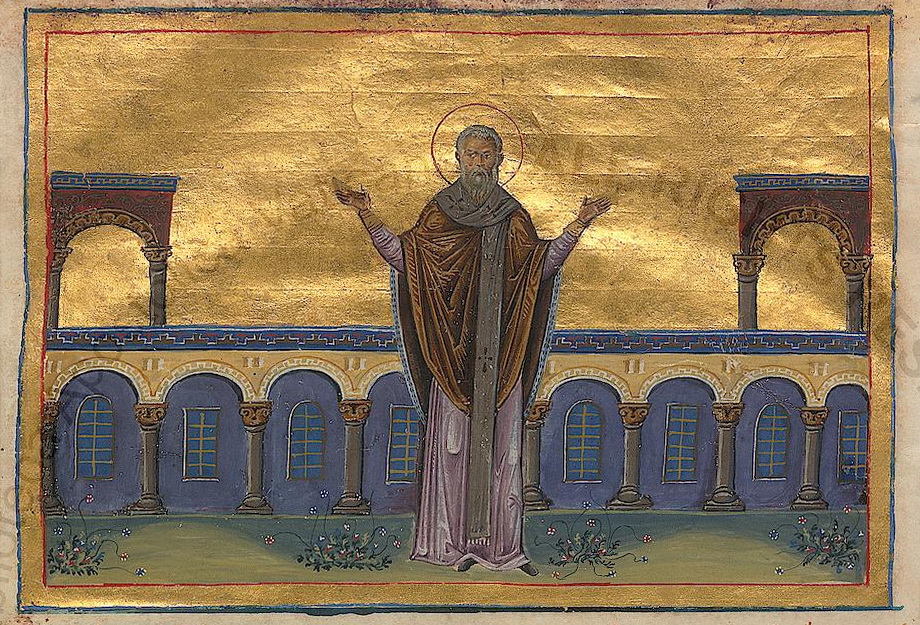
John is depicted as an aged, gaunt hierarch with a short grey beard — the face of a faster — most often in the monastic habit or in bishop's vestments with omophorion, blessing or holding the Gospel. The stored image is the miniature for his feast from the Menologion of Basil II (Constantinople, c. 985), which shows him standing orans before the colonnades of the capital, clothed not in episcopal vestments but in the brown mantle of a monk — the Menologion's own witness to the primacy of the ascetic in his memory.
Disputed questions
- Authorship of the penitential. As above: the "Penitential of John the Faster" is transmitted under his name but is generally judged a later compilation; the entry records the attribution as traditional, not established.
- The commemoration of August 30. The Byzantine calendar commemorates on August 30 the Patriarchs of Constantinople Alexander, John and Paul the New. The "John" of that feast is identified by some authorities with John the Faster and by others with other patriarchs named John (notably John III Scholasticus); the question is left open here, and no second feast is claimed for this entry.
- Classification. The Greek Menaion labels his service that "of the venerable one" (τοῦ Ὁσίου), honouring the ascetic; the calendars nonetheless commemorate him as a hierarch, and he is classified here as patriarch.
- Not to be confused with his near predecessor John III Scholasticus, Patriarch of Constantinople 565–577 (kept February 21), the lawyer and canonist: that John is John III, this one John IV the Faster (582–595). Their nearness in see and century makes the two easy to confuse.