
John the Russian
Our Righteous Father John the Russian, the Confessor and Wonderworker, whose relics are on Euboea
Righteous · Confessor · Wonderworker · b. c. 1690, in Little Russia (Ukraine) — d. 27 May 1730, at Prokopion in Cappadocia
Commemorated 27 May — Repose at Prokopion (1730)
John the Russian (c. 1690–1730) was a Ukrainian soldier of the army of Peter the Great who was taken prisoner by the Tatars in the Pruth campaign of 1711, sold into slavery in Cappadocia, and spent the remaining nineteen years of his life as the stable-slave of a Turkish cavalry officer at Prokopion, refusing under torture and then under kindness alike to renounce Christ. He slept among the animals, gave away what little he had, and kept the fasts and the vigils of the Church in a Muslim household; his holiness was recognised by Christians and Muslims of the town before his death on 27 May 1730. His relics were found incorrupt, survived an attempt to burn them in 1832, and were carried by the refugees of the 1924 population exchange to Euboea, where his shrine at Nea Prokopi is one of the great pilgrimage places of the Greek world. He is honoured as a confessor — a martyr in will though not in blood — and is one of the most popular saints of modern Greece.

Origins and the campaign of 1711
John was born about 1690 in Little Russia — the Ukrainian lands of the Russian Empire — and was raised, his Life says, in piety and in love for the Church. Nothing is recorded of his family or his village. As a young man he was conscripted into the army of Peter I and served as a private soldier in the Russo-Turkish war. In the Pruth campaign of 1711, when Peter's army was surrounded on the river Pruth in Moldavia and forced to terms, John was among the many thousands taken prisoner. He was seized by the Tatars, who trafficked in captives, and sold on into the Ottoman interior.
His purchaser was a Turkish cavalry commander — an officer of the sipahis — whose home was at Prokopion in Cappadocia, the town the Greeks called Prokopi (the modern Ürgüp, in the region of Caesarea). There John was brought, one slave among the Russian prisoners distributed through Asia Minor after the campaign.
The refusal
Ottoman households pressed their Christian slaves hard to convert, and the pressure on John was severe: he was beaten, burned about the head, thrown to the ground and trampled, held in filth and hunger. His answer, as the tradition preserves it, was absolute and courteous at once — that he would serve his master faithfully in everything belonging to his service, but that no power on earth could make him deny his faith, and that if he were forced to choose he would rather die a Christian than live a Muslim. He told his master to do with his body what he wished, for his soul belonged to Christ.
What broke the persecution was not John's yielding but his master's exhaustion. After a long while the beatings stopped; the household came to see that the young Russian would not be turned, and they left him to his religion. He was given the care of the stables and the animals.
The stable at Prokopion
For the rest of his life John lived in the stable, sleeping on the straw among the horses. He was offered a small room of his own when his master's fortunes improved and refused it, preferring the manger, in what his Greek Life reads as a deliberate imitation of the Nativity. He fasted often on bread and water, gave away his food and what coins came to him to the poor of the town, and at night went out to the cave church of St George at the edge of Prokopion, where he kept vigil in the porch, and on Saturday nights and the feasts received the Holy Mysteries. The Christians of the town knew him; so, in the end, did the Muslims, who called him a man of God and believed that the prosperity of his master's house came from the presence of the slave in the stable.
The dish of pilaf
The most famous incident of his life belongs to this later period. His master went on the pilgrimage to Mecca, and while he was away his wife prepared the pilaf that was his favourite dish and, out of kindness, sent a plate of it to John in the stable. John asked her to give him the dish so that he might send it to his master. She let him have it, expecting nothing; John prayed over it, and it was gone. When the master returned from Mecca he told his household — before they told him anything — that on a certain day he had found in his locked lodging in Mecca a steaming dish of pilaf, and that the copper plate it stood in bore his own name engraved upon it, as the plates of his own kitchen did. The plate was recognised. The story was told throughout the region and is the reason John's veneration spread among the Greeks of Cappadocia in his own lifetime.
Repose
In May of 1730 John fell ill, and knowing that he was dying asked for the Holy Mysteries. The priest, afraid to carry the Gifts openly through a Muslim quarter, brought the Communion to the stable hidden in the hollow of an apple. John received, and reposed on 27 May 1730, about forty years old. His master gave the body to the Christians, who buried him with honour in the cemetery of Prokopion.
Relics
Three years later, in 1733, the priest who had communed him is said to have been shown in a dream that the body was incorrupt; the grave was opened and the relics were found whole and fragrant, and were translated into the church of St George. They became at once a source of healings, honoured — as often happened in Anatolia — by Muslims as well as Christians.
In 1832, during the disorders that followed the Egyptian campaign of Ibrahim Pasha, Turkish irregulars broke into the church, dragged out the relics and threw them onto a fire. The tradition, and the memory of the community, holds that the bones were recovered from the ashes unconsumed, though blackened, and that the saint appeared in the flames; the relics survive to this day with the marks of that burning. In 1845 a portion was taken to the Russian monastery of St Panteleimon on Mount Athos, where a chapel was dedicated to him.
Nea Prokopi on Euboea
At the exchange of populations of 1923–24 the Christians of Prokopion were uprooted with the rest of the Anatolian Greeks. They carried the relics of John with them, across Asia Minor and over the sea, and settled in central Euboea (Evia) at a village they renamed Nea Prokopi — New Prokopi — after the town they had lost. The relics were kept first in the village church; a great new church of St John the Russian was built for them and consecrated in 1951. In 1962 the Ecumenical Patriarchate formally inscribed him in the calendar of the Church.
Nea Prokopi is now among the most visited shrines in Greece: coaches of pilgrims come all year and in tens of thousands on his feast, and he is invoked particularly by soldiers, by prisoners, by the sick, and — through his own long captivity — by refugees and by those far from home. His veneration passed from the Greeks to the Russians and the Antiochians and is now general.
Feast and commemoration
May 27 (church date; Old Calendar civil June 9), the day of his repose. His feast is kept with a great festal gathering at Nea Prokopi on Euboea, and is observed throughout the Greek Church, in the Russian Church and on Mount Athos, and in the Antiochian Archdiocese. On the New Calendar the feast falls on the civil May 27; the Old Calendar communities keep it on civil June 9. Because he was inscribed in the calendar of the Great Church only in 1962, his office is entirely modern, and older service books do not contain him.
Hymns
Troparion — Tone 4
Taken captive from thy homeland and sold into a strange land, thou wast not parted from Christ, O blessed John; for in the stable of thy master thou didst make a temple of prayer, and in slavery thou wast free indeed. Wherefore, having kept the faith unto the end, thou dost pour out healings upon all who run to thee: entreat Christ God that our souls may be saved.
Original translation from the Greek
Kontakion — Tone 8
A soldier of the earthly king thou wast, and becoming a slave of men thou wast found a free servant of the Heavenly King; therefore, O John, glory of the faithful and boast of the exiled, we cry to thee: Rejoice, thou consolation of those far from home.
Original translation from the Greek
Iconography
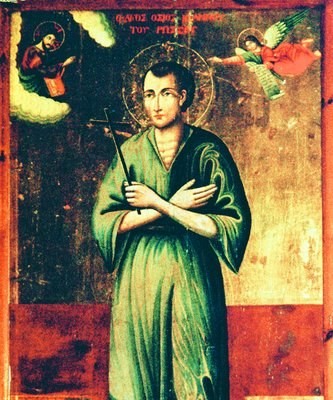
John is painted as a young man — beardless or with the first growth of a beard, in contrast to almost every other saint of the fixed calendar — in the plain belted tunic of a servant or the coat of a Russian peasant, standing with his hands open in prayer or holding a cross. His attributes are drawn directly from his Life: the stable with its horses behind him, the manger and straw, and very often the copper dish of pilaf, which serves as his identifying emblem in Greek workshops; some icons show the apple in which he was given Communion, and some the church of St George at Prokopion. Full-length shrine icons at Nea Prokopi place him beside his reliquary. Narrative cycles paint the four scenes of the pilaf, the burning of the relics, the flight of 1924, and the arrival on Euboea.
Because his cultus dates from the eighteenth century and was formalised only in 1962, every icon of him is modern, and the icons in circulation are the copyrighted work of living or recent iconographers. A candidate image on Wikimedia Commons (an icon photographed in the church of the Dormition at Poros, uploaded 2024 under a CC BY-SA 4.0 licence) was examined and rejected: the licence covers only the photograph, while the underlying painting is a modern icon of undetermined authorship whose painter's rights are untouched by the photographer's grant. The final sentence this entry once carried — that no pre-1900 image of the saint exists "and none can, given his date" — proved wrong: he died in 1730, and the stored image is an icon of c. 1790 from the church of St John the Russian at Prokopi on Euboea, where his relics rest — the young confessor in the green mantle of his captivity, cross and sprig in hand, inscribed Ο ΟΣΙΟΣ ΙΩΑΝΝΗΣ Ο ΡΩΣΣΟΣ, painted within living memory of his glorification.
Disputed questions
- Martyr or confessor? John was not executed; he died of illness in his bed of straw. The Church honours him as righteous and confessor rather than as a new-martyr, on the classical understanding that a lifetime of refusal under compulsion is a martyrdom of the will. Some popular Greek usage nonetheless calls him a new-martyr; the calendars do not.
- Birthplace and name. The Life gives only "Little Russia," and no village has been established; both Ukrainian and Russian traditions claim him, and the Greek epithet ὁ Ρῶσος ("the Russian") reflects the eighteenth-century imperial usage rather than a modern national one.
- The date 1730. The year and day of his death are secure in the local tradition of Prokopion and are given by all the calendars; the year of his birth (c. 1690) is an inference from his age at death.