
John the Theologian
The Holy, Glorious, All-laudable Apostle and Evangelist, Virgin, and Beloved Friend of Christ, John the Theologian
Apostle · Evangelist · Virgin · d. early 2nd century (c. 100)
Commemorated 8 May — Synaxis at the tomb; the miracle of the holy dust (manna), 30 June — Synaxis of the Twelve Apostles, 26 September — Repose (Metastasis) at Ephesus
John the Theologian (died at Ephesus early in the second century) is the apostle and evangelist whom the Gospel calls "the disciple whom Jesus loved": son of Zebedee and Salome, one of the Twelve and of the innermost three, the disciple who leaned on the Lord's breast at the Supper, stood alone among the apostles at the Cross, and received the Mother of God as his own mother. He wrote the fourth Gospel, three epistles, and — by the tradition of the Church — the Revelation, composed in exile on Patmos. Alone among the apostles he did not die a violent death; his grave outside Ephesus was found empty, and the Church keeps September 26 as the feast of his "metastasis" — his translation rather than his death. Of all the saints only he, Gregory of Nazianzus, and Symeon the New Theologian bear the title "the Theologian."

Origins and early life
John was a Galilean, the son of Zebedee, a fisherman of the Sea of Galilee prosperous enough to keep hired servants and a partnership with Simon Peter and Andrew (Mark 1:19–20; Luke 5:10). His mother was Salome, one of the women who followed the Lord and ministered of their substance, who stood by the Cross and came to the tomb with myrrh (Mark 15:40, 16:1). The Byzantine tradition, followed by the synaxaria, makes Salome a daughter of Joseph the Betrothed by his first marriage, so that John was accounted a kinsman of the Lord in the household of Joseph; a Western reading of John 19:25 instead identifies Salome with "his mother's sister," which would make John the Lord's cousin through the Theotokos. Either way the tradition remembers a family tie behind the singular intimacy of the beloved disciple. His elder brother was James, with whom he worked the nets.
The fourth Gospel opens with two disciples of John the Forerunner who, hearing "Behold the Lamb of God," followed Jesus and remained with him that day (John 1:35–40). One is named as Andrew; the other is unnamed, and the tradition — noting the evangelist's habit of veiling himself — has from antiquity seen in that anonymous disciple John himself, making him a hearer of the Baptist before he was an apostle of Christ.
Ministry
The formal call came at the lakeside: Jesus, having called Peter and Andrew, "saw two other brethren, James the son of Zebedee, and John his brother, in a ship with Zebedee their father, mending their nets; and he called them. And they immediately left the ship and their father, and followed him" (Matthew 4:21–22). In the appointment of the Twelve the Lord surnamed the brothers Boanerges, "sons of thunder" (Mark 3:17) — a name the Gospels illustrate: it was John who forbade a man casting out demons in Christ's name "because he followeth not us" and was corrected for it (Mark 9:38–40), John and James who asked leave to call down fire on a Samaritan village and were rebuked — "ye know not what manner of spirit ye are of" (Luke 9:51–56) — and the two brothers who asked for the seats at the Lord's right and left hand in his glory, drawing the answer that they would indeed drink of his cup, but that the places were not his to give (Mark 10:35–40). The Church's hymnography delights in the reversal: the hot-tempered son of thunder became the apostle of love, and his thunder became the theology that opens his Gospel.
With Peter and James, John belonged to the innermost three, present where the other nine were not: at the raising of the daughter of Jairus (Mark 5:37), on Tabor at the Transfiguration (Matthew 17:1), and in Gethsemane, taken apart to watch with the Lord in his agony (Matthew 26:37). With Peter he was sent to prepare the Passover (Luke 22:8). At the mystical Supper he lay next to the Lord and, at Peter's beckoning, leaned back upon Jesus' breast to ask who the betrayer was (John 13:23–25) — the gesture that fixed his place in the Church's memory and iconography as ho epistēthios, "the one who lay on the breast," the disciple who drew his theology from the very heart of the Word.
He followed the arrested Lord into the court of the high priest, to whom he "was known" (John 18:15–16), and he alone of the Twelve is recorded standing at the Cross. There the crucified Lord, seeing his Mother and the disciple whom he loved, said, "Woman, behold thy son," and to the disciple, "Behold thy mother; and from that hour that disciple took her unto his own home" (John 19:26–27) — the charge the Church reads at his Liturgy, by which the virgin disciple received the Virgin Mother. On the morning of the Resurrection he outran Peter to the tomb, stooped to see the linen cloths lying, entered after him, "and he saw, and believed" (John 20:1–10). At the Sea of Tiberias it was John who first knew the stranger on the shore: "It is the Lord" (John 21:7). The chapter closes with Peter's question about him and the Lord's answer — "If I will that he tarry till I come, what is that to thee?" — and the evangelist's own careful correction of the saying that had gone abroad among the brethren "that that disciple should not die" (John 21:20–23): a correction that did not prevent the saying from shaping the traditions of his end.
In the apostolic Church of Jerusalem John appears at Peter's side: at the healing of the lame man at the Beautiful Gate, before the Sanhedrin — "unlearned and ignorant men," the council marvelled, who "had been with Jesus" (Acts 3–4) — and sent with Peter to lay hands on the baptized of Samaria (Acts 8:14). Paul names him with Peter and James the Lord's brother as one of those "who seemed to be pillars" of the Church (Galatians 2:9). The tradition holds that he remained in Jerusalem, keeping the Theotokos in his care as the Lord had charged him, until her Dormition, and only afterwards took up the apostolic lot that had fallen to him: Asia Minor, with Ephesus at its head.
Ephesus and Patmos
At Ephesus, the metropolis of Asia and seat of the temple of Artemis, John laboured for the rest of his long life, and around him grew the circle of Asian churches — the seven to whom the Revelation is addressed — and the generation of disciples through whom the second century received him: Polycarp of Smyrna, who "had been taught by apostles and had conversed with many who had seen Christ" and told the young Irenaeus of his intercourse "with John and with the rest of those who had seen the Lord"; Papias of Hierapolis, "a hearer of John"; and, by tradition, Ignatius of Antioch. The witness of Irenaeus, Polycrates bishop of Ephesus, and Clement of Alexandria — men of the second century with living links to the apostle's circle — fixes John at Ephesus "until the times of Trajan," and Polycrates adds the striking detail that John "was a priest wearing the petalon" — the high-priestly plate — "and a witness and a teacher; he sleeps at Ephesus."
Under Domitian (81–96) the persecution of the Church reached him. The apostle, by then a very old man, was banished to Patmos, a small rocky island of the Sporades, "for the word of God, and for the testimony of Jesus Christ" (Revelation 1:9). There, "in the Spirit on the Lord's day," he received the apocalyptic vision that closes the New Testament, with its letters to the seven churches of Asia and its liturgy of the Lamb. A Latin tradition recorded by Tertullian (about a century later) relates that before the exile John was brought to Rome and plunged into a cauldron of boiling oil at the Latin Gate, emerging unharmed; the Roman church long kept a feast of "St John before the Latin Gate" on May 6. The Greek tradition knows nothing of the episode, and it is recorded here as what it is: an early but unverifiable Latin legend. On the accession of Nerva (96), when the sentences of Domitian were annulled, John returned from Patmos to Ephesus.
To the Patmos years the later tradition attaches the figure of Prochorus, one of the Seven Deacons of Acts 6:5, whom a widely read Byzantine romance — the so-called Acts of John attributed to Prochorus, in fact a fifth-century composition — makes the apostle's disciple, travelling-companion, and amanuensis. From that book comes the scene beloved of the iconographers: the aged apostle in the cave of Patmos, his face turned to heaven whence the revelation descends, dictating to Prochorus who writes at his knee. The association is late and legendary — the historical Prochorus is otherwise unknown after Acts — but it has shaped the iconography of every Orthodox land.
At Ephesus, at the request of the bishops and churches of Asia — so Irenaeus, Clement, and Jerome transmit — John wrote his Gospel, the last of the four, "that ye might believe that Jesus is the Christ, the Son of God" (John 20:31) and against those already denying that the Word had come in the flesh: Cerinthus and the first Docetists and Ebionites. Clement of Alexandria preserves the earliest characterisation: seeing that the "bodily things" had been set forth in the other Gospels, John, urged by his friends and borne by the Spirit, composed a "spiritual Gospel." Its opening — "In the beginning was the Word" — gave the Church the vocabulary of her dogma and John his title: the Theologian, the one who spoke rightly of God the Word. His three epistles, with their single unwearying theme — God is love, and he that loveth is born of God — complete the picture; the second and third, written by "the Elder," are one leaf each.
The memory of the aged apostle at Ephesus survives in a handful of anecdotes the early Church treasured. Irenaeus, on Polycarp's authority, tells that John, entering the bath-house at Ephesus and finding Cerinthus within, fled without bathing, crying, "Let us flee, lest the bath fall in, for Cerinthus the enemy of the truth is inside" — the son of thunder not wholly extinct in the apostle of love. Clement of Alexandria tells at length the story of the young man of Smyrna whom John had entrusted to the local bishop and who fell away and became captain of a robber band: the apostle, learning of it, mounted a horse, rode into the hills, let himself be captured, and pursued the fleeing youth — an old man crying, "Why fleest thou from me, thy father, unarmed and old? Pity me, my child; there is yet hope of life" — until he had won him back with tears and restored him to the Church. And Jerome relates that when the apostle was so feeble he had to be carried into the assembly and could no longer speak at length, he would repeat only, "Little children, love one another"; asked why he always said the same thing, he answered, "Because it is the Lord's commandment, and if it alone be kept, it is enough."
Repose — the Metastasis
Alone of the Twelve, John did not die a martyr — though the Church, mindful of the cauldron, the exile, and the Lord's word that he too would drink the cup, has never accounted his crown the less. He died at Ephesus early in the second century, in extreme old age — the synaxaria reckon more than a hundred years, some traditions a hundred and five, in the reign of Trajan — the last of the apostolic company, the one survivor of those who had seen the Lord.
Of his end the tradition tells this, drawn from the ancient (second-century) apocryphal Acts of John and repeated by pseudo-Prochorus and the synaxaria: knowing that his departure was at hand, John went out of Ephesus with seven of his disciples, bade them dig a cross-shaped grave, laid aside his garments, and lay down in it while yet alive; he spoke peace to them, and they covered him and returned weeping to the city. When the other disciples heard, they came and opened the grave — and found it empty. Hence the Church's name for this feast: not koimēsis, falling-asleep, but metastasis — translation, removal — a deliberate reticence about a death no one witnessed and a body no one ever found. The old saying of John 21 — "that that disciple should not die" — echoed on: Augustine, commenting on that very passage, records (without endorsing) the belief current in his day that John lay sleeping rather than dead at Ephesus, the earth over the grave gently heaving with his breath. And Polycrates' word for the apostle's state was already, simply, "he sleeps at Ephesus."
Each year on the eighth of May, the tradition continues, a fine holy dust — called by the local faithful manna — rose from the place of the grave, and those who gathered it with faith received healings; the Church appointed a second feast, the synaxis of May 8, in memory of the miracle. The hymnography of both feasts holds the paradox in balance: the Church does not assert that John never died — his Gospel itself corrects that reading — but she celebrates an end unlike any other apostle's, a grave that holds no relics, and a presence that the faithful of Asia went on experiencing at the tomb.
Veneration and later cultus
Over the grave on the hill of Ayasoluk outside Ephesus a martyrium stood from early Christian times; Justinian in the sixth century replaced it with one of the greatest churches of the empire, the cruciform, six-domed basilica of St John the Theologian, modelled on the Holy Apostles in Constantinople, its altar directly above the empty tomb. It was a major pilgrimage goal of the Byzantine world — the manna-miracle drew crowds each May — and gave its name to the town (Ayasoluk, from Hagios Theologos). The basilica fell to ruin after the Turkish conquest; its excavated remains, and the marked site of the tomb, survive today. There were never corporeal relics to translate: the empty grave is itself the relic, and the Church's veneration attached instead to the tomb, the manna, and the apostle's writings.
Miracles and traditions
Beyond the traditions of the grave, the apocryphal Acts and the synaxaria transmit a cycle of wonders from the Ephesus and Patmos years: the collapse of the temple of Artemis at the apostle's prayer; the confounding of the sorcerer Kynops on Patmos (a favourite of Patmian tradition); and the challenge of the pagan priest Aristodemus, who required the apostle to drink poison — John drank and took no harm, whence the chalice with the serpent that became his attribute in Western art. These belong to the legendary Acts, not to the historical record, and are recorded as such. Later centuries knew him above all as a wonderworker at his tomb and as the special patron of theologians, iconographers, and all who labour over the word — in the Russian tradition, of students and of the writing of books.
Hymnographic and literary legacy
John's literary bequest to the Church — Gospel, three epistles, Apocalypse — is the summit of the New Testament: the prologue of the Word made flesh, the Bread of Life and Good Shepherd discourses, the farewell prayer "that they may be one," the epistles' "God is love," and the Revelation's liturgy of heaven, from which the Church drew images for her own worship. The fathers called his Gospel "spiritual" (Clement) and him "the theologian" — the title fixed in the manuscript headings of the Apocalypse and in liturgical use, and shared, in the whole calendar of the Church, by only two others: Gregory of Nazianzus and Symeon the New Theologian. The epithet ho Parthenos, "the Virgin," is equally ancient and equally his own: the tradition from the second century onward held that he alone of the apostles lived and died in virginity, the virgin disciple to whom the Virgin was entrusted — the Church's hymns for this day address him so directly ("Who shall recount thy mighty deeds, O virgin?").
In hymnography he is everywhere: the Menaion gives him two full feasts with proper services (September 26 and May 8), a rich cycle of stichera (several by Andrew Pyros and other named melodes stand in the Greek Menaion of September 26), two proper canons of the feast with the acrostics "I hymn the son of thunder, delighting in Christ" (Tone 2) and "A sixth supplication I bring to the Initiate of God" (Tone plagal 2), joined to a canon of the Theotokos whose acrostic runs the alphabet in reverse. The exaposteilarion of the feast condenses his whole glory into four lines: "Become a son of thunder, thou didst theologise to mortals the 'In the beginning was the Word,' O Apostle John; for leaning faithfully on thy Master's breast, and drawing thence the streams of theology, thou waterest all creation."
Feast and commemoration
The Church keeps three feasts of the apostle. September 26 (church date; Old Calendar civil October 9), the feast of his repose or metastasis, is his chief feast throughout the Byzantine rite: the Menaion appoints a full festal service (in Greek parochial practice one of the great apostle-feasts of the year, and in Slavic use a vigil-rank feast), and the day is kept universally — Antiochian, Greek, Slavic, and OCA calendars agree. May 8 commemorates the annual miracle of the holy dust (manna) at his tomb at Ephesus, with its own proper service — a secondary feast of the same apostle, not a separate saint. On June 30 he is commemorated with his brethren in the Synaxis of the Twelve Apostles. In the Russian Church the glorification of Patriarch Tikhon of Moscow was deliberately performed on this feast (October 9, 1989, civil = September 26, church date), joining the confessor-patriarch to the apostle of love. The Latin church keeps the evangelist on December 27 (a date the Byzantine rite gives to Stephen the Protomartyr's ancient commemoration cycle) and formerly kept "St John before the Latin Gate" on May 6 — the boiling-oil tradition recorded above.
Hymns
Troparion — Tone 2
O Apostle beloved of Christ God, make haste to deliver a people without defence: He who received thee leaning upon His breast receiveth thee falling before Him in intercession. Entreat Him, O Theologian, to scatter the persistent cloud of the nations, asking for us peace and great mercy.
Original translation from the Greek
Kontakion — Tone 2
Who shall recount thy mighty deeds, O virgin one? For thou pourest forth wonders and art a wellspring of healings, and thou dost intercede for our souls, as the Theologian and the friend of Christ.
Original translation from the Greek
Appointed readings
Epistle — 1 John 4:12–19
12No man hath seen God at any time. If we love one another, God dwelleth in us, and his love is perfected in us. 13Hereby know we that we dwell in him, and he in us, because he hath given us of his Spirit. 14And we have seen and do testify that the Father sent the Son to be the Saviour of the world. 15Whosoever shall confess that Jesus is the Son of God, God dwelleth in him, and he in God. 16And we have known and believed the love that God hath to us. God is love; and he that dwelleth in love dwelleth in God, and God in him. 17Herein is our love made perfect, that we may have boldness in the day of judgment: because as he is, so are we in this world. 18There is no fear in love; but perfect love casteth out fear: because fear hath torment. He that feareth is not made perfect in love. 19We love him, because he first loved us.
Gospel — John 19:25–27; 21:24–25
25Now there stood by the cross of Jesus his mother, and his mother’s sister, Mary the wife of Cleophas, and Mary Magdalene. 26When Jesus therefore saw his mother, and the disciple standing by, whom he loved, he saith unto his mother, Woman, behold thy son! 27Then saith he to the disciple, Behold thy mother! And from that hour that disciple took her unto his own home. 24This is the disciple which testifieth of these things, and wrote these things: and we know that his testimony is true. 25And there are also many other things which Jesus did, the which, if they should be written every one, I suppose that even the world itself could not contain the books that should be written. Amen.
Iconography
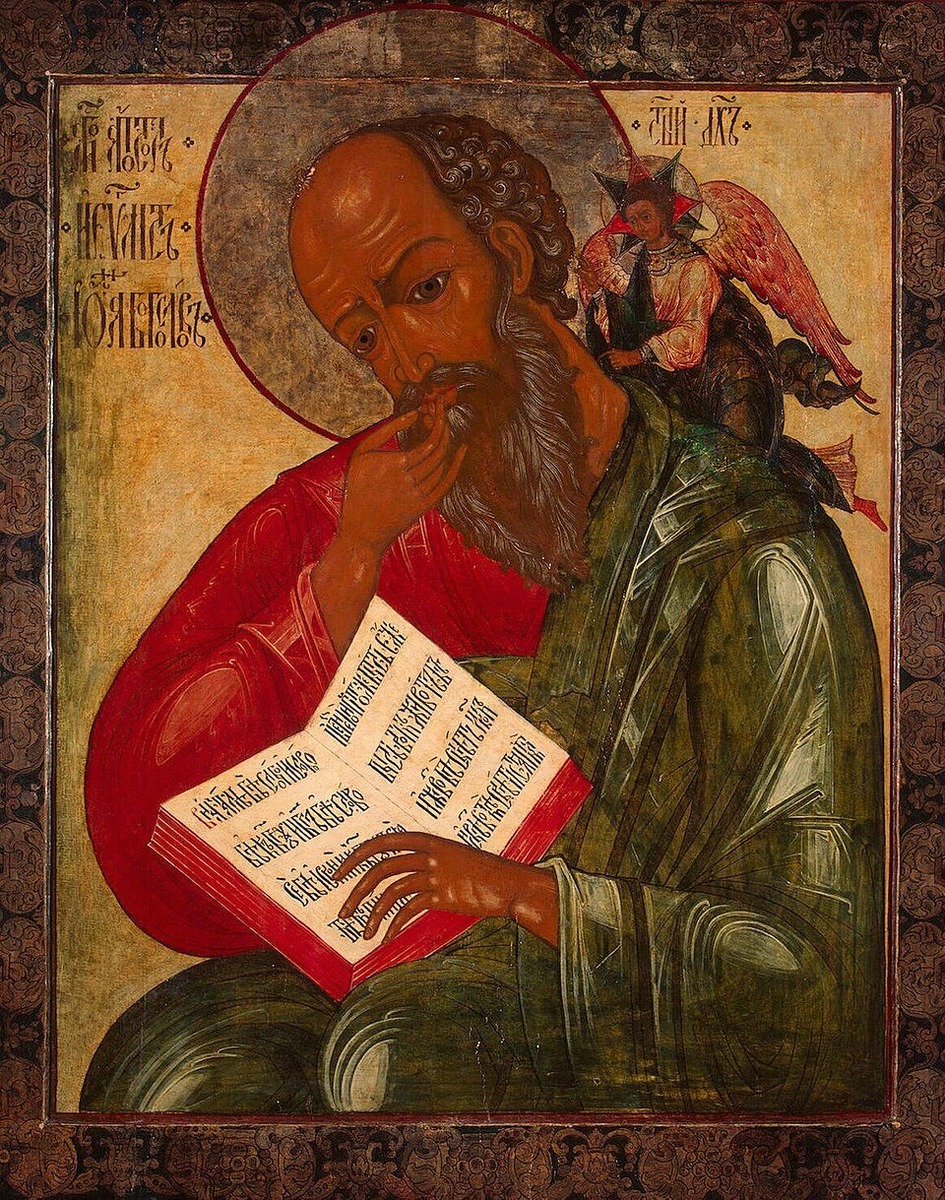
John is among the most frequently depicted saints in existence, with several fixed types. As apostle and evangelist he appears as an old man — high domed forehead, sparse white hair and beard — holding the book of his Gospel, often open at Ἐν ἀρχῇ ἦν ὁ Λόγος; as one of the Twelve he stands in every apostle-tier, festal image of Pentecost or the Ascension, and at the foot of every Crucifixion opposite the Theotokos, and he is a fixture of the extended Deesis row of the iconostasis. The narrative type — John in the cave of Patmos dictating to Prochorus, the apostle's head turned back over his shoulder to the segment of heaven — derives from the pseudo-Prochorus Acts and became the standard evangelist-portrait in Byzantine and Slavic Gospel books. The eagle, in the now-universal distribution of the four living creatures (Irenaeus's older scheme differed), is his symbol and sometimes accompanies him. A distinctively Russian type, "John the Theologian in Silence," shows the apostle with the fingers of one hand laid on his lips — the silence of the mystic before the mystery — while an angel (the Holy Spirit's wisdom) whispers at his shoulder and his other hand rests on the open Gospel. In Western art (rarely in Orthodox icons) he carries the poison chalice with the serpent.
The stored primary icon is a Russian "John the Theologian in Silence" of 1679 by the monk Nectarius Kulyuksin (Hermitage Museum). A second stored image is a Cretan icon of the early eighteenth century, John dictating to Prochorus at the cave of Patmos — Christ in glory above, an angel of inspiration at the apostle's ear, both figures identified by inscription — from the monastery of St John the Theologian at Anopoli, now in the St Catherine Collection, Heraklion (source, public domain, pd-old-work).
Disputed questions
- One John or several? The tradition of the Church identifies the son of Zebedee, the beloved disciple, the evangelist, the author of the three epistles, and the seer of Patmos as one man. The identification is as old as Irenaeus (c. 180), who had it through Polycarp, and is supported by Polycrates and Clement. But the questions are themselves ancient. Papias (as quoted by Eusebius) appears to distinguish the apostle John from "the elder (presbyter) John," another personal disciple of the Lord; Eusebius — who disliked the Apocalypse — seized on the distinction, noted the report of two tombs "of John" at Ephesus, and floated the presbyter as the seer of Revelation. Before him Dionysius of Alexandria (third century) had argued from style, vocabulary, and the author's self-naming that the Revelation could not be by the evangelist, while accepting it as the work of a holy and inspired John. Modern critical scholarship has extended every branch of the question: many scholars ascribe the Gospel to a "Johannine school" gathered around the beloved disciple, treat the epistles' "Elder" as possibly the presbyter, and regard the seer of Revelation as an otherwise unknown John of Asia; others continue to defend common authorship, and the linguistic gulf between the polished Gospel and the rugged Greek of the Apocalypse remains the crux it was for Dionysius. The Orthodox Church's liturgical tradition is untroubled and unambiguous: one John, apostle, evangelist, theologian, and seer, and this entry follows her usage while recording the debate.
- Did John die a martyr? A pair of late chroniclers (Philip of Side, George the Monk) cite Papias for the statement that John, like James, was "killed by Jews," and some modern critics — reading Mark 10:39 as a prophecy after the event — have argued for an early martyrdom. Against this stands the massive and much earlier Ephesian tradition (Irenaeus, Polycrates, Clement, Tertullian) of the apostle's peaceful end under Trajan, and the Church's whole liturgical memory. The martyrdom notice is generally judged a corruption or misquotation of Papias.
- The date of death and of Revelation. The synaxarion tradition gives the apostle more than a hundred years, dying at Ephesus "in the time of Trajan" (98–117) — conventionally c. 100, with some lines of the tradition reckoning as late as 104–107; hence his indexing here under the second century, though the first is arguable. The Revelation is dated by Irenaeus to "the end of Domitian's reign" (c. 95), the majority view ancient and modern; a minority tradition and some modern scholars place the exile and the vision under Nero (before 70).
- Salome's identity — daughter of Joseph the Betrothed (Byzantine synaxaria) or sister of the Theotokos (one Western reading of John 19:25) — is noted above; the traditions cannot both be true and neither can be verified.
- Not to be confused with the many other Johns of the calendar — among them John the Forerunner (whose conception is kept September 23), John the Faster of Constantinople (September 2), and John Chrysostom (November 13): "the Theologian" belongs to the apostle alone.