
Joseph of Arimathea
The Holy and Righteous Joseph of Arimathea, the Noble Counsellor, who buried the Lord
Myrrhbearer · Righteous · d. 1st century, in peace
Commemorated 31 July — Repose in peace of the noble Joseph, Pascha offset 14
Joseph of Arimathea is the rich and noble counsellor — εὐσχήμων βουλευτής — who alone of the Sanhedrin refused to consent to the condemnation of Christ, and who, when the Twelve had scattered, went in to Pontius Pilate and asked for the body of Jesus. All four Evangelists record him; the Church names him in every one of her Passion services. With Nicodemus he took the Lord down from the Cross, wound the body in clean linen with the spices, and laid it in his own new tomb, hewn in the rock in a garden beside Golgotha — the sepulchre from which Christ rose, and the holiest place in the Christian world. Tradition adds that he afterwards preached the Gospel and reposed in peace; the Church keeps his memory on July 31 and, with the myrrhbearing women and Nicodemus, on the movable Sunday of the Myrrhbearers.

Arimathea, and a counsellor of rank
Joseph takes his name from Arimathea (Ἀριμαθαία), which Saint Luke is careful to call "a city of the Jews" (Luke 23:51) — a note that suggests it was not well known to his Gentile readers. The name is the Greek form of the Hebrew Ramathaim, and the identification made from antiquity is with the Ramathaim-Zophim of the hill country of Ephraim, the town of Elkanah and Hannah and the birthplace of the prophet Samuel (1 Samuel 1:1). Eusebius and Jerome place it near Lydda-Diospolis, and the usual modern candidate is Rentis, north-east of Lydda in the Samarian foothills. Nothing in the Gospels says that Joseph still lived there; he owned a rock-cut tomb in a garden immediately outside the wall of Jerusalem, which is the property of a man settled and wealthy in the capital.
Saint Mark, the earliest witness, calls him εὐσχήμων βουλευτής (Mark 15:43) — literally "a counsellor of good standing," a man of rank and office. The Latin tradition rendered this nobilis decurio, from which comes his western title "the Decurion." Saint Luke says plainly that he was βουλευτής, "a counsellor," and that he was "a good man and just, who had not consented to their counsel and deed" (Luke 23:50–51). The Church has always understood this to mean a member of the Sanhedrin, the seventy-one elders and chief priests who sat in judgement on Jesus that night; and Luke's careful clause — οὐκ ἦν συγκατατεθειμένος τῇ βουλῇ καὶ τῇ πράξει αὐτῶν, "he was not one who had assented to their decision and their act" — is the earliest notice that the condemnation was not unanimous.
Saint Matthew calls him simply "a rich man of Arimathea, named Joseph, who also himself was Jesus' disciple" (Matt. 27:57). Saint John supplies the qualification that reconciles all four: he was a disciple "secretly, for fear of the Jews" (John 19:38) — of the same sort as Nicodemus, who had come to Jesus by night (John 3:2). Mark and Luke add a phrase that belongs to the language of the pious remnant rather than of a party: he was one who "waited for the kingdom of God."
The petition to Pilate
The Crucifixion took place on the Preparation, the day before a Sabbath that was itself a great feast, and the Law required that a body hanged on a tree should not remain overnight (Deuteronomy 21:23). The bodies of the crucified were the property of the magistrate who had ordered the execution, and Roman custom left them on the cross or threw them into a common pit. Someone had to ask, and to ask quickly.
Saint Mark's verb is the one the Church has never let go of: Joseph τολμήσας, "having dared," went in to Pilate and asked for the body of Jesus (Mark 15:43). The daring was real and of several kinds at once. He was a member of the very council that had procured the sentence, and was now publicly claiming the condemned man as his own; he was a Jew of rank presenting himself in the praetorium of a governor who had just been manoeuvred into a judicial murder he did not want; and by handling a corpse on the eve of the feast he made himself ritually unclean for the Passover. The secret disciple, at the hour when the open disciples had fled, became the public one. Saint John notes that Nicodemus came with him — "he who at the first came to Jesus by night" (John 19:39) — and the two members of the Sanhedrin who had not consented did together what the Twelve were not there to do.
Mark alone preserves the detail that Pilate marvelled that He was already dead, and summoned the centurion of the watch to certify the death before granting the corpse (Mark 15:44–45) — a passage the Fathers, and after them the whole apologetic tradition, took as the Roman state's own attestation that Jesus of Nazareth truly died. Pilate then "gave the body to Joseph."
The taking-down and the burial
Joseph bought fine linen — σινδών (Mark 15:46) — and the two men took the body down from the Cross. The moment is the Ἀποκαθήλωσις, the Taking-Down, and it is the visual and liturgical centre of Great Friday in the Orthodox Church: the Vespers of that afternoon are called the Vespers of the Taking-Down, and the epitaphios is carried out during the singing of the very apolytikion that names Joseph.
Nicodemus brought a great weight of myrrh and aloes, about a hundred pound (John 19:39), and together they wound the body in the linen cloths with the spices, "as the manner of the Jews is to bury" (John 19:40). "In the place where He was crucified there was a garden; and in the garden a new sepulchre, wherein was never man yet laid" (John 19:41). Saint Matthew says that the tomb was Joseph's own, "which he had hewn out in the rock," and that he rolled a great stone to the door and departed (Matt. 27:60). The nearness of the tomb and the imminence of the Sabbath dictated the haste — "there laid they Jesus therefore because of the Jews' preparation day; for the sepulchre was nigh at hand" (John 19:42) — and it is that haste which brings the myrrhbearing women back on the first day of the week to finish the burial rites, and so to the empty tomb.
The Church reads this burial as prophecy fulfilled. Isaiah had said of the Servant that "He made His grave with the wicked, and with the rich in His death" (Isaiah 53:9); the rich man of Arimathea is that clause. The hymnography also dwells on the reversal by which the one who possessed nothing is buried in another man's grave, and on the honour that a borrowed sepulchre did to the Lord of glory. The presence of the Mother of God and the myrrhbearing women, who "beheld where He was laid" (Mark 15:47), is part of the same account and is the ground of the joint commemoration on the Sunday of the Myrrhbearers.
The tomb
The sepulchre Joseph gave is not a lost place. The rock-cut chamber in the garden outside the second wall was enclosed within the city by Herod Agrippa's third wall a decade later, buried under the platform of Hadrian's forum, and uncovered again under Constantine in 325–326, when the rock around it was cut away and the Church of the Anastasis built over it. The Edicule in the rotunda of the Holy Sepulchre encases what survives of it. Behind the Edicule, in the west apse, is a rock-cut chamber with kokhim burial shafts of the Second Temple period, kept by the Syriac Orthodox and known from at least the crusader period as the Tomb of Joseph of Arimathea — pointed out to pilgrims as the burial place he made for himself and gave away.
Later traditions and the question of Britain
The canonical record ends at the stone. What follows is tradition, of unequal weight.
The eastern account is the briefest and the oldest. The Synaxarion of Constantinople says of him under this day only that Joseph of Arimathea, ὁ κηδευτὴς τοῦ Δεσπότου Χριστοῦ — "he who buried Christ the Master" — reposed in peace. Nothing more: no journey, no martyrdom, no country. The Greek books have never claimed more for him than that.
The apocryphal Passion literature gives him a sequel. In the Acts of Pilate, the eastern core of what became the Gospel of Nicodemus, the Jewish authorities seize Joseph for having buried the body and shut him up in a windowless room under seal; when the room is opened after the Sabbath he is gone, and he is afterwards found at Arimathea and relates that the risen Christ Himself came to him at midnight, raised him up and led him out. A separate late Greek text, the Narrative of Joseph of Arimathea, elaborates the same material around the two thieves. These are devotional legends of the third to fifth centuries, not history, but they circulated very widely in Greek, Latin, Coptic, Syriac and Slavonic, and much of the later Joseph tradition grows out of them.
The western tradition is later still and much larger. From the twelfth and thirteenth centuries the abbey of Glastonbury claimed that Joseph, sent by the Apostle Philip, came with twelve companions to Britain, received the isle of Avalon from a British king, built a wattle church there in honour of the Mother of God, and died and was buried on the spot; the flowering Glastonbury Thorn, said to have sprung from his staff, was the sign of it. The claim is absent from William of Malmesbury's original account of the abbey (c. 1129) and appears in the interpolations made to it after the fire of 1184; it is entwined from the first with Robert de Boron's Joseph d'Arimathie (c. 1200) and the Grail romances, in which Joseph becomes the keeper of the vessel of the Last Supper and of Christ's blood. Late-medieval English diplomacy pressed the legend seriously — at the councils of Constance and Basel the English delegation argued precedence over France and Spain on the ground that Britain had received the faith from Joseph in the first century. The relics claimed by Moyenmoutier in Lorraine belong to the same family of claims.
Modern Orthodox lives, including the widely used American synaxarion of the Orthodox Church in America, repeat that Joseph "preached the Gospel and reposed in England." This is the western legend received into an eastern calendar, and it is worth naming as such rather than treating it as the memory of the Church.
Feast and commemoration
July 31 (church date; New Calendar civil July 31, Old Calendar civil August 13) is Joseph's fixed commemoration, entered in the Greek Menaion and the Slavonic books alike as the day of his repose in peace. It is not the day on which the Church chiefly honours him, and it carries no festal office: the day belongs liturgically to the forefeast of the Procession of the Cross and to Eudocimus of Cappadocia, who has the canon and the apolytikion, and Joseph is a synaxarion notice beneath them.
His great commemoration is movable: the Sunday of the Myrrhbearers, the third Sunday of Pascha (14 days after Pascha), on which the Church keeps together "the holy myrrhbearing women, and the noble Joseph, and Nicodemus, who buried the Lord." That feast has no fixed date, is recorded here in movable_feasts, and is listed under its rule and not under this day.
Beyond the calendar altogether, Joseph is named in the services of every Great Friday and Holy Saturday in the Orthodox world, in the apolytikion of the Taking-Down and throughout the Lamentations. This makes him one of a very small number of saints whom the whole Church addresses by name every single year in the most solemn services she has, quite apart from any feast of his own. July 31 falls in the last day of the open season before the Dormition Fast, which begins on August 1.
Hymns
Apolytikion — Tone 2
The noble Joseph, taking down Thy most pure body from the tree, wrapped it in clean linen with sweet spices, and laid it in a new tomb.
Kontakion — Tone 2
Thou didst say "Rejoice" to the myrrhbearing women, and didst still the lamentation of the foremother Eve by Thy Resurrection, O Christ God; and Thou didst bid Thine apostles preach: The Saviour is risen from the grave.
Original translation from the Greek
Iconography
Joseph is painted as an elderly man of rank, grey- or dark-bearded and balding, in a long tunic and a full mantle of a rich colour, without the philosopher's or the priest's marks — the dress of a wealthy layman of standing. He almost never appears alone. His three standing scenes are the three moments of the Gospel account, and they run in sequence through the Passion cycle of every painted church:
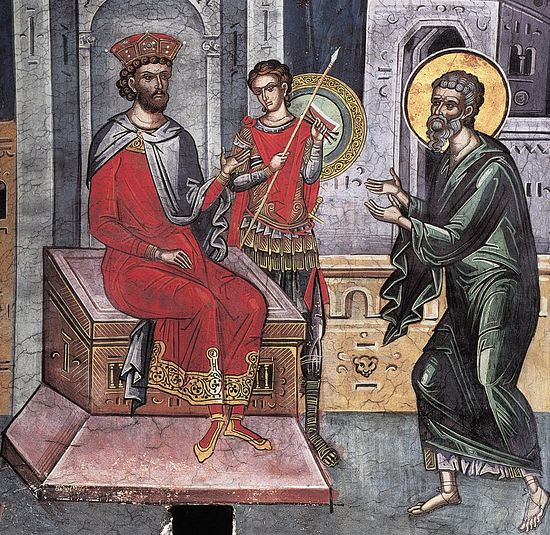
- Joseph before Pilate, asking for the body: the governor enthroned with a soldier at his shoulder, and Joseph before him with hands extended in petition — the image stored here.
- The Taking-Down from the Cross (Ἀποκαθήλωσις): Joseph on a ladder against the Cross, receiving the body into his arms, while Nicodemus draws the nails from the feet with pincers and the Mother of God takes the Lord's hand.
- The Entombment (Ἐνταφιασμός) and the Lamentation (Θρῆνος): Joseph at the head or the feet of the shrouded body, lowering it to the stone of unction or into the rock tomb. This is the composition embroidered on the epitaphios carried in procession on Great Friday, so that his figure is present in nearly every Orthodox church in the world.
He is very often shown holding a white winding-sheet as his attribute, and in the Taking-Down he is the one whose hands actually bear the weight of the body — an iconographic point the hymns press: what the seraphim dare not gaze on, these hands carried down. In western art from the thirteenth century onward he acquires a chalice or cruets, from the Grail legend; this attribute is unknown to Orthodox iconography.
The stored image is a Byzantine fresco of the fourteenth to sixteenth century showing Joseph before Pilate: Pilate seated in imperial red on a jewelled throne, a spear-bearing guardsman behind him, and at the right the haloed Joseph in a green mantle, barefoot, both hands open in entreaty.
Disputed questions
- Did he go to Britain? The Glastonbury story has no support before the late twelfth century, no eastern attestation at all, and a demonstrable interest behind it: an abbey rebuilding after a catastrophic fire and a kingdom arguing for precedence at a general council. Bede, who gathered everything he could find on the origins of British Christianity, knows nothing of it. The Greek synaxarion's flat "reposed in peace" is both earlier and more modest, and this collection follows it, recording the British tradition as tradition.
- Was he of the Sanhedrin? Βουλευτής can in principle mean a member of any council. The unanimous reading of the Fathers, and the force of Luke's "he had not consented to their counsel and deed," support the Sanhedrin; a minority of modern commentators leave it open.
- Joseph and Nicodemus. They are named together in John's burial account and are honoured together on the Sunday of the Myrrhbearers, and the pairing is so strong that some later synaxaria join their fixed feasts. In fact the eastern calendar separates them: Joseph is kept on July 31, and Nicodemus on August 2, with the finding of his relics together with those of the Protomartyr Stephen, Gamaliel and Abibus at Kaphargamala in 415.
- Not to be confused with Joseph the Betrothed, the guardian of the Theotokos; with Joseph called Barsabbas Justus, put forward with Matthias for the apostolic lot (Acts 1:23); or with the Old Testament patriarch Joseph the All-Comely, whose memory is kept on Great and Holy Monday. The confusion is old and is helped by the fact that Joseph the Betrothed is likewise commemorated on a movable Sunday.