
Joshua son of Nun
The Righteous Joshua the Son of Nun
Righteous · d. traditionally aged 110
Commemorated 1 September
Joshua son of Nun (in the Greek of the Septuagint and the Byzantine service books, "Jesus son of Nave") was the servant and successor of Moses who led Israel across the Jordan into the promised land, before whom the walls of Jericho fell and the sun stood still at Gibeon. The Orthodox Church venerates him among the righteous of the Old Covenant and reads him as a type of Christ, whose name he bears; his commemoration on September 1 stands at the opening of the church year.

In the Scriptures
Joshua appears first as Hoshea son of Nun, of the tribe of Ephraim, renamed Yehoshua ("the Lord saves") by Moses (Numbers 13:16). From his youth he was Moses' attendant: he commanded Israel in the battle against Amalek at Rephidim while Moses held up his hands in prayer (Exodus 17), accompanied Moses on the ascent of Sinai, and kept watch at the tent of meeting. Sent with the twelve to spy out Canaan, he and Caleb alone returned trusting that God would give Israel the land, and of that whole generation they alone lived to enter it (Numbers 13–14).
Commissioned by Moses at God's command and "full of the spirit of wisdom, for Moses had laid his hands upon him" (Deuteronomy 34:9), Joshua led Israel across the Jordan — the waters standing in a heap as the priests bore the ark into the riverbed — and kept the first Passover in the land at Gilgal. Before Jericho he was met by a man with drawn sword who named himself "commander of the army of the Lord," before whom Joshua fell to the ground and was bidden, like Moses at the bush, to remove his sandals (Joshua 5:13–15). At his obedience to the divine command Jericho's walls collapsed after the sevenfold procession of the ark; in the battle for Gibeon he spoke the famous word, "Sun, stand thou still upon Gibeon," and the day was prolonged (Joshua 10). After the conquest he divided the land among the tribes by lot, and at Shechem, in his old age, he renewed the covenant with the words the Church still makes her own: "Choose you this day whom ye will serve... but as for me and my house, we will serve the Lord" (Joshua 24:15). He died at a hundred and ten years and was buried in his inheritance at Timnath-serah in the hill country of Ephraim.
In the tradition of the Church
The Fathers read Joshua above all through his name, which in Greek is simply Ἰησοῦς — Jesus. As Moses, representing the Law, could bring Israel only to the border of the promise, it was Jesus/Joshua who led the people through the waters (a figure of baptism) into the land of rest — the argument made explicitly in Hebrews 4. The "commander of the army of the Lord" who appeared before Jericho is identified in Byzantine tradition with the Archangel Michael, and the scene became a standard subject of iconography, especially beloved in warrior-princely contexts. Joshua's halting of the sun was cited by the Fathers as the clearest proof that the prayer of the righteous commands even the created order.
Feast and commemoration
September 1 (church date; Old Calendar civil September 14), among the commemorations that open the church year. Joshua has no separate proper service; he is commemorated within the service of September 1 and again among the Holy Fathers and Forefathers in the pre-Nativity Sundays' remembrance of the righteous of the Old Covenant. No proper troparion or kontakion is appointed to him in the received Menaion.
Iconography
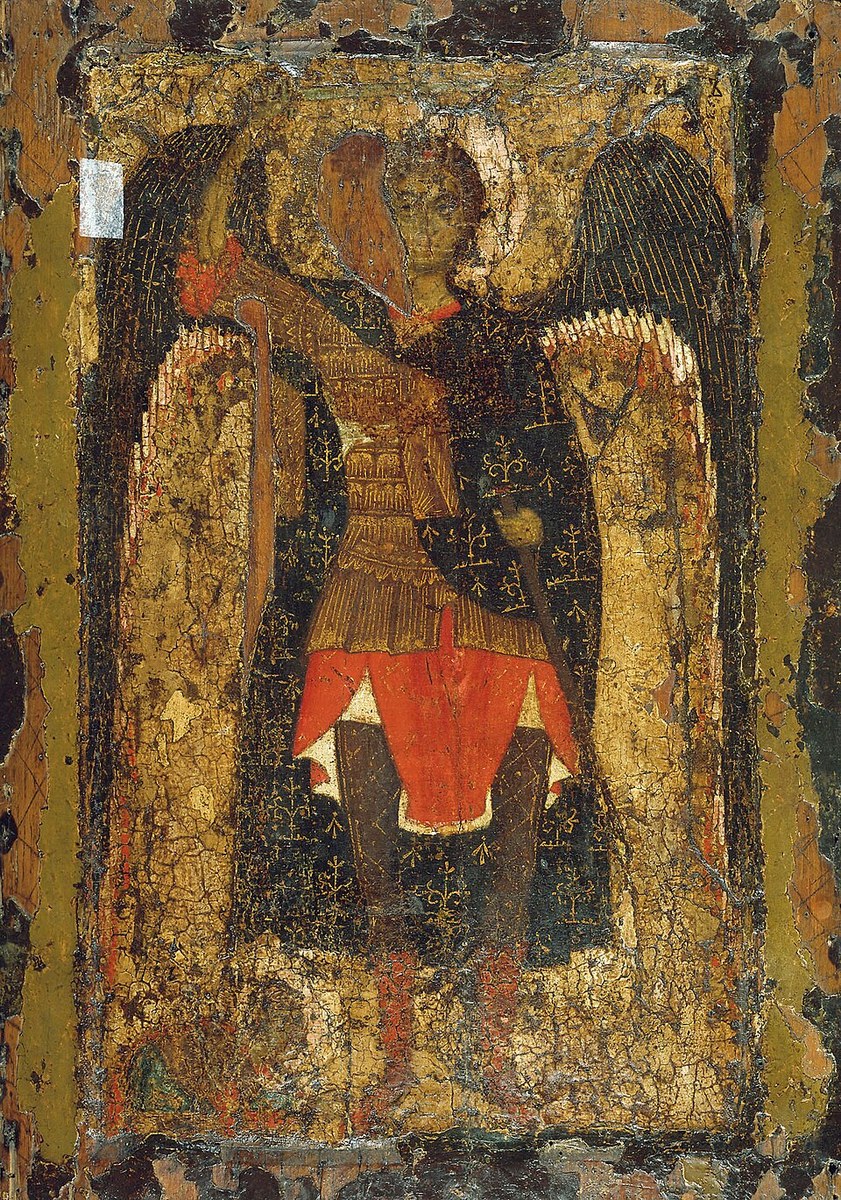
Joshua is depicted as a young or middle-aged warrior in armour, often bareheaded, in the scene most frequent in Orthodox art: kneeling to unloose his sandal before the Archangel Michael, the commander of the heavenly host, before Jericho. The stored icon is the celebrated early thirteenth-century icon (c. 1210) of the Archangel Michael appearing to Joshua.
Disputed questions
- Dating. The conquest of Canaan is placed by differing chronologies anywhere from the fifteenth to the thirteenth century BC; the traditional Byzantine world-era chronology gives its own reckoning. The frontmatter records the later conventional dating; no precision is possible.
- Why September 1. The connection of Joshua's memory with the Indiction is ancient but variously explained — most commonly, that the new year of the church recalls the entry into the promised inheritance.