
Julian and Basilissa
The Holy Martyrs Julian and Basilissa and Those with Them
Venerable Martyr · Martyr · d. early 4th century, at Antinoë in Egypt
Commemorated 8 January — Martyrdom of Julian and his companions; kept within the afterfeast of the Theophany
Julian and Basilissa were a married couple of Antinoë in Egypt who, by mutual consent, lived together in perpetual virginity and, on the death of their parents, gave their wealth to found two monasteries — one for men under Julian, one for women under Basilissa. Basilissa reposed in peace after guiding her sisters; Julian remained, and in the persecution of the early fourth century he was arrested, tortured, and beheaded, together with a company won to Christ through his constancy: the youth Celsus (son of his persecutor), Marcionilla the boy's mother, the priest Anthony, a converted pagan baptised Anastasius, seven young brothers, and twenty soldiers. They are commemorated together on January 8, within the afterfeast of the Theophany.
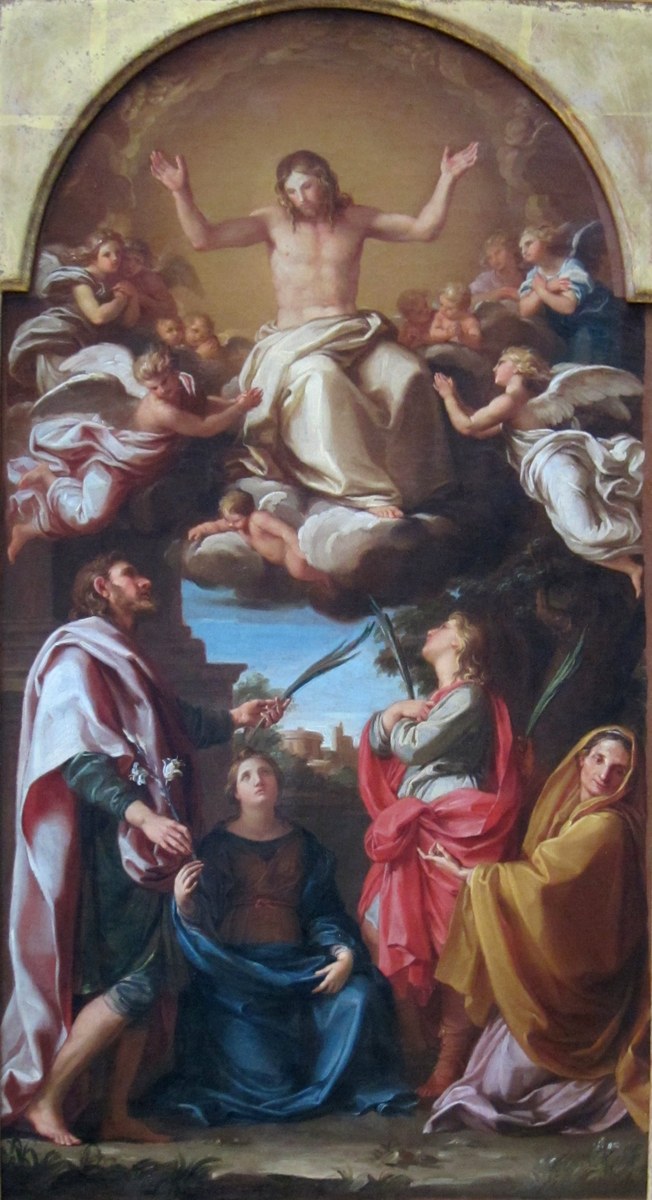

Julian and Basilissa of Antinoë
Julian was born of Christian parents at Antinoë (Antinoöpolis), a city of the Thebaid in Upper Egypt. To satisfy his parents he consented to marry, and was joined to Basilissa, a maiden of a noble and wealthy house; but, according to the Passio, the two agreed on their wedding night to keep their virginity untouched and to live as brother and sister in the service of Christ. On the death of their parents they used their inheritance not for themselves but for God, establishing two monastic communities — Julian gathering and guiding a company of men, Basilissa a company of women. Basilissa laboured to bring her sisters safely through a time of persecution and, her task complete, reposed in peace; the calendars therefore honour her among the day's saints though she did not die by the sword.
The martyrdom of Julian and his companions
Julian outlived his wife and met the persecution head on. Arrested under the provincial authority — the Passio names the governor Marcian (Marcianus) — he was subjected to prolonged and cruel tortures for his confession of Christ. His steadfastness under torment became the seed of a whole harvest of martyrs. The governor's own son, the boy Celsus, moved by Julian's endurance, confessed Christ; his mother Marcionilla (Marionilla) followed; the priest Anthony baptised the converts; and a dead pagan, restored to life at the saint's prayer, was baptised under the name Anastasius, "the risen." With them the Passio numbers seven young brothers and a guard of twenty soldiers who came to faith. Cast into prison and then brought out, they were all beheaded by the sword and received the crown together. The tradition places their death in the early fourth century, in the age of Diocletian's persecution.
Feast and commemoration
The company is commemorated on January 8 (church date; Old Calendar civil January 21), within the afterfeast of the Theophany, together with the day's venerables and confessor. The Greek and Slavic Menaia keep them on this day (the Slavic books enumerating Julian, Celsus, Anthony, Anastasius, Basilissa, Marcionilla, the seven youths, and the twenty soldiers); the Western martyrologies keep a feast of Julian and Basilissa on January 9. Their office is that of martyrs, sung under the hymns of the afterfeast of the Baptism.
Hymns
Troparion — Tone 4
Thy Martyrs, O Lord, in their contest received imperishable crowns from thee our God; for possessed of thy strength, they cast down the tyrants and shattered the feeble insolence of the demons. By their supplications, O Christ our God, save our souls.
Original translation from the Greek
Iconography
Julian and Basilissa are shown together as a youthful married pair in the dress of Egyptian monastics or nobles, each crowned as a martyr and often holding a cross; in narrative scenes Julian is depicted at his beheading, or baptising his converts, or amid the company of Celsus, Marcionilla, and Anthony. The stored image is a Western work, not a Byzantine icon: the altarpiece of Pompeo Batoni (1736–1738, now in the Getty Museum), Christ in glory above the whole company of the acts — Julian with the martyr's palm, Basilissa veiled at the right, the young Celsus and his mother Marcionilla between them. It is stored under the ruling that admits Western works for saints with no located Eastern image (the project's record of open questions); an Orthodox icon of the pair remains wanted and is listed among the upgrade-wanted icons.
Disputed questions
The Passio of Julian and Basilissa is a hagiographic romance of uncertain historical value, and the details of the companions and their number vary in the manuscripts; the martyrdom of a Julian at Antinoë in Egypt is the constant core. The date is transmitted loosely as "under Diocletian" — some notices give the year 313, which sits awkwardly beside the peace of the Church in that year, and the persecution is better placed a decade earlier (c. 303–305); the entry gives the century rather than a precise year. Basilissa's inclusion among the martyrs of the day, though she reposed in peace, follows the calendars' practice of keeping the whole company together on the one feast.