
Kyranna of Thessalonica
The Holy New Martyr Kyranna of Thessalonica
New Martyr · Virgin · b. c. 1720s, at Ossa near Thessalonica — d. 1751, at Thessalonica
Commemorated 28 February — Martyrdom in prison at Thessalonica in 1751
Kyranna (†1751) was a young Greek woman of the village of Ossa (in Turkish Vysoka), in the region of Langadas near Thessalonica, who suffered martyrdom under the Ottoman yoke for her refusal to renounce Christ or to marry a Turk. Beautiful, devout, and steadfast, she was pursued by a Janissary — the local tax-collector — who, unable to win her by persuasion or threats, falsely accused her before the Turkish judge at Thessalonica of having promised to embrace Islam. Before the court Kyranna denied the lie and confessed herself a Christian. Cast into prison and cruelly beaten day after day at her persecutor's bidding, she gave up her soul under the torments on the night of February 28, 1751, and a heavenly light was seen to shine over her body. The Church honours her as a new-martyr and a virgin, on the day of her death.
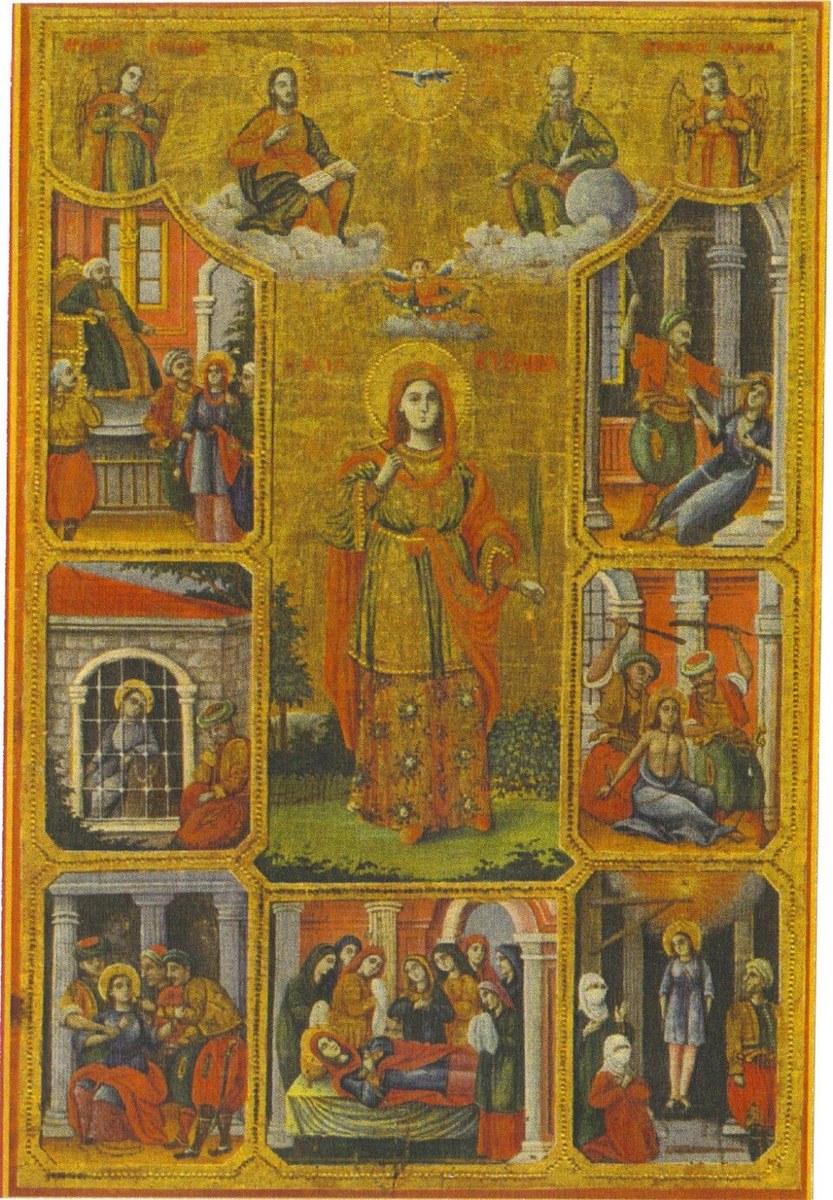

Kyranna belongs to the great company of the New Martyrs — the Orthodox Christians who, under Turkish rule, sealed their faith with their blood rather than deny Christ or accept Islam, and whose witness sustained the enslaved nations of the Balkans through the centuries of the Ottoman yoke. Her martyrion was recorded in the eighteenth century and gathered into the collections of the New Martyrs.
The maiden of Ossa
Kyranna was born in the first half of the eighteenth century in the village of Ossa, called by the Turks Vysoka, in the fertile country of Langadas to the northeast of Thessalonica. She was reared by pious Christian parents in the fear of God, and grew into a young woman marked, the tradition says, as much by her modesty, industry, and virtue as by her natural beauty. She lived quietly, labouring and keeping herself unspotted from the world.
The Janissary's pursuit
Her beauty drew upon her the desire of a Janissary stationed in the village — by the account, the collector of the imperial taxes — who conceived a violent passion for her and determined to make her his wife. Because a marriage between a Muslim and a Christian could go forward only if she embraced Islam, his suit was also a demand of apostasy; and Kyranna refused him utterly and without wavering, neither his promises nor his threats moving her from her faith and her chastity. Enraged at being scorned, the Janissary resolved to compass by force and fraud what he could not gain by courtship. He went before the Turkish judge at Thessalonica and swore falsely that Kyranna had agreed to become a Muslim and to marry him, and now went back on her word — a charge that, under Ottoman law, put her life in his enemies' hands.
Confession and martyrdom
Brought before the court, Kyranna denied the lie to his face and openly confessed Christ, declaring that she was born a Christian and would die one, and that no torment could make her deny her Lord or give herself to her accuser. For this confession she was thrown into prison. There the Janissary, by bribes to the guards, had her beaten and tortured without respite, day after day, to break her will; but she endured every blow with patience, praying and giving thanks, and would not yield. At last, worn out by the ceaseless cruelty, she died of her sufferings in the prison on the night of February 28, 1751 — a martyr in all but the final stroke, killed by the long torture her faith had drawn upon her. The tradition relates that at the hour of her death a heavenly light shone about her body in the cell, so that even the Turkish guards were struck with awe; and the Christians took up her holy remains and buried them with honour. She was at once acclaimed a new-martyr of Christ.
Feast and commemoration
Kyranna is commemorated on February 28 (church date; New Calendar civil February 28; Old Calendar civil March 13), the day of her repose in prison. Her veneration is centred in the Greek Church, and especially in her own country of Langadas and Thessalonica, where her memory is cherished as that of a local new-martyr and a heavenly patroness. A proper akolouthia (liturgical service) has been composed in her honour; because it survives only in modern, copyrighted form, its hymns are not reproduced here, and the common of a woman martyr is given below instead — a fresh translation from a public-domain original in the standard service to a woman martyr. A translation of her proper hymns from any public-domain source is owed to a later pass.
Hymns
Troparion — Tone 4
Thy ewe-lamb, O Jesus, crieth out with a loud voice: Thee, O my Bridegroom, do I love, and seeking Thee I contend, and I am crucified and buried together with Thee in Thy baptism; I suffer for Thy sake, that I may reign with Thee; I die for Thee, that I may live in Thee: accept me, offered unto Thee in longing as a spotless sacrifice. At her prayers, O Merciful One, save our souls.
Original translation from the Greek
Iconography
Kyranna is depicted as a young woman in the dress of an eighteenth-century Greek maiden, holding the cross of martyrdom and often the martyr's palm, sometimes with the prison and the heavenly light of her death indicated behind her. The stored image is a nineteenth-century icon of the saint preserved in the Holy Metropolis of Langadas, Lete and Rentina — the church of her own country (source, public domain, pd-old-work).