
Lazarus of Murom
Our Venerable Father Lazarus of Murom, Wonderworker of Lake Onega
Venerable · Wonderworker · b. c. 1286, at Constantinople — d. 8 March 1391, at the Murom monastery on Lake Onega
Commemorated 8 March — Repose at the Murom monastery on Lake Onega
Lazarus of Murom (c. 1286 – 1391) was a Greek monk from Constantinople who became one of the first apostles of monasticism in the far Russian North. Sent, by the tradition, from the imperial city into the lands of Novgorod, he received the blessing of the archbishop Basil Kalika and withdrew to a wild, uninhabited island on the eastern shore of Lake Onega, in the Olonets country, where about the middle of the fourteenth century he founded the Murom (Muromsky) Monastery — one of the oldest religious houses of the Russian North. There he endured great hardship among the pagan Lop and Chud of the region, whom he converted to Christ by his patience and his miracles, and he gathered a brotherhood about him. He reposed, the tradition says, at the great age of a hundred and five, on March 8, 1391. The little wooden church of the Raising of Lazarus he is said to have built with his own hands survives to this day — removed to the island of Kizhi — as the most ancient wooden temple of the Russian North.

From Constantinople to Novgorod
Lazarus was, by the received tradition, a Greek of Constantinople, born about the year 1286 and formed in the monastic life of the Byzantine East. He is said to have been sent northward — the accounts variously connect him with the bishop Basil of Caesarea and with a Greek monastery — into the lands of Novgorod the Great, then at the height of its northern dominion, arriving in the reign of the archbishop Basil Kalika (1330–1352). Received and blessed by that hierarch, Lazarus was drawn not to the city but to the wilderness, and set out into the sparsely peopled forests and lakes of the Olonets country, the watershed between Novgorod's world and the White Sea.
The founding of the Murom monastery
He settled at last on a remote, uninhabited peninsula (or island) on the eastern shore of Lake Onega, called Murom (Muromsky) — not the ancient city of Murom on the Oka, but a place of the northern lakes — where, about the year 1350, he built a cell and a small wooden church and began the Murom Monastery, dedicated to the Resurrection of Lazarus (whose name he bore) and to the Dormition of the Mother of God. The beginnings were of the hardest: the land was held by the pagan Lop (Lapps) and Chud, who resented the newcomer and, the tradition holds, harried and threatened him and sought to drive him out. Lazarus met their hostility with patience and prayer, and — as the northern vitae love to tell — overcame it by miracles: the healing of a chieftain's blind child is remembered as the sign that turned the people, so that many of them received baptism, and some took the monastic habit and joined his brotherhood. From this beginning the monastery grew into one of the oldest and most venerable houses of the Russian North, a mother of the northern monastic colonisation that would fill those forests with hermitages in the generations after him.
Repose
Lazarus governed his house into extreme old age and, having appointed a successor, reposed on March 8, 1391, at the age — the tradition insists — of one hundred and five years. He was buried at the monastery he had founded, where his relics were kept and honoured, and his memory was carried in the Russian North as that of its Greek founder-father. (Some notices give his repose as 1343; the received date is 1391.)
Veneration and the church at Kizhi
The Murom monastery preserved the memory and the relics of its founder through the centuries. Its greatest surviving treasure — and the most tangible link to Lazarus — is the tiny wooden church of the Raising of Lazarus (Voskreshenie Lazarya), which the tradition ascribes to the saint's own hands and reckons the oldest wooden church in the Russian North. In 1959 it was carefully dismantled and removed for preservation to the open-air museum on the island of Kizhi in Lake Onega, where it stands among the famous wooden churches of the North — a relic of the founder venerated in its own right. Lazarus is commemorated in the Russian Church (and by the Orthodox Church in America) on March 8, together with his monastery's later abbot Athanasius of Murom.
Feast and commemoration
Lazarus is kept on March 8 (church date; New Calendar civil March 8; Old Calendar civil March 21), the day of his repose, as a local commemoration of the Russian Church and of the Orthodox Church in America; the day commonly falls within Great Lent, on whose weekdays no fixed Epistle and Gospel are appointed. He is remembered together with Athanasius of Murom, the abbot who laboured at his monastery in the following century, and stands among the venerable founders of the monasticism of the Russian North.
Hymns
Troparion — Tone 8
In thee, O Father, was the divine image kept secure; for taking up the Cross thou didst follow Christ, and by thy deeds thou didst teach us to despise the flesh, which passeth away, and to care rather for the soul, a thing immortal; wherefore thy spirit, O venerable Lazarus, rejoiceth with the Angels.
Original translation from the Slavonic
Iconography
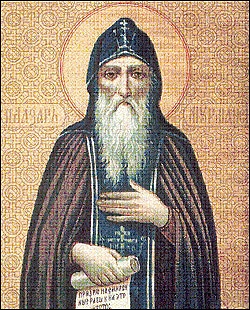
Lazarus is depicted as a venerable monk of the Russian North: an aged, white-bearded elder in the monastic mantiya and schema, holding a scroll or a cross, sometimes shown against his monastery and the waters of Lake Onega, or with the little wooden church he built. The stored image is a nineteenth-century Russian icon (c. 1850) of the saint alone — the founder-elder of Murom in the settled type of a northern venerable (source, public domain, pd-old-work).