
Leo of Catania
Our Father among the Saints Leo the Wonderworker, Bishop of Catania
Bishop · Wonderworker · b. c. 703, at Ravenna — d. c. 780, at Catania
Commemorated 20 February — Repose at Catania
Leo the Wonderworker (c. 703 – c. 780) was bishop of Catania in Sicily, an island then still within the Byzantine Empire. Born at Ravenna of noble and pious parents and renowned from youth for his charity to the poor and to strangers, he was ordained at Ravenna, served as archdeacon at Reggio in Calabria, and was called to the see of Catania, which he governed with such gentleness and generosity that the whole island honoured him. The tradition remembers him above all as a wonderworker who healed the sick, and for his victory over the sorcerer Heliodorus — a baptized Catanian turned magician, whose public bewitchments had long defied and mocked the Church. When at last Heliodorus disrupted the very Liturgy, Leo bound him with his omophorion, led him into a great fire, and stood praying within the flames unharmed while the sorcerer was reduced to ashes, so that all glorified God. He reposed in peace on February 20 and was buried in a church he had built at Catania, where his relics gave healing. He is not to be confused with Leo the Great of Rome (February 18).

Origins and early life
Leo was born about the year 703 at Ravenna, the seat of the Byzantine exarchate in Italy, of parents described as both noble and devout. From his youth he was marked by a love of the poor, of widows, orphans, and wandering strangers, on whom he spent what he had; and by a purity and gravity of life that drew the Church's notice. Completing his studies, he was ordained to the priesthood at Ravenna, and afterward went south to Reggio in Calabria, where the bishop — the tradition names him Cyril — made him archdeacon, entrusting to him the care of the church's charity and worship.
Bishop of Catania
When the see of Catania, at the foot of Mount Etna in eastern Sicily, fell vacant, Leo was chosen for it — the hagiography adds the pious detail that the Catanians were led to him by a revelation, an angel directing their search to the man of God at Reggio. He accepted the charge reluctantly and governed the church for some years (his episcopate is placed from about 765) in the same spirit that had marked his priesthood: unstinting almsgiving, care for the destitute and for travellers, and a reputation for holiness that made him beloved through Sicily. Sicily in his day was a Greek-speaking province of the Byzantine world, and his memory passed early and firmly into the Greek calendars; his was the age of the Iconoclast emperors, and the later Sicilian tradition remembers him as one who did not bend to the imperial war on the holy images, though the Byzantine Life dwells rather on his miracles than on any confession under persecution.
The sorcerer Heliodorus
The event for which Leo is chiefly remembered, and which fills the Byzantine Life, is his contest with Heliodorus. Heliodorus was a Catanian who had been baptized a Christian but apostatized, giving himself — the account says — to a demonic pact and to the arts of magic, which he had learned from a sorcerer. By these he worked a long train of public deceptions upon the city: he made men see gold and silver that turned in their hands to stones and shells, threw the markets and the baths into confusion, seemed to transport himself from place to place, and mocked openly at the faith and at its bishop. Twice, the tradition relates, he was summoned to Constantinople to answer for his sorceries before the emperors, and twice escaped their justice by his arts, returning to trouble Catania as before.
Leo bore long with him, praying and warning; but when at last Heliodorus dared to enter the church and to disturb the Divine Liturgy itself with his enchantments, the bishop rose from the altar, went to him, and — with the omophorion from his own shoulders — bound the sorcerer fast about the neck. Leading him out of the church to a fire that stood ready (the Life sets it at the public baths), Leo stepped with him into the midst of the flames and there stood, holding Heliodorus and praying, until the sorcerer was wholly consumed to ashes; and Leo came forth from the fire unharmed, his vestments untouched and shining, so that the whole people, seeing the power of Christ over the powers of darkness, glorified God. The Church keeps the miracle as the sign of Leo's sanctity — the meek almsgiving bishop shown mightier than all the arts of the enemy — and his iconography and hymnography both turn upon it.
Repose, relics, and miracles
Leo continued to the end of his life to heal the sick and to work wonders, and reposed in peace at Catania on February 20, about the year 780 (the Western Sicilian tradition gives 789). He was buried in a church of the Most Holy Theotokos — by other accounts the church of Saint Lucy — which he had himself built within the city, and his tomb became a source of healings, so that the epithet Thaumaturgus, "the Wonderworker," attached to his name and has never left it. He is honoured as a patron of several Sicilian towns, and in the West is kept, like the East, on February 20.
Feast and commemoration
Leo is kept on February 20 (church date; Old Calendar civil March 5), the day of his repose, universally — in the Greek, Slavic, and Antiochian calendars — and on the same day in the Roman calendar of Sicily. The Menaion for the day appoints his office, with the proper kontakion translated below; the falling of the feast within Great Lent in most years means the office is sung with the Lenten Triodion.
Hymns
Troparion — Tone 4
The truth of thy deeds revealed thee to thy flock as a rule of faith, an image of meekness, and a teacher of temperance; therefore by humility thou hast gained the heights, and by poverty riches. O Father and Hierarch Leo, intercede with Christ our God that our souls may be saved.
Original translation from the Greek
Kontakion — Tone 6
Him who from infancy was dedicated to the Lord, and from his swaddling-clothes received grace, let us all crown with hymns — Leo, the luminary and champion of the Church; for he is her firm support.
Original translation from the Greek
Iconography
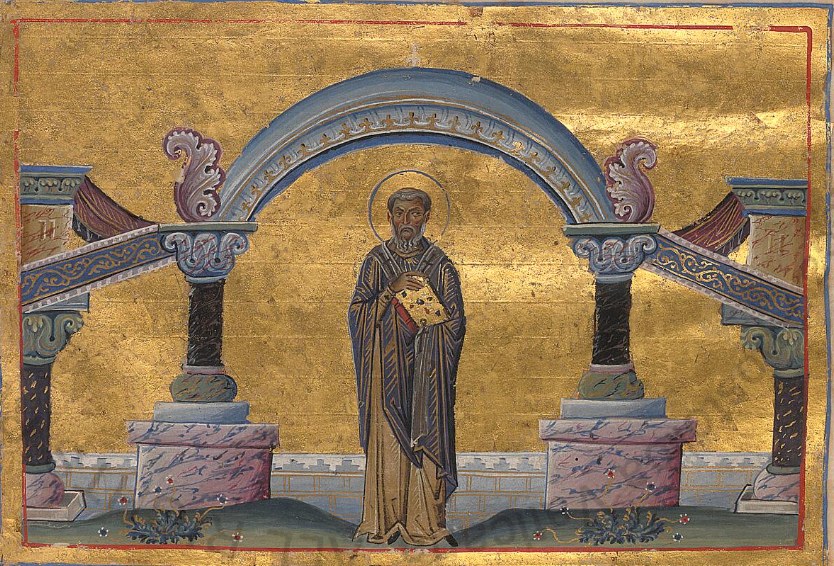
Leo is depicted as a bishop in the settled hierarchical type — vested in the phelonion or the cross-figured polystavrion, the omophorion about his shoulders, blessing with his right hand and bearing the Gospel-book in his left, his hair and beard grey with age. His narrative image is the miracle of Heliodorus: the bishop leading the bound sorcerer into the flames, or standing unharmed within the fire. The stored image is the miniature for February 20 from the Menologion of Basil II (Constantinople, c. 985): Leo shown as a haloed bishop in the standing hierarch's posture, hand raised in blessing (source, public domain, pd-old-work).
Disputed questions
- The dates of his life. The year of his birth (c. 703 or 709), of his accession to Catania (c. 765), and of his repose (c. 780, or 789 in the Sicilian reckoning) are all approximate; the fixed and certain datum is the day, February 20. The reign under which the miracle of Heliodorus is set is given in the Life simply as that of "the emperors Leo and Constantine," which the iconoclast chronology allows to be read of more than one imperial pair (Leo IV and Constantine VI, or Leo III and Constantine V); the entry leaves the identification open.
- Not to be confused with Leo the Great, Pope of Rome and Doctor of the Church (†461, kept February 18), the author of the Tome to Flavian — a wholly different saint of a different see and century; nor with the several imperial and other Leos of the calendar. "The Wonderworker of Catania" belongs to this Leo alone.