
Lucy of Syracuse
The Holy Virgin-Martyr Lucy of Syracuse
Martyr · Virgin · b. c. 283 — d. 304
Commemorated 13 December — Martyrdom at Syracuse under Diocletian
Lucy (Lucia) of Syracuse (c. 283–304) was a virgin-martyr of Sicily, put to death in her native city during the persecution of Diocletian. A wealthy young Christian who had vowed her virginity to Christ and given her goods to the poor, she was denounced by a rejected suitor to the prefect Paschasius, condemned to a brothel yet kept inviolate by the power of God, and, when fire could not consume her, slain by a sword-thrust to the throat. Her Latin name derives from lux, "light," and she has been venerated from ancient times as a patroness of light and of the blind; a tradition that her eyes were put out has fixed this association. Though a saint of the pre-schism West, she was received early and widely into the Byzantine calendar and is kept on December 13.
.jpg)
Origins and vow
Lucy was born about 283 into a noble and wealthy family of Syracuse in Sicily, her father a Roman who died in her infancy. Raised a Christian by her widowed mother Eutychia, she secretly consecrated her virginity to Christ. When her mother, afflicted with a long haemorrhage, was healed at the tomb of Agatha of Catania — the great Sicilian martyr of the previous century — Lucy took the cure as her warrant to disclose her vow and to persuade her mother to let her distribute her dowry and inheritance among the poor.
Denunciation and trial
A young man to whom Lucy had been betrothed, seeing her wealth given away and his hopes of marriage lost, denounced her to Paschasius, the governor of Syracuse, as a Christian — this in the year 304, when Diocletian's edicts against the Church were in full force. Brought to trial, Lucy refused to sacrifice to the idols and confessed Christ without wavering. Paschasius sentenced her to be dragged to a house of prostitution and there defiled; but, the account relates, she was held fast where she stood, immovable, so that neither men nor teams of oxen could stir her, and her virginity was preserved by divine power.
Martyrdom
Enraged, the governor ordered her burned where she stood; pitch, resin and oil were heaped about her and set alight, yet the flames did not harm her. At the last she was killed by a sword driven into her throat. The tradition holds that she foretold, before her death, the peace that would soon come to the Church under Constantine and the downfall of her persecutors. She died at Syracuse in 304 and was buried there, in the catacombs that still bear her name.
The eyes and the light
A tradition — later than the earliest passion, but of long standing — relates that Lucy's eyes were torn out, whether by her torturers or by her own hand to repel a suitor who had praised them, and were afterwards miraculously restored. Whatever its origin, the story fastened upon the meaning of her name, Lucia from lux, light: she is invoked for diseases of the eyes and for those who have lost their sight, and is depicted in later art bearing her eyes upon a dish. The same solar sense of her name, falling near the winter solstice, made her feast a festival of light in the northern lands, most famously in the Scandinavian observance of St Lucy's Day.
Relics
Lucy's relics were venerated at Syracuse and were later translated — the medieval accounts differ as to the stages — by way of Constantinople to Venice, where the greater part is enshrined in the church of San Geremia. Portions are claimed by other centres; the church of San Giovanni Maggiore at Naples has long professed to keep her eyes.
Feast and commemoration
December 13 (church date; Old Calendar civil December 26), within the Nativity Fast, on the same day as the Five Martyrs of Sebaste and, in the American Church, the repose of Herman of Alaska. A martyr of the Latin West, Lucy passed early into the Byzantine synaxaria and is kept universally on this day in both East and West. In the East she is commemorated as a virgin-martyr with the common service; in the West her feast is one of the best-loved of Advent.
Hymns
Troparion — Tone 4
Thy ewe-lamb Lucy cries out to Thee, O Jesus, with a loud voice: "O my Bridegroom, I long for Thee; seeking Thee I contend, and I am crucified and buried together with Thee in Thy baptism. I suffer for Thy sake, that I may reign with Thee; I die for Thee, that I may live in Thee. Receive me as a spotless sacrifice, offered to Thee with love." By her prayers, O merciful One, save our souls.
Original translation from the Greek
Iconography
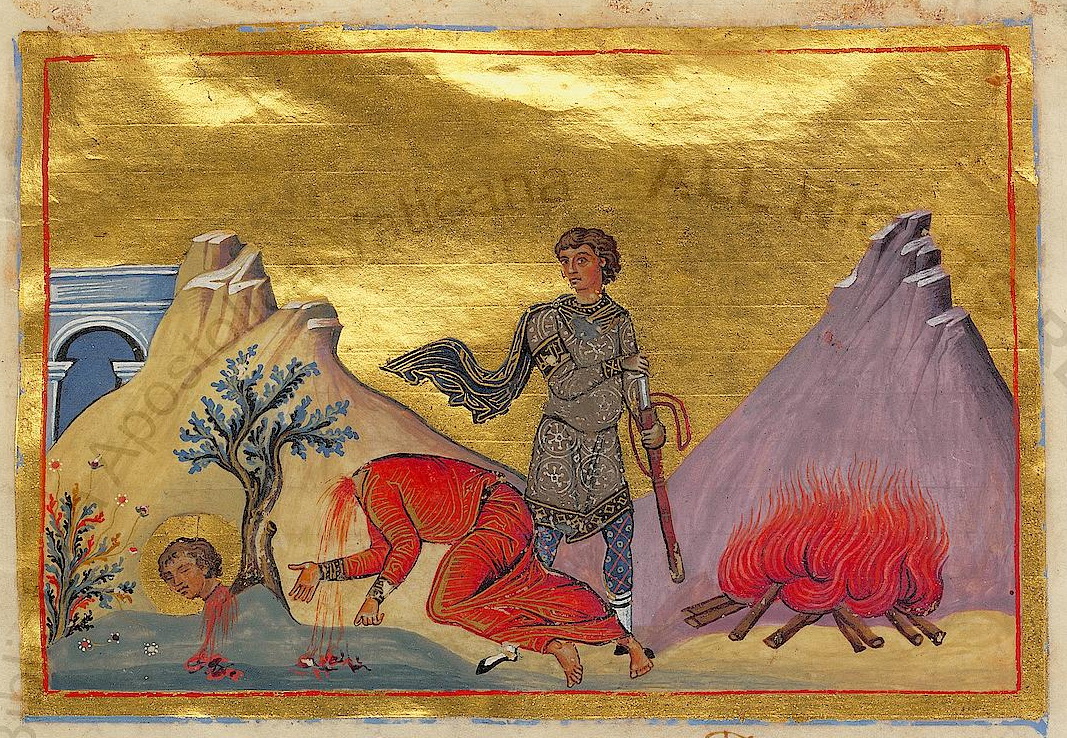
Lucy is depicted as a young virgin-martyr in the maphorion or in the rich dress of a noblewoman, holding the martyr's cross; in the Byzantine manner she carries no distinguishing attribute beyond it. In later Western art she is shown bearing a lamp or a dish with two eyes upon it, the emblems of her name and of the tradition of her blinding. The stored image is the miniature for her commemoration in the Menologion of Basil II (Constantinople, c. 985), which depicts the martyr.
Disputed questions
- Not to be confused with Lucy of Campania, a widow martyred with Geminianus and commemorated on July 6 — a distinct saint whom the OCA is careful to distinguish from the Syracusan virgin. The Roman Lucia the widow, remembered in some Greek synaxaria, is likewise another person.
- Not to be confused, further, with Lucia the Virgin and Rixius Varus — the virgin of Campania carried off by a Roman officer, who converted her captor and was beheaded with him at Rome under Diocletian, commemorated on July 6. She is the saint the Byzantine calendars of that day carry, and she is a virgin, distinct both from the Syracusan and from the Roman widow named above.
- The passion. Lucy's earliest cult is securely attested — her name stands in the ancient Roman canon of the Mass and in fifth-century inscriptions at Syracuse — but the surviving acts of her martyrdom are later and legendary in their detail; the historical core is her death as a virgin-martyr at Syracuse under Diocletian.