
Major of Gaza
The Holy Martyr Major
Martyr · d. c. 304
Commemorated 15 February — Martyrdom under scourging at Gaza
Major (Greek Μαΐωρ) was a martyr of Gaza in Palestine, put to death under scourging in one of the persecutions of the early fourth century. The synaxaria remember him for the manner of his confession: as the lash tore his flesh he answered his tormentors with the words of the Psalmist — "I am ready for scourges" — and so gave up his soul under the blows. His memory is kept on February 15; of his life beyond this the record transmits little.
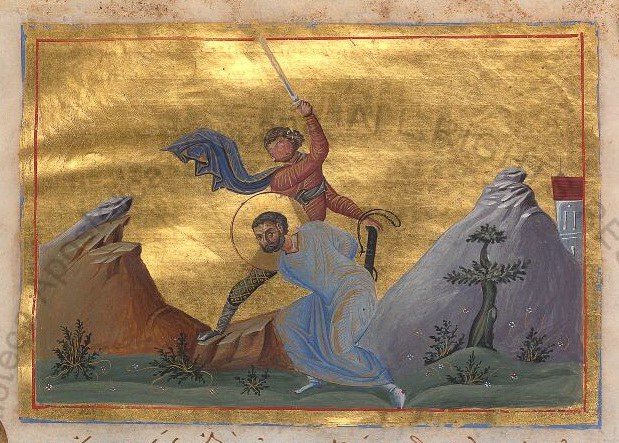

The whole surviving account of Major is a synaxarion notice, and this entry asserts no more than it gives. He was a Christian of Gaza, the ancient city of the Palestinian coast, and suffered — the setting of the account is a persecution, most naturally that of Diocletian and Maximin at the opening of the fourth century, in which the churches of Palestine were cruelly tried and Gaza gave many martyrs. Brought before the persecutors and refusing to deny Christ, Major was condemned to be scourged, and under the lash — the verses of the day say his loins were "filled with scourges" — he did not cry out against his torment but took up the word of David, "for I am ready for scourges, and my sorrow is continually before me" (Psalm 37:18 LXX; 38:17). Making the Psalmist's confession his own, he endured the beating to the end and reposed under it, receiving the martyr's crown.
The name Major is Latin (maior, "greater") in a Greek dress, of the kind borne by soldiers and citizens of the Roman East; some accounts accordingly make him a soldier, though the synaxarion fixes only on his scourging and his dying confession. No year, magistrate, or fuller passion is transmitted; the tradition keeps him as the martyr of Gaza who died singing the psalm of the scourged.
Feast and commemoration
February 15 (church date; Old Calendar civil February 28), on the day of the Apostle Onesimus, in the Greek Menaion and the synaxaria; the day's verses keep his couplet beside those of Onesimus and the hermit Eusebius. He has no proper service; the common of a martyr supplies the hymnography where one is sung.
Iconography
The stored image is the miniature of the Menologion of Basil II (Constantinople, 985) for his commemoration, which renders his death in the manuscript's beheading convention — the soldier-martyr in a white mantle kneeling beneath the sword. (The synaxarion has him scourged to death over seven days; the miniaturist, as often in the manuscript, has painted the generic martyr's end rather than the particular torment.) A portrait icon would show the classic martyr's type — a man in chiton and himation holding the martyr's cross.