
Mamas of Caesarea
The Holy Great Martyr Mamas of Caesarea in Cappadocia
Great Martyr · b. c. 260 — d. c. 275
Commemorated 2 September — Martyrdom at Caesarea in Cappadocia
Mamas of Caesarea (c. 260–c. 275) is one of the great-martyrs of the early Church: born in prison to the martyred confessors Theodotus and Rufina, raised in Caesarea of Cappadocia by the pious widow Ammia, and put to death as a youth of about fifteen in the reign of Aurelian, pierced with a trident after fire, the sea and the wild beasts had failed to harm him. The tradition remembers him as a shepherd-hermit of the mountain near Caesarea who milked the wild deer and fed the poor with their cheese; Basil the Great and Gregory the Theologian preached in his honour. Venerated from Cappadocia to Cyprus, Lebanon, Georgia and Gaul, he is a patron of shepherds and their flocks.
.jpg)
Origins and early life
The tradition places Mamas's parents, Theodotus and Rufina, among the Christian nobility of Gangra in Paphlagonia. In the persecutions of the later third century Theodotus was arrested for his open confession of Christ and, as a man of rank, was sent for judgement to Caesarea, the metropolis of Cappadocia, where he died in prison; Rufina, who had followed her husband into confinement though she was with child, gave birth there and died soon after the delivery. The infant born in the prison was taken in by a wealthy and pious widow of Caesarea named Ammia, who obtained the bodies of the martyred parents for burial and raised the boy as her own son. The name by which the Church knows him is explained in the Lives from his infancy: the child was slow to speak, and his first word, addressed to his foster-mother, was "mama."
Ammia had the boy educated in Caesarea, where his quickness and his piety were noticed together. She died when he was about fifteen, leaving him her heir — and leaving him, in the renewed persecution which the Lives set under the emperor Aurelian (270–275), an exposed and conspicuous young confessor, for he made no secret of his faith and drew his schoolfellows after him.
Martyrdom
Denounced to Democritus, the governor, Mamas refused to sacrifice to the gods; because of his noble birth he was not judged summarily but sent on to the emperor himself. Neither flattery nor torture moved him: the Lives recount beatings, burning with torches, and finally an attempt to drown him in the sea, from which he was delivered — the tradition says by an angel, who directed him to a mountain in the wilderness near Caesarea.
There the martyr's life took the pastoral turn that the hymnography and iconography of the Church have never forgotten. Living as a hermit on the mountain, he was surrounded by the wild animals of the desert, which came to him tamely as to a shepherd; he milked the wild deer and the goats, made cheese of the milk, and carried it down to feed the poor of the city. His fame spread, and with it the attention of the authorities. Alexander, the governor of Cappadocia, sent a detachment of soldiers to take him; Mamas met them on the road, received them hospitably, and — as they did not recognise him — revealed himself as the man they sought.
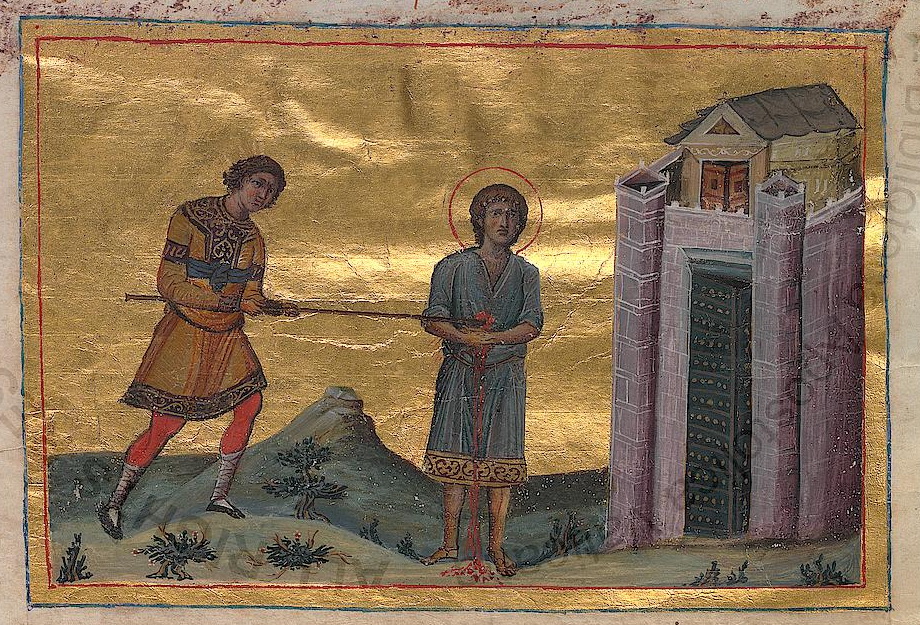
Brought to trial, he was tortured and condemned to the beasts, but the animals of the arena would not touch him; the accounts tell that a lion, released against him, lay down at his feet and defended him. At last a pagan priest struck him in the belly with a trident. Mortally wounded, the martyr dragged himself outside the city to a cave, where he gave up his soul to God. The verses of the synaxarion fix the manner of his death — "wounded by the points of the trident, Mamas endured" — and the received chronology places it around the year 275, when he was about fifteen years of age. He was buried at the place of his death, and his tomb became a fountain of healings.
Relics and veneration
The cultus of Mamas is among the best attested of any Cappadocian martyr. A century after his death, Basil the Great preached his Homily 23 on the martyr Mamas at his festival in Caesarea, and Gregory the Theologian, in the oration read on New Sunday, invokes the memory of "Mamas the famous shepherd, who milked the does" — a contemporary witness that the pastoral traditions of the saint were already fixed in the fourth century.
From Cappadocia his veneration spread through the whole Christian world. In Constantinople a quarter, a palace, and a celebrated monastery of St. Mamas (later the home of Symeon the New Theologian) bore his name. In Cyprus his shrine at Morphou, where a tomb held to be the saint's exudes a healing myrrh, remains one of the island's great pilgrimage churches, and dozens of Cypriot villages and churches are dedicated to him. In Lebanon the church of Mar Mama at Ehden, founded in 749, is reckoned among the oldest Maronite churches — a witness to his early veneration in the Patriarchate of Antioch's own heartland. In Georgia he has been beloved since the early Middle Ages, depicted riding the lion in manuscript and metalwork. In the West, relics brought from the East made the cathedral of Langres in Gaul a centre of his cultus (Saint-Mammès), and a town on the Seine bears his name. He is invoked as a patron of shepherds, herdsmen and flocks, and in popular devotion as a protector of those who suffer in the body, since he was pierced in the bowels.
Miracles and traditions
Two traditions above all shaped his image. The first is Cappadocian: the hermit-shepherd of the mountain, feeding the poor with the milk of wild creatures, the beasts obedient to him as to unfallen Adam. The second is Cypriot: there it is told that Mamas, a hermit who refused to pay the poll-tax, was being led to the duke when a lion sprang upon a lamb by the road; the saint took the lamb in his arms, mounted the lion, and rode it to the ruler's seat — who, astonished, exempted him from the tax. This local legend, whatever its relation to the Cappadocian martyr, fixed the most famous iconographic type of the saint: Mamas riding a lion, the lamb in his arms.
Feast and commemoration
September 2 (church date; Old Calendar civil September 15), the leading commemoration of the day, on which the Menaion joins his service with that of John the Faster. The feast is kept throughout the Byzantine rite. In the Slavic usage his parents Theodotus and Rufina are commemorated with him on the same day; the Roman Martyrology keeps him on August 17, and Cyprus keeps his principal panegyris at Morphou in early September.
Hymns
Troparion — Tone 4
Thy martyr, O Lord, in his contest received an incorruptible crown from Thee, our God; for possessing Thy strength he cast down the tyrants and shattered the feeble insolence of the demons. By his intercessions save our souls.
Original translation from the Greek
Kontakion — Tone 3
With the staff given thee from God, O holy one, shepherd thy people in life-bearing pastures, and crush the invisible and savage beasts beneath the feet of them that hymn thee; for all we who are in perils have gained thee, O Mamas, as a fervent protector.
Original translation from the Greek
Iconography
Two types of the saint coexist. The Byzantine type shows a young, beardless martyr, often with shepherd's staff or with a deer or lamb, in the short tunic of a herdsman or with the martyr's cross; scenes of his passion show the trident-thrust before the walls of Caesarea. The later and now most famous type — dominant in Cyprus and Georgia — shows Mamas riding a lion, carrying a lamb in his arms, from the Cypriot legend of the tax. The stored image is the miniature for September 2 from the Menologion of Basil II (Constantinople, c. 985): the young saint, haloed, in a herdsman's tunic before a city gate, run through the belly with the executioner's trident.
Disputed questions
- Chronology. The received Lives set the martyrdom under Aurelian (270–275) and give the saint's age as about fifteen, whence the conventional dates c. 260–c. 275; but the acts are late and legendary in form, and the dating cannot be controlled from independent sources. What is historically certain is the flourishing cultus at Caesarea by the time of Basil's homily (c. 375).
- Birthplace. The family is placed at Gangra in Paphlagonia, but the birth in prison is located by most accounts at Caesarea in Cappadocia, where his father had been sent for trial; some retellings compress the two and call him simply a Paphlagonian.
- Style. The Greek and Slavic calendars style him great-martyr (μεγαλομάρτυς); the OCA calendar heading styles him simply "Martyr Mamas."
- Western date. The Roman Martyrology commemorates him on August 17; the Byzantine calendar keeps September 2.
- His parents Theodotus and Rufina are themselves commemorated as martyrs on September 2 in the Slavic tradition (so the OCA calendar); their story is wholly contained in the opening of their son's Life.