
Manuel, George and the 377 Martyrs of Bulgaria
The Holy Martyrs Manuel, George, Peter and Leo the Bishops, Parodus the Presbyter, and the Three Hundred and Seventy-Seven Martyrs with them in Bulgaria
Hieromartyr · Martyr · Bishop · Priest · d. c. 815, in Bulgaria (beyond the Danube)
Commemorated 22 January — Martyrdom in Bulgaria under the Bulgar khans
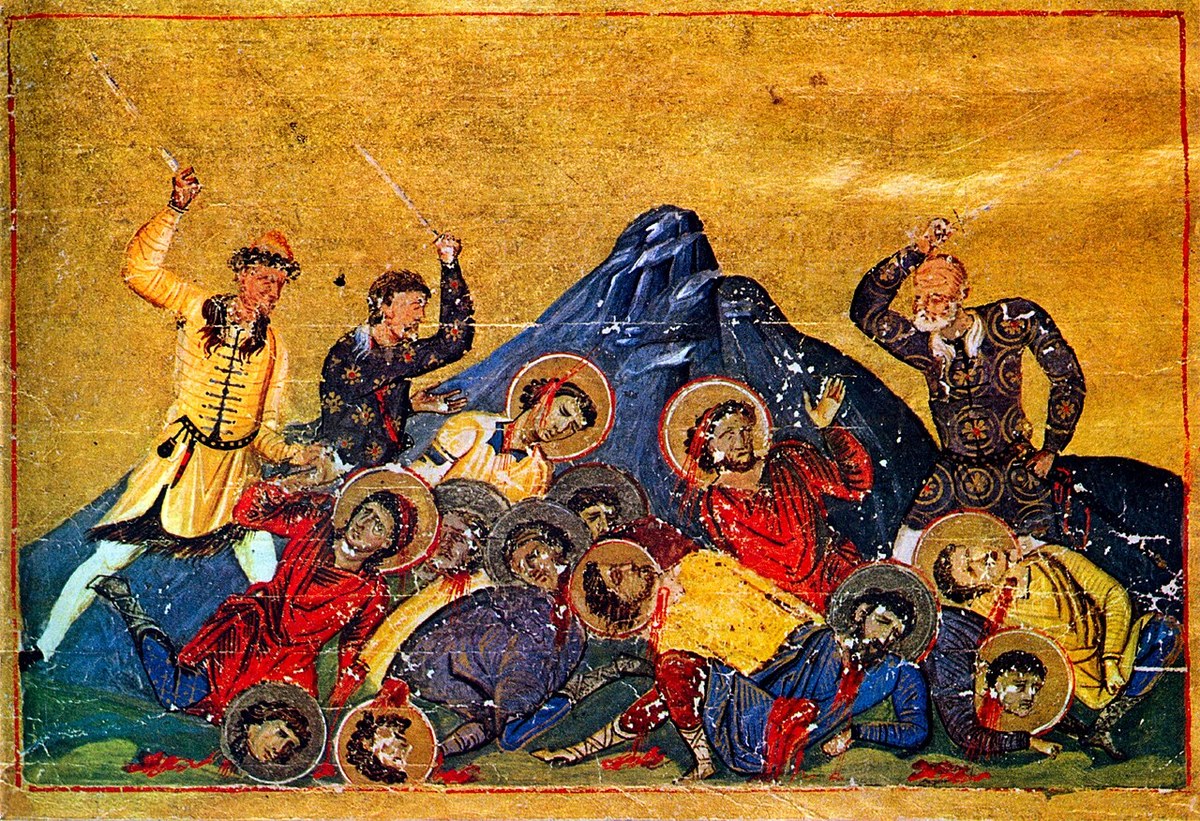
The Three Hundred and Seventy-Seven Martyrs of Bulgaria — also called the Martyrs of Adrianople — were a company of Christians of the Byzantine frontier, led by the bishops Manuel of Adrianople, George of Develtos, Peter, and Leo of Nicaea, and the presbyter Parodus, who were carried off as captives into Bulgaria in the wars of the pagan Khan Krum (813) and, refusing under his son and successor to abandon Christ, were put to death in various ways about the year 815. Deported "beyond the Danube" with whole populations of the Thracian towns, the bishops and clergy and some three hundred and seventy-seven of the faithful sealed their confession with their blood — the archbishop of Adrianople trampled and slain, others clubbed and beheaded, one bishop disembowelled — a martyrdom of the ninth century kept by the whole Church on January 22.

The Bulgar wars and the captivity
In the second decade of the ninth century the pagan Bulgar state under Khan Krum (r. c. 803–814) pressed hard on the Byzantine frontier in Thrace. Krum took Develtos (Debeltos) in 812 and transplanted its people, with their bishop George, across his borders; and in 813, after his victory over the emperor at Versinikia, he seized the great city of Adrianople (Adrianopolis) itself and deported its population — many thousands of Christians, among them the family of the future emperor Basil the Macedonian — "beyond the Danube" into Bulgaria. With them went their shepherds: Manuel, archbishop of Adrianople, and the other bishops, priests, and people who make up the company of this feast.
The persecution and the martyrdoms
The martyrdom belongs not to the deportation itself but to the persecution that followed. Krum died in April 814; and either he in his last days, or (as the Menologion of Basil II relates) an officer named Tzok (Čok) under his son and successor Omurtag (Mortagon), demanded that the captive Christians renounce their faith and worship after the manner of the Bulgars. Those who refused were killed. The tradition names the leaders and the manner of their deaths: Manuel of Adrianople, thrown down and trampled, then hacked in pieces; George of Develtos and Peter the bishop, clubbed to death and beheaded; Leo (Leontius), bishop of Nicaea in Thrace, a eunuch, whose belly was cut open; and with them the presbyters Parodus, Sionius, Gabriel, John, and Leontius, and a great multitude of the laity — the number transmitted as three hundred and seventy-seven. The rolls and the spelling of the names vary from book to book, but the company is kept whole in the one feast. The persecution is remembered as an early witness of Christian Bulgaria's own birth-pangs, for within two generations the Bulgar nation itself would be baptized.
Feast and commemoration
The martyrs are kept on January 22 (church date; New Calendar civil January 22; Old Calendar civil February 4), together with the Apostle Timothy and Anastasius the Persian. The commemoration is universal in the Byzantine calendars — Antiochian, Greek, and Slavic — and rests on an ancient notice, the martyrs being figured already in the Menologion of Basil II (c. 985) for this day. The feast falls in no fasting season.
Hymns
Troparion — Tone 4
Thy martyrs, O Lord, in their contest received incorruptible crowns from thee our God; for having thy strength, they cast down the tyrants and broke the powerless insolence of the demons. By their supplications, O Christ God, save our souls.
Original translation from the Greek
Iconography
The martyrs are depicted as a company — bishops in the omophorion, priests, and lay people together — being led out or put to death, in the narrative "martyrdom of a multitude" type of the menologia. The stored image is the miniature for January 22 from the Menologion of Basil II (Constantinople, c. 985; Vatican, Vat. gr. 1613): the martyrs of Adrianople slain for Christ in Bulgaria (source, public domain, pd-old-work).
Disputed questions
- "Under the Iconoclasts." These martyrs are sometimes loosely said to have suffered "under the Iconoclasts," because their deaths fell in the years of the Byzantine Empire's second Iconoclasm (renewed under Leo V in 815). In fact they were slain not by iconoclasts but by the pagan Bulgars — Krum, and Tzok under Omurtag — for refusing to abandon Christ altogether; the iconoclast controversy is the backdrop of the age, not the cause of their martyrdom.
- The year and the agent. The sources divide over whether the killings began under Krum before his death (April 814) or were carried out under his son Omurtag (by the officer Tzok), and the date is given variously between 814 and 815; this entry follows the Menologion's account and dates the martyrdoms to about 815.
- The names and the number. The catalogues differ; the leaders most consistently named are the bishops Manuel, George, Peter, and Leo, and the presbyter Parodus, "with 377 others." The number is the figure transmitted by the synaxaria and kept in the feast's title.