
Marana and Cyra
Our Venerable Mothers Marana and Cyra, Ascetics of Beroea in Syria
Venerable · d. c. 450
Commemorated 28 February — Repose after some forty years of enclosed asceticism at Beroea
Marana and Cyra (†c. 450) were two well-born women of Beroea in Syria — the city that is now Aleppo — who forsook wealth, marriage, and the world to live as enclosed ascetics in a small roofless enclosure outside their city, walled in behind a low door and a single window through which alone they received a little food. Loading themselves with heavy iron chains and crosses, keeping an almost unbroken silence, and enduring fasts of extraordinary length in the open air through the heat and cold of the Syrian seasons, they persevered in this discipline for some forty years. Twice they broke their enclosure to make pilgrimage — to the holy places of Jerusalem and to the shrine of the Protomartyr Thecla at Seleucia — eating nothing on the whole journey until they had worshipped. Their memory is preserved by Theodoret, bishop of Cyrrhus, who visited them and set down their story in his Religious History.
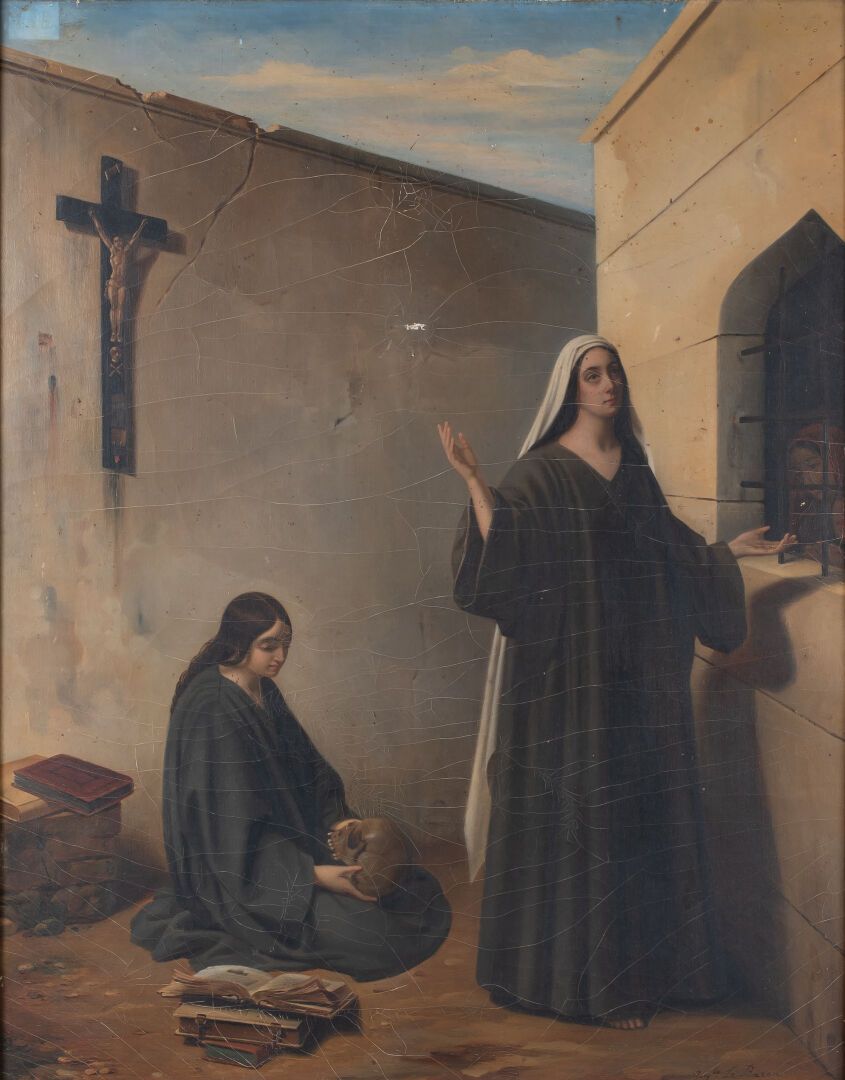

Almost everything known of Marana and Cyra comes from a single, precious source: the twenty-ninth chapter of the Religious History (the Philotheos Historia) of Theodoret of Cyrrhus (c. 393 – c. 460), the great chronicler of Syrian monasticism, who as a bishop of the region knew them personally and describes what he saw with his own eyes. Their witness belongs to the golden age of the Syrian ascetic movement, and to a strand of it particularly its own: the enclosed, chain-bearing solitaries of the northern Syrian cities.
Origins and renunciation
Marana and Cyra were natives of Beroea (Beroea of Syria, the modern Aleppo), born of a distinguished and wealthy family and reared in comfort and honour. Reaching maturity, they turned their backs on all of it — on their rank, their inheritance, and the prospect of marriage — and chose for the love of God a life of the most severe self-denial. They did not withdraw to a distant desert but built a small enclosure on the edge of their own city, and there shut themselves in, walling up the door with stones and clay and leaving only a small window through which they might receive the little food they took and, at rare intervals, speak. Their maidservants, who wished to share their mistresses' struggle, were housed in an outer enclosure adjoining, where the holy women could oversee and encourage them through the window while keeping their own solitude.
The ascetic struggle
The discipline they embraced was of extreme rigour. They lived in the open air, their enclosure without a roof, exposed to the rains and frosts of winter and the fierce heat of the Syrian summer. They bound upon their bodies heavy iron chains — so heavy, Theodoret says, that Cyra, being the smaller and bent double beneath the weight of iron, could scarcely lift herself; the chains hung about their necks, their loins, their hands and feet. They kept a near-perpetual silence, speaking only at the feast of Pentecost. And they fasted with a severity that recalled the great fasts of Scripture: at times, Theodoret reports, they passed three weeks without food in imitation of Moses, at other times as long as forty days, and once (following the example of Daniel's abstinence) even longer, until nature's need compelled them to take a little nourishment. In this manner of life they endured for forty-two years — a lifetime given whole to prayer, fasting, and the bearing of iron.
The pilgrimages
Twice in those long years the two women left their cell to go on pilgrimage. Once they journeyed to Jerusalem, to worship at the places of the Lord's saving Passion and Resurrection; and once, in the other direction, to the famous shrine of the Protomartyr Thecla at Seleucia in Isauria. On both journeys they held to their fast with astonishing resolve: they ate nothing at all upon the whole road, going and returning, until they had reached the holy place and completed their worship — only then breaking their fast, and then again fasting all the way home. Their pilgrimages were themselves an ascesis, an offering carried in the body across the miles.
Theodoret's visit and their repose
Theodoret relates that when he came to visit them, they opened their door to receive him — a rare concession, granted out of reverence for the episcopal office — so that he might see and bless their labour; and it is from this visit that his eyewitness account of the chains and the enclosure derives. Having completed their long course, the two holy women reposed in peace, about the year 450, and passed to the Bridegroom whom they had sought with so single a heart. The Church honours them together, as they lived and struggled together, on February 28.
The companion Domnina
The calendars of this day also name Domnina (sometimes given as Domnica or Domnina of Syria) as a companion of Marana and Cyra. She is in fact the subject of a separate chapter of Theodoret's Religious History (chapter 30) — another enclosed ascetic of the Beroea region, who lived in a little hut of reeds in her mother's garden, wept continually, and served the poor — and belongs to the same world and the same day. Her fuller commemoration is noted among the pending entries of this date.
Feast and commemoration
Marana and Cyra are commemorated on February 28 (church date; New Calendar civil February 28; Old Calendar civil March 13). Their feast is universal, and its witness is of particular Antiochian and Syriac note, for they belong to the monasticism of the Patriarchate of Antioch and are known through the greatest of its historians, Theodoret of Cyrrhus. The Greek and Slavic calendars keep them on the day; the Slavic tradition often renders the first name as Marina, a corruption of Theodoret's Marana.
Hymns
Troparion — Tone 8
In you, O mothers, the divine image was preserved unto perfection; for taking up the cross, and iron with it, ye followed after Christ, and by your deeds ye taught the despising of the flesh, which passes away, and the care of the soul, a thing immortal. Wherefore, O venerable Marana and Cyra, your spirits rejoice together with the angels.
Original translation from the Greek
Iconography
Marana and Cyra are depicted as two ascetic women, veiled and clothed in dark monastic habit, often shown with the heavy chains that were the mark of their struggle, and set against the low wall of their roofless enclosure outside Beroea. The stored image is a nineteenth-century Western devotional painting — Sainte Marane et sainte Cyre by the French artist Augusta Lebaron-Desves (1806–1894), exhibited at the Paris Salon of 1844 — which depicts the two Syrian sisters at their prayer (source, public domain, pd-old-work). It is a Latin academic image rather than an Orthodox icon, and stands here as a faithful pre-modern depiction of the saints pending a Byzantine one.