
Marcella of Rome
Our Venerable Mother Marcella of Rome
Venerable · b. c. 325, Rome — d. 410, Rome
Commemorated 31 January — Repose at Rome after the Gothic sack
Marcella of Rome (c. 325 – 410) was a noble Roman widow who turned her palace on the Aventine into one of the first houses of ascetic and monastic life for women in the Latin West. Widowed after only a few months of marriage, she refused a second and illustrious match and gave the rest of her long life to prayer, fasting, charity, and the study of Scripture, gathering about her a circle of Roman matrons and virgins. When Saint Jerome came to Rome she became his pupil and searching questioner in the Scriptures, and after his departure she was reckoned an authority to whom the Roman clergy themselves referred hard questions. In the sack of Rome by Alaric's Goths in 410 she was beaten by the plunderers to make her yield treasure she had long since given to the poor, and, having secured the safety of her companion, died soon after of the ill-usage. She is commemorated on January 31.
_Kluizenaressen_(serietitel)_Sacra_Eremus_Ascetriarum_(serietitel),_RP-P-BI-2326.jpg)
The widow of the Aventine
Marcella was born about the year 325 into one of the great senatorial families of Rome, and raised in wealth and Christian piety by her mother Albina. Married young, she was left a widow after only seven months; and when the aged and immensely rich consular Cerealis pressed her to marry him, she refused with the famous answer (preserved by Jerome) that had she wished to marry rather than to consecrate herself to continence, she would have looked for a husband and not an inheritance. She chose instead the ascetic life, and made her palace on the Aventine hill a centre of prayer and self-denial in the very heart of pagan and worldly Rome.
There is good reason to reckon Marcella a pioneer of Western monasticism for women: she had heard, through Athanasius and others, of the ascetic life of the Egyptian desert and of Antony, and she gave it a Roman and domestic form, drawing around her a company of noble widows and virgins — among them Principia, Paula and her daughters, and others whose names Jerome records — who lived under her guidance in continence, poverty, psalmody, and works of mercy. She gave her fortune to the poor rather than leaving it to kin, saying she would rather store it in heaven.
Pupil and questioner of Jerome
When Jerome came to Rome (382–385) as secretary to Pope Damasus, Marcella sought him out, and her circle on the Aventine became the setting for much of his Scriptural teaching there. She was no passive hearer: Jerome's letters show her as a relentless questioner, pressing him on the meaning of Hebrew words and difficult passages, never satisfied with a superficial answer, so that he called her his taskmistress. After he left Rome for Bethlehem, her mastery of Scripture was such that (Jerome writes) when disputes over the sense of a text arose, the Roman clergy themselves would consult Marcella; and she took a firm part, with discretion, against the errors of Origenism when that controversy troubled Rome. She and Principia were the recipients of several of Jerome's letters, and it is to Jerome's long memorial letter to Principia (Epistle 127) that we owe almost all we know of her.
The sack of Rome and her death
In August 410 the Goths under Alaric took and sacked Rome — a calamity that shook the whole Roman world. When the plundering soldiers broke into Marcella's house, they could not believe that so great a lady had nothing to give, and beat her with cudgels and scourges to force her to reveal hidden gold; but she had long since given all to the poor, and had nothing. Jerome records that she felt the blows scarcely at all, but threw herself at the soldiers' feet and begged with tears that they would not part her from her young companion Principia nor offer the girl any violence — and that, softened, they conducted the two women for safety to the basilica of Saint Paul. Marcella, aged and broken by the ill-treatment, survived only a short time, and died in Principia's arms, rejoicing (Jerome says) that the city's fall had found her poor and not rich. Her death, about the age of eighty-five, closed one of the longest and most influential ascetic lives of the early Latin Church.
Feast and commemoration
Marcella is kept on January 31 (church date; Old Calendar civil February 13) in both the Western and the Eastern reckonings. Her cult is chiefly Western — she is a saint of the undivided Church, of the city of Rome, and her memory is carried above all in the Roman martyrology and in Jerome's letters — but as a pre-schism saint of the one Church she is received on the same day in Orthodox calendars, where she appears (for example in the Russian-language synaxaria) among the righteous women of the fifth century. She has no proper Byzantine office; the common of a venerable woman serves her.
Verification note: Marcella's presence on the Orthodox January 31 rests on the reception of the pre-schism Roman saints and is attested here from the Russian-language calendar (azbyka.ru); the classification as a russian jurisdiction reflects that witness rather than any distinctively Russian cult, and should be reviewed in Pass 2 against a fuller pre-schism-saints authority.
Hymns
Troparion — Tone 8
In thee, O mother, was the divine image surely kept; for taking up thy cross, thou didst follow Christ, and by thy deeds thou didst teach us to despise the flesh, for it passeth away, but to care for the soul, a thing immortal: wherefore thy spirit, O venerable Marcella, rejoiceth with the angels.
Original translation from the Greek
Iconography
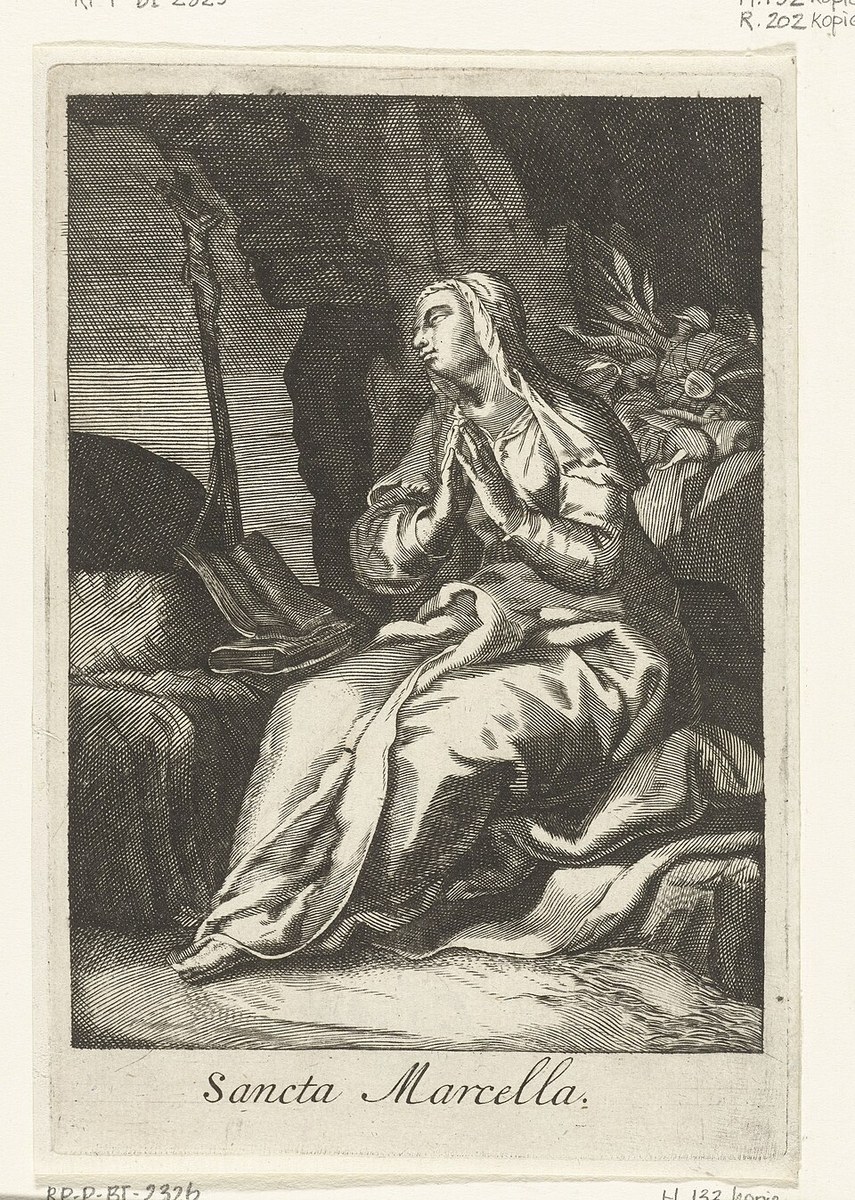
There is no established Byzantine iconographic type for Marcella, whose veneration is Western. She is represented in Latin devotional art as an aged, veiled widow at prayer, sometimes with a book (for her Scriptural learning) or the palm and scourge that recall her beating by the Goths. The stored image is a Netherlandish engraving of about 1600, from a series of the holy women hermits (Sacra Eremus Ascetriarum): a veiled woman kneels in prayer in a rocky solitude, hands joined, a staff beside her, over the caption "Sancta Marcella" — a Western Baroque devotional print, identity fixed by its inscription, rather than an Orthodox icon (source, Rijksmuseum, CC0 / pd-old-work). (An identity-verified Orthodox icon, should one surface, would be preferable.)