
Marinus of Rome
The Holy Martyr Marinus of Rome
Martyr · d. c. 283
Commemorated 16 December — Martyrdom at Rome under Carinus
Marinus (†c. 283) was a young Roman of senatorial family who confessed Christ in the City itself in the reign of the emperor Carinus and was crowned with martyrdom. Arrested and pressed to sacrifice to the idols, he refused; the synaxarion tells that he was hung up and cut with swords, laid on fire, set on a red-hot griddle and plunged into a boiling cauldron, yet by God's grace remained unharmed, and that the wild beasts loosed upon him — lions and bears — would not touch him. Brought at last into a pagan temple to sacrifice, he prayed instead, and the idols fell and were shattered; the enraged ruler ordered him beheaded, and so he gave up his soul to God. He is commemorated on December 16.
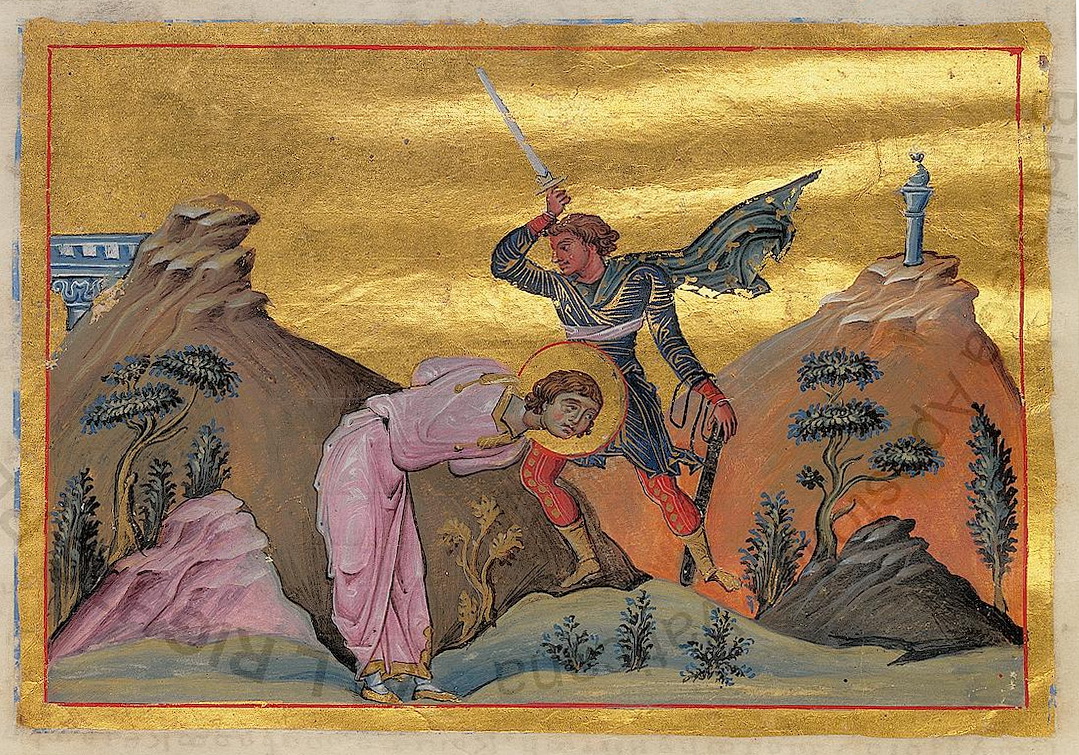
.jpg)
The account of Marinus is a synaxarion notice, and this entry keeps to what it transmits. He lived in the reign of the emperor Carinus (282–285) and was, though still young in years, of noble birth, holding the dignity of a synkletikos — a senator, one of the highest ranks of the Roman state. As a Christian he was seized and required to offer sacrifice to the idols. When he would not, he was subjected to a succession of torments that the notice recounts in the manner of the martyr-acts: hung up and cut with swords, cast on the fire, laid on a burning iron griddle, thrown into a seething cauldron — and preserved unhurt through them all by the grace of God, so that even the lions and bears set loose upon him drew back and did him no harm.
When these things only hardened his persecutors, they resolved to force him into an idol-temple and compel him to sacrifice. But Marinus, entering, turned to the Lord Jesus Christ in prayer, and at his word the idols toppled and were broken to pieces. At this the ruler, confounded and enraged, ordered his head struck off; and thus the martyr yielded his spirit to God. Devout Christians reverently took up his body and buried it.
Feast and commemoration
Marinus is commemorated on December 16 (church date; Old Calendar civil December 29), together with the Prophet Haggai and the Empress Theophano, within the Nativity Fast. The Greek and Slavic synaxaria alike style him "of Rome" (Μαρῖνος; Марин Римский), and he has no proper service of his own: his memory is kept by the synaxarion reading, the hymns of the day being those of the prophet and the common of a martyr.
Not to be confused with
The calendars know several martyrs named Marinus, and the Byzantine notices of this day have been variously understood; the confusions should be kept in view:
- Marinus the Elder (October 18), the aged martyr of Cilicia under Diocletian — a different man, of a different reign and province, distinguished by his epithet "the Elder." (His entry already flags the December 16 Marinus of Rome; this is the reciprocal note.)
- Marinus the soldier of Caesarea in Palestine (†c. 260, August 7), the officer beheaded when, about to be made centurion, he refused the oath by the pagan gods, and buried by the senator Asterius (whose own feast is the same August 7) — the martyr whose story Eusebius tells (Church History VII.15). The Orthodox Church in America's Lives of the Saints gives this soldier's story under the December 16 "Marinus of Rome," conflating the two; the Greek and Slavic (azbyka) synaxaria of December 16, by contrast, tell of the young Roman senator under Carinus followed here. The divergence is recorded, not silently harmonised.
Iconography
Marinus is depicted as a young martyr, beardless, in tunic and cloak with the martyr's cross, or in the narrative type of his beheading. The stored image is the miniature of the Menologion of Basil II (Constantinople, c. 985) appointed to December 16, which shows the young saint, haloed, bowed beneath the sword of the executioner. (This is the same Menologion miniature noted under Marinus the Elder as belonging properly to the December 16 martyr, and it is stored here on that identity.) The miniature carries a faint diagonal source-scan watermark; it should be replaced if a cleaner reproduction surfaces.