
Martyrius of Zelenets
Our Venerable Father Martyrius, Abbot of Zelenets
Venerable · b. 16th century, Velikiye Luki — d. 1603, at Zelenets
Commemorated 1 March — Repose at the Zelenets monastery
Martyrius of Zelenets (†1603) was a Russian monastic saint, the founder and first abbot of the Trinity monastery of Zelenets — the "Green Island" in the marshes east of the river Volkhov, in the Novgorod land. Born Menas in the town of Velikiye Luki and orphaned in childhood, he was raised in piety by a priest, was tonsured under his own spiritual father, and after years of shared cell-life withdrew into the deep forest, guided (the tradition holds) by visions of the Mother of God and of a radiant cross of stars. On the wooded island he found there he raised a church of the Life-giving Trinity and gathered a brotherhood, becoming their abbot; he was granted the gift of wonders, and reposed in great old age in 1603, having dug his own grave and taken leave of his monks with a final charge to trust in the Holy Trinity and the Mother of God.

Origins and monastic beginnings
The saint was born in the sixteenth century in Velikiye Luki, a town of the Pskov land, and given in baptism the name Menas (Mina). Losing both parents about the age of ten, he was taken in and raised by a devout priest of the Church of the Annunciation in his town, who nurtured in the orphan a love of God and of the Church. His own spiritual father — a priest named Boris, who himself became a monk with the name Bogolep ("comely to God") — drew him to the monastic life; and at the Trinity–Sergius monastery of Velikiye Luki the young Menas received the tonsure and the name Martyrius. For some seven years teacher and disciple laboured together in a single cell, Martyrius serving as cellarer and in the altar, until the elder's repose left him free to seek the solitude for which he had long yearned.
Into the wilderness, and the visions of the Mother of God
The tradition of Martyrius is marked throughout by the special protection of the Mother of God. It tells that he saw the wonderworking Tikhvin Icon raised up in a pillar of fire, and, when he had gone out into the wild, beheld in the sky a shining cross formed of stars standing over a certain forest — a sign that led him at last to the place of his monastery. Passing through Tikhvin and its great shrine of the Mother of God, and counselled by holy men, he came into the marshy forest country east of the Volkhov and found there an island of dry ground ringed by bog, green with trees — the "Green Island," Zelenets — and settled on it as a hermit.
The founding of Zelenets
Others soon sought him out for the sake of his life, and a brotherhood gathered about him. Martyrius built first a chapel and then a church of the Life-giving Trinity, in which he set the icons he had brought, and so founded the Trinity Zelenets monastery. Benefactors supplied the growing community: the Novgorod boyar Theodore Syrkov built a church of the Annunciation there. About the year 1570 Martyrius was ordained priest at Novgorod, and by 1582 he was made igumen (abbot) of his house. His fame as a man of prayer and a wonderworker spread; the tradition records that in 1595 he raised to life the dying son of the baptised Tatar prince Simeon Bekbulatovich (once briefly set up by Ivan the Terrible as titular grand prince), and that Tsar Theodore Ioannovich endowed the monastery with lands.
Repose
Having reached a great age and governed his brotherhood long, Martyrius made ready for death: he dug his own grave with his hands and prepared himself by prayer. He fell asleep in the Lord on March 1, 1603, leaving the brethren a last exhortation to place all their hope in the Holy Trinity and the Mother of God. He was buried in his monastery, and his relics were afterward enshrined beneath the Trinity church of Zelenets, where his memory has been kept by the Russian Church, which numbers him among the venerable founders of the Northern monasteries.
Feast and commemoration
Martyrius is commemorated on March 1 (church date; New Calendar civil March 1; Old Calendar civil March 14), the day of his repose, in the Russian Church and by the OCA; his is a local Russian veneration rather than a universal feast. The day falls within Great Lent, and his office is kept with the Triodion. A second commemoration of the uncovering of his relics (in the seventeenth century) is kept in some Russian usage.
Iconography
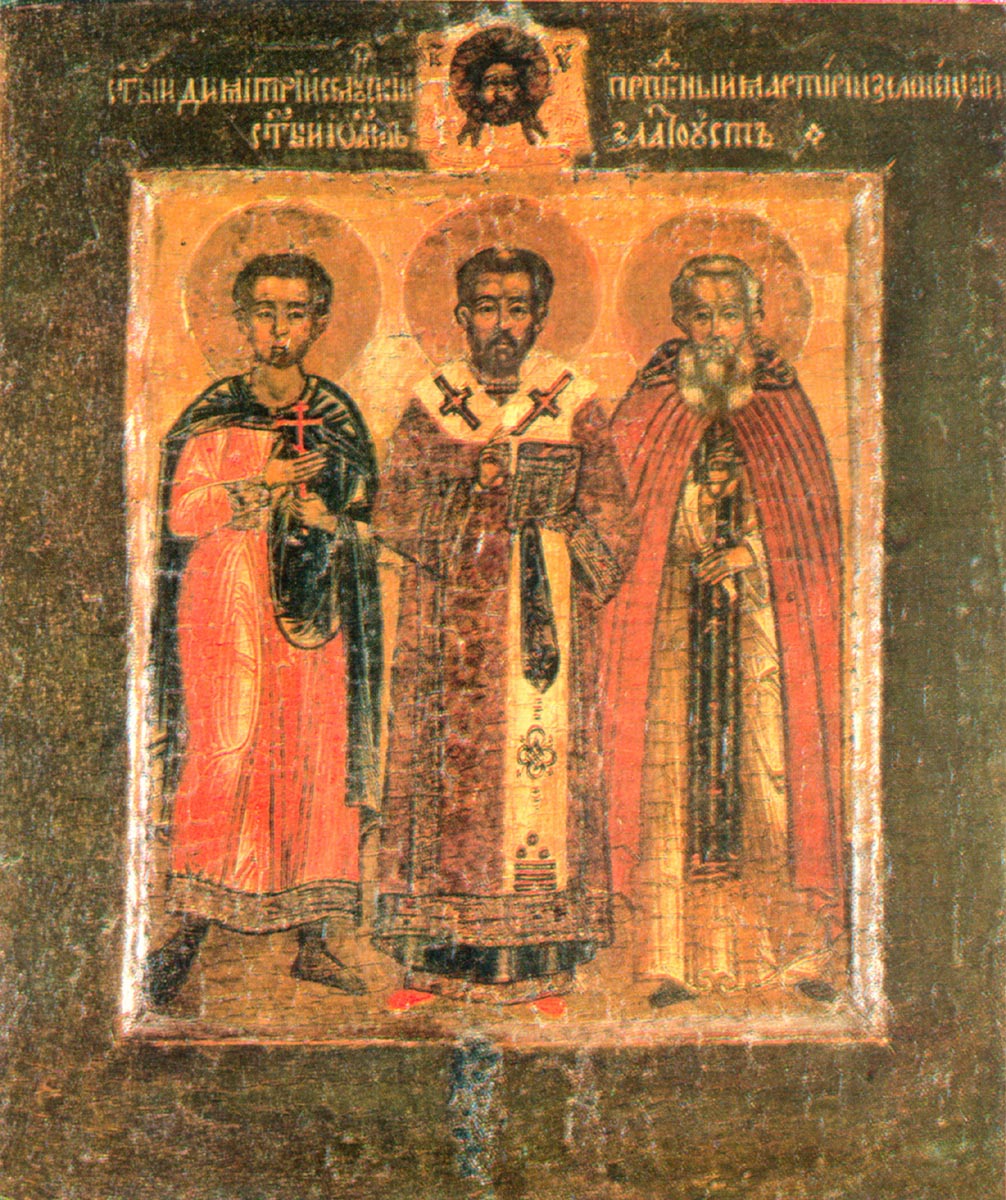
Martyrius is depicted as a monastic elder — long grey beard, in the schema or mantle of an abbot, often holding a scroll — sometimes shown against his forest island, or with the Trinity church of Zelenets that he built. The stored image is an eighteenth-century Russian icon on which he is portrayed together with Saint John Chrysostom and the Great-martyr Demetrius of Thessalonica; Martyrius stands at the right as the monastic founder (source, public domain, pd-old-work).
Disputed questions
- Not to be confused with the earlier martyr Martyrius the notary of Constantinople (with Marcian, kept October 25), nor with Martyrius the Deacon of the Kiev Caves. The Martyrius of this day is the sixteenth–seventeenth-century Russian abbot of Zelenets.