
33 Martyrs of Melitene
The Holy Thirty-Three Martyrs of Melitene, Hieron and his Companions
Martyr · d. c. 298
Commemorated 7 November — Martyrdom at Melitene
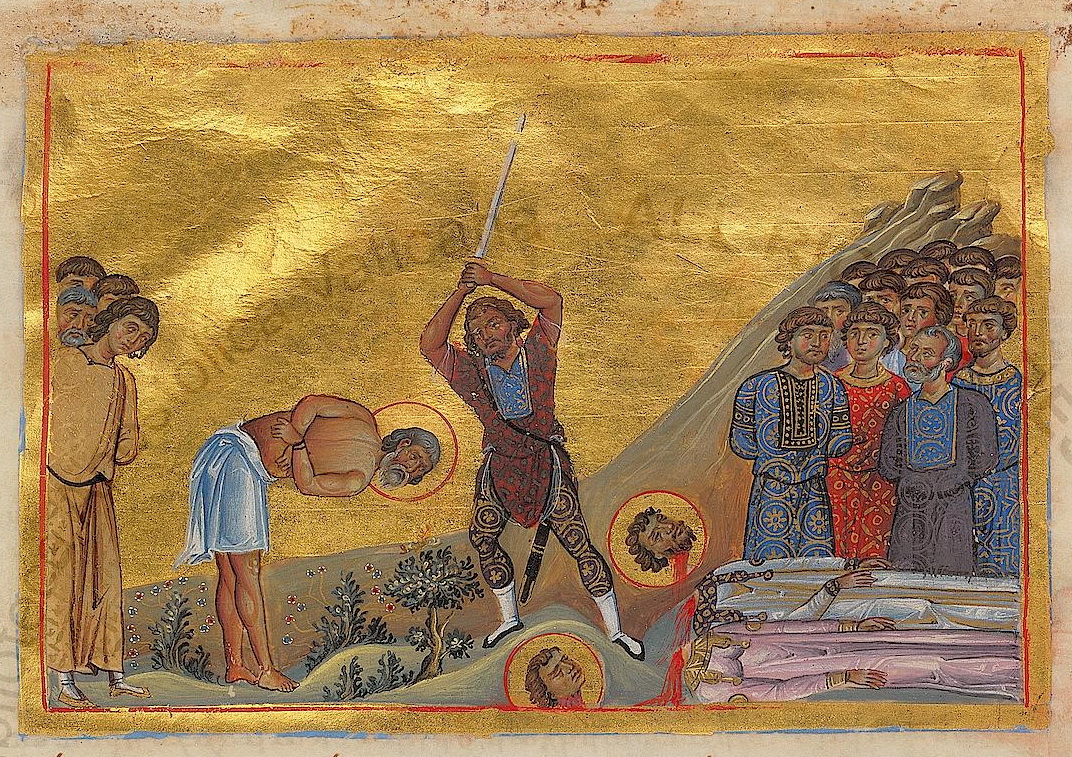
The Thirty-Three Martyrs of Melitene were a company of Cappadocian Christians put to death for Christ around the year 298, in the reign of Diocletian and Maximian. Their leader was Hieron, a farmer of Tiana renowned for his physical strength, who beat off the soldiers sent to conscript him into an army employed to persecute the faith, hid in a cave, and — persuaded at last to give himself up — refused with thirty-two fellow soldiers to sacrifice to the idols at Melitene. After torture, in which Hieron's arm was struck off, all were beheaded. Their memory is kept universally on November 7, and their martyrdom is depicted in the Menologion of Basil II.

Origins and early life
The chief of the martyrs, Hieron (Ἱέρων), was born at Tiana in Great Cappadocia and raised by a devout mother, from whom he had his Christian faith and his gentle, upright character. By trade he was a farmer, and he was distinguished among his neighbours by an exceptional bodily strength and agility — the detail on which the whole narrative of his arrest turns.
Martyrdom or repose
In the persecution the co-emperors Diocletian (284–305) and Maximian dispatched to Cappadocia a large military detachment under an officer named Lysias, with a double commission: to root out Christianity in the province and to press strong, healthy men into the imperial army. Hieron's strength marked him at once for conscription, but he would not serve emperors who made war on Christ and on Christians. When Lysias's men came to take him by force, he seized a staff and drove them off single-handed, and the soldiers withdrew in shame at being routed by one man. He then took refuge in a cave with eighteen other Christians. Rather than lose men storming it, Lysias raised the siege on the advice of one Cyriacus, a friend of Hieron; and it was this same Cyriacus who afterwards persuaded Hieron not to set himself against the authority of the state. Yielding, Hieron went with the other new conscripts under escort to the nearby city of Melitene (on the upper Euphrates, in Lesser Armenia).
At Melitene a dream forewarned Hieron of his coming martyrdom. When Lysias assembled the soldiers and commanded them to sacrifice to the gods, Hieron and thirty-two others openly confessed Christ and refused. The persecutor had them beaten, and ordered Hieron's arm severed at the elbow. Barely alive after their torments, the confessors were cast into prison, and four days later all were beheaded — thirty-three in number, counting their leader.
Relics and translations
A wealthy and prominent Christian named Chrysanthus ransomed Hieron's head from Lysias. When the persecution ended he raised a church on the place of execution and enshrined the head there, while the bodies of the martyrs were buried secretly by the faithful. Later tradition relates that under the emperor Justinian, during building work on a church of Hagia Eirene ("Holy Peace"), the relics were rediscovered and found incorrupt.
Veneration and later cultus
The company is commemorated as a unit throughout the Byzantine rite on November 7. The Menaion transmits the names of the thirty-two who suffered with Hieron — read out in the festal stichera — though the spellings vary between the Greek and Slavonic books. Beside Hieron they are usually given as: Hesychius, Nicander, Athanasius, Mamas, Barachius, Callinicus, Theagenes (Theogenes), Nikon, Longinus, Theodore, Valerius, Xanthias (Xanthius), Theodoulus, Callimachus, Eugene, Theodochus, Ostrychius, Epiphanius, Maximian, Dulcitius (Ducitius), Claudian, Theophilus, Gigantius, Dorotheus, Theodotus, Castrichius, Anicetus (Anicletus), Themelius, Eutychius, Hilarion, Diodotus, and Amonitus.
Feast and commemoration
November 7 (church date; Old Calendar civil November 20), kept universally in the Byzantine rite. The Menaion appoints proper festal stichera — which recite the martyrs' names — and a proper kontakion, but no proper apolytikion: the common troparion of martyrs is sung. The day falls within the period of the Nativity Fast's approach but before its opening (November 15), so it is an ordinary fast-free commemoration in most usage.
Hymns
Troparion — Tone 4
Thy Martyrs, O Lord, in their courageous contest have received from Thee, our God, crowns incorruptible; for, possessed of Thy strength, they cast down the tyrants and utterly destroyed the powerless boldness of the demons. By their prayers, O Christ our God, save our souls.
Original translation from the Greek
Kontakion — Tone 4
A choir of Martyrs, far-shining and light-bearing, rising up in spirit, hath today made bright the Church with the beams of its wonders. Wherefore, as we keep their sacred memory, we entreat Thee, our Saviour: by their supplications deliver us from dangers, as a God merciful and the Friend of mankind.
Original translation from the Greek
Iconography
The martyrs are shown as a close-ranked company, in the manner the Byzantine painters used for groups of soldier-martyrs: a crowd of young men, several bearded and several beardless, in cloaks or the short military tunic, holding the martyr's cross, with their leader Hieron distinguished at the head — often with his severed right arm indicated, the sign of his particular torment. The stored image is the miniature for November 7 from the Menologion of Basil II (c. 985, Vatican, gr. 1613), which depicts the martyrdom of the company.
Disputed questions
- Number. The calendars and service books lead with thirty-three martyrs (Hieron and thirty-two companions); some accounts, counting only the companions, speak of Hieron "and his thirty-two." The rolls of names in the Greek and Slavonic Menaia differ slightly in both spelling and membership, which is why the body above gives the names as transmitted rather than as a fixed list.
- Date. The martyrdom is placed under Diocletian and Maximian, conventionally around 298; the sources give no exact year.