
156 Martyrs of Palestine
The Holy 156 Martyrs of Palestine, with the Hieromartyrs Peleus and Nilus the Bishops, the Presbyter Zeno, and the Noblemen Patermuthius and Elias
Martyr · Hieromartyr · Bishop · Priest · d. c. 310
Commemorated 17 September
The 156 Martyrs of Palestine were confessors — most of them Egyptians, with Palestinians among them — condemned to the mines of Palestine in the last great persecution and put to death about the year 310 under the governor Firmilian, in the reign of the emperor Galerius and his caesar Maximinus. At their head the tradition names the Egyptian bishops Peleus and Nilus, a presbyter Zeno, and the noblemen Patermuthius and Elias; of the company, one hundred were beheaded and the rest, with their leaders, were burned. They are commemorated together on September 17.
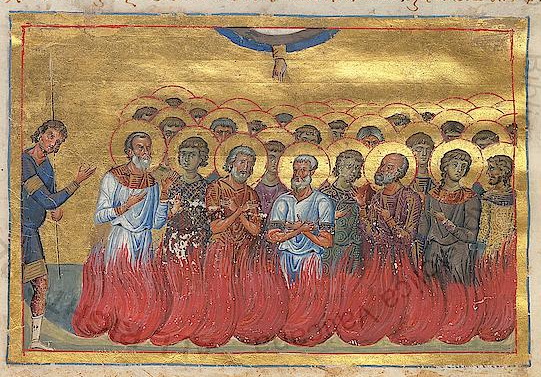
.jpg)
The company belongs to the terminal phase of the Great Persecution in Palestine, for which the Church possesses an eyewitness historian: Eusebius of Caesarea, whose Martyrs of Palestine describes how confessors from Egypt and Palestine — many already mutilated for the faith, blinded in the right eye and hamstrung in the left leg — were condemned to penal labour in the copper mines of Phaeno, south of the Dead Sea. There the condemned organised themselves into a church in chains, with their own places of prayer and their bishops and clergy among them, until the authorities resolved to break the community. The governor Firmilian had already presided over the great martyrdoms at Caesarea; on the emperor's order the leaders of the mine-church and their companions were put to death.
The synaxarion tradition, which the Byzantine calendar follows on September 17, gives the arithmetic of the company thus: one hundred martyrs of Egyptian origin, beheaded in one day with a single eagerness, as the verses say; fifty martyrs of Palestine given to the fire; and, named at their head, the bishops Peleus and Nilus — Egyptian bishops serving among the condemned — with the presbyter Zeno and the distinguished laymen Patermuthius and Elias, all of whom were burned. The received total of 156 embraces the whole company. The OCA Life adds the tortures that preceded: eyes put out, the tendons of the feet cut — the standard mutilation of confessors sent to the mines, exactly as Eusebius records it.
The date falls around 310 (the persecution under Galerius and Maximinus, 305–311/313; Eusebius places the Phaeno executions near the persecution's end).
Feast and commemoration
September 17 (church date; Old Calendar civil September 30), within the afterfeast of the Elevation of the Cross; carried by the OCA calendar and, as a sequence of notices (the hundred Egyptians; Peleus and Nilus the bishops; the fifty of Palestine; Patermuthius and Elias), by the Greek synaxarion of the day (both consulted live). No proper service is appointed.
Hymns
Troparion — Tone 4 (from the common of martyrs)
Thy martyrs, O Lord, in their contest received incorruptible crowns from Thee, our God; for possessing Thy strength they cast down the tyrants and shattered the feeble insolence of the demons. By their intercessions save our souls.
Original translation from the Greek
Iconography
The stored image is the miniature for the commemoration in the Menologion of Basil II (c. 1000), which depicts the martyrs given to the flames — a group of figures amid the fire, the manuscript's standard iconography of martyrdom by burning. Later depictions of the company are not part of the standard panel-icon repertoire.
Disputed questions
- "Of Palestine" and "of Egypt." The title of the company is geographical — they suffered in Palestine — while most of its members, including the bishops Peleus and Nilus, were Egyptians: hence the OCA styles Peleus and Nilus "Bishops of Egypt" within a company called the Martyrs of Palestine. The two usages describe the same men.
- Composition of the number. The synaxarion's groups (100 Egyptians beheaded; 50 burned in Palestine; the named leaders burned) sum with the named individuals to the received 156, but the manuscripts transmit the groups as distinct notices, and the precise roll cannot be recovered; Eusebius names Peleus, Nilus, Patermuthius (Patermuthes) and Elias among those burned at Phaeno but gives no full list.