
Mary of Egypt
Our Venerable Mother Mary of Egypt
Venerable · b. c. 344 — d. c. 421
Commemorated 1 April — Commemoration of the penitent of the Jordan desert
Mary of Egypt (c. 344 – c. 421) is the great penitent of the Church — a woman who for seventeen years lived in unbridled licentiousness at Alexandria, was turned back from the doors of the church of the Holy Sepulchre in Jerusalem by an unseen power on the feast of the Exaltation of the Cross, and, struck to the heart before an icon of the Theotokos, crossed the Jordan into the wilderness, where she lived in solitary repentance for forty-seven years. Her story, told to the monk Zosimas whom she met at the end of her life, is read in full during Great Lent; she is the Church's supreme image of the power of repentance, and her memory, kept on April 1, crowns the Fifth Sunday of Great Lent.
.jpg)
The years of sin, and the conversion
Mary was born in Egypt and at the age of twelve left her parents for Alexandria, where — as she herself told it, sparing herself nothing — she gave herself for seventeen years to a life of insatiable lust, not for gain but from the burning of her own passion, drawing many to ruin with her. One summer she joined, out of curiosity and appetite, a company of pilgrims sailing to Jerusalem for the feast of the Exaltation of the Cross, paying her passage with her body along the way.
At Jerusalem, when the crowds pressed into the church of the Resurrection to venerate the Precious Cross, Mary was carried forward with them to the doors — and there an invisible force held her back, three and four times, however she strove, while all others entered freely. Standing apart in the corner of the courtyard, she was pierced with the sudden knowledge of her defilement, and, lifting her eyes, she saw an icon of the Most Holy Theotokos. Weeping, she prayed to the Virgin to be her surety, vowing to renounce the world if only she might be let in to venerate the Wood of the Cross. At once the way was opened; she went in, kissed the Cross, and returning to the icon heard, as it were, a voice: "If thou cross the Jordan, thou shalt find rest."
Forty-seven years in the desert
Buying three loaves, Mary went out that same day, crossed the Jordan, and plunged into the trackless wilderness beyond, where for forty-seven years she saw no human face. The first seventeen years, she said, were a martyrdom, the old passions raging in her memory like wild beasts, and she would throw herself upon the ground and weep until the Theotokos, her surety, gave her peace; her clothing rotted away and she was scorched by the sun and frozen by the cold, sustained by God alone. But at length the war ceased, and she was filled with light; she who had never learned letters spoke the Scriptures as though she had studied them, and in prayer she was seen to be raised above the earth.
Zosimas, and her repose
Near the end of her life, the priest-monk Zosimas, who had gone out into the deep desert beyond the Jordan for the Great Fast according to the custom of his monastery, came upon her — a naked figure, her body blackened and her hair white. She fled, then, knowing his priesthood, asked him by name (though they had never met) to cast his cloak over her; and she told him the whole of her life. She asked him to return the next year on Holy Thursday and to bring her the Holy Mysteries to the bank of the Jordan. He did so, and she came, crossing the river on foot upon the water, and received the Body and Blood of Christ. A year later Zosimas returned again and found her dead, her body incorrupt, with a writing traced in the sand beside her: that she had died on the very night she had communed, and asking his prayers. A lion came and helped the old man dig her grave. Zosimas carried her story back to his monastery, and so it was preserved.
Feast and commemoration
April 1 (church date; Old Calendar civil April 14). Her chief commemoration is the Fifth Sunday of Great Lent (movable, 14 days before Pascha), and on the Thursday of the fifth week — the Thursday preceding that Sunday — the whole of the Great Canon of St Andrew of Crete is sung together with her Life, so that Mary stands, near the end of the Fast, as the Church's last and greatest call to repentance before Holy Week.
Hymns
Troparion — Tone 8
In thee, O Mother, was preserved unimpaired that which is according to God's image; for taking up the Cross thou didst follow after Christ, and by thy deeds thou didst teach us to despise the flesh, for it passeth away, but to care for the soul, a thing immortal. Wherefore, O venerable Mary, thy spirit rejoiceth with the angels.
Original translation from the Greek
Kontakion — Tone 3
Thou who wast once defiled with every impurity, art seen today through repentance a bride of Christ; loving the angelic life, thou dost trample down the demons with the weapon of the Cross. Wherefore, O glorious Mary, thou art shown to be a bride of the Kingdom.
Original translation from the Greek
Iconography
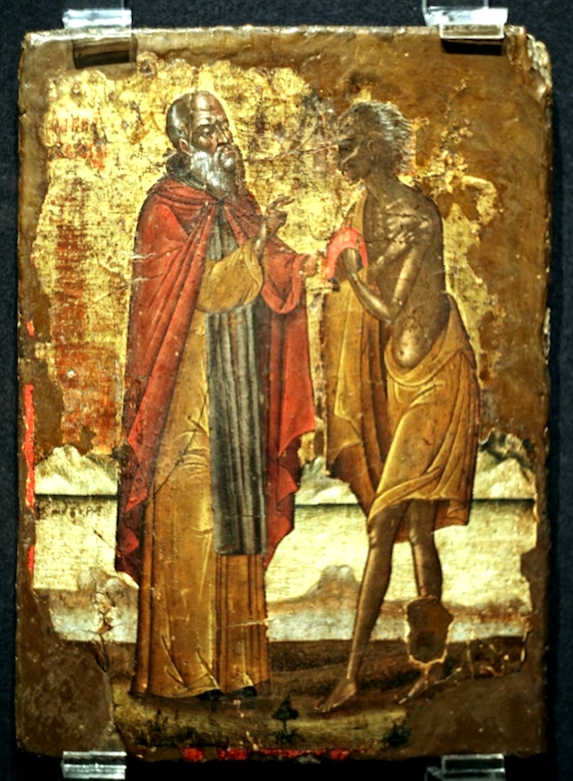
Mary is shown as a gaunt, sun-blackened woman, her white hair her only covering, often receiving the Holy Communion from the hands of the aged monk Zosimas at the Jordan, or kneeling before the icon of the Theotokos at Jerusalem, or lying dead in the desert with the lion at her grave. The stored icon shows her communion from Zosimas.