
Menodora, Metrodora and Nymphodora
The Holy Martyrs Menodora, Metrodora and Nymphodora, the Virgin Sisters of Bithynia
Martyr · Virgin · d. c. 305–311
Commemorated 10 September — Martyrdom at the warm springs of Pythia in Bithynia
Menodora, Metrodora and Nymphodora (†c. 305–311) were three sisters of Bithynia in Asia Minor, consecrated virgins who withdrew to a solitary life of prayer and fasting near the warm springs of Pythia, where the sick were healed through their prayers. Denounced in the last great persecution, they were tried before the governor Fronto and, refusing to sacrifice, were tortured and killed in turn — Menodora first, and four days later Metrodora and Nymphodora before her battered body. They are the chief saints of September 10, with a proper kontakion and canon in the Menaion; the Menologion of Basil II preserves their miniature.
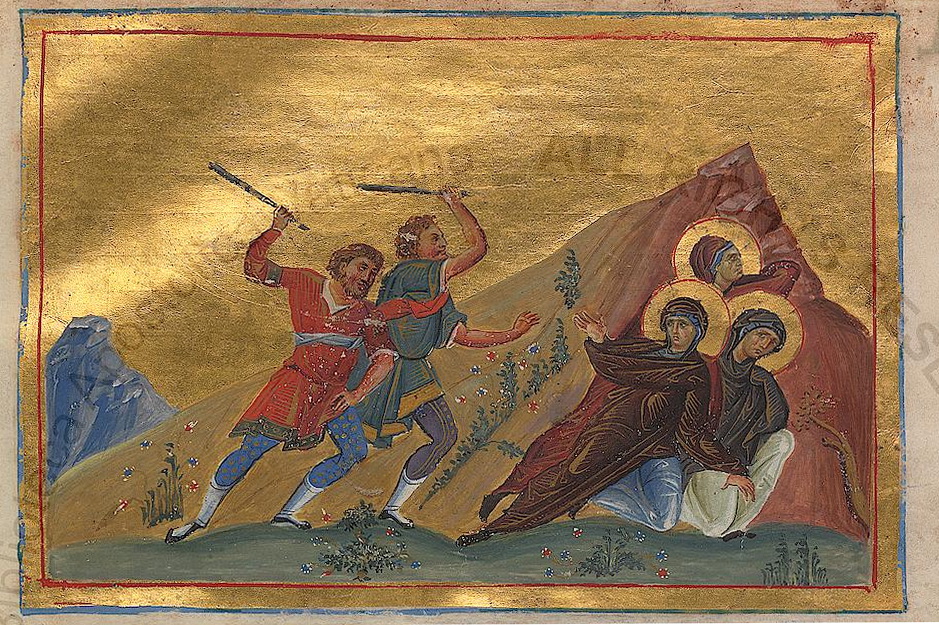
.jpg)
The three sisters were natives of Bithynia in north-western Asia Minor. Distinguished from youth for their piety, they dedicated their virginity to Christ and, wishing to escape the entanglements of the world, withdrew to a retired place in the hill country near the hot springs called Pythia (the "warm springs" near the Gulf of Nicomedia, in the region of the modern Yalova). There they lived in fasting and unceasing prayer, and the tradition records that God glorified their hidden struggle: the sick who came to them were healed by their prayers, and the fame of the three virgins spread through the province.
That fame reached Fronto (Φρόντων), the governor of the region under the persecution begun by Diocletian and continued under Galerius, and he had the sisters arrested and brought before him. He tried persuasion first, promising honours and rewards if they would renounce Christ; the sisters answered together that the temporal things of this world meant nothing to them, and that death for their heavenly Bridegroom was the gateway to life.
The governor turned his rage first on Menodora, the eldest. Stripped and beaten by four men in turn while a herald urged her to sacrifice, she cried out — the synaxaria preserve the words — "Sacrifice? Can you not see that I am offering my whole self as a sacrifice to my God?" Beaten again, her limbs broken with rods and bars, she gave up her soul with a prayer that Christ, the joy of her heart, receive her in peace.
Four days later the two younger sisters were brought to court, and the battered body of Menodora was displayed before them to break their resolve. They wept over their sister but held fast. Metrodora was tortured next and died calling on the Lord Jesus with her last breath. Fronto then changed his manner with Nymphodora, the youngest, feigning to be moved by her youth and beauty and promising rewards if she would only worship the gods; she scoffed at his words and was beaten to death with iron rods, following her sisters.
The governor ordered the bodies burned, but a sudden storm of rain quenched the pyre and — the accounts add — lightning struck down Fronto and his attendant. Christians took up the bodies of the three and buried them together at the warm springs of Pythia.
Relics and translations
The sisters were buried at Pythia in Bithynia, and their veneration in the region is ancient — the Menologion of Basil II (c. 1000) already carries their notice and miniature. Portions of their relics are preserved on Mount Athos: part in the cathedral church of the Protection at the Russian monastery of Saint Panteleimon, and the hand of Metrodora at the monastery of Pantocrator.
Feast and commemoration
September 10 (church date; Old Calendar civil September 23), within the afterfeast of the Nativity of the Theotokos. They are the principal saints of the day in the received Menaion, where their service — stichera, a proper kontakion and oikos, kathisma, and a canon by Joseph the Hymnographer — is joined to that of the feast. The Roman Martyrology also commemorates the three sisters on September 10.
Hymns
Troparion — Tone 4 (from the common of martyrs)
Thy martyrs, O Lord, in their contest received incorruptible crowns from Thee, our God; for possessing Thy strength they cast down the tyrants and shattered the feeble insolence of the demons. By their intercessions save our souls.
Original translation from the Greek
Kontakion — Tone 4
Contending steadfastly for the Trinity, you routed the enemy of many devices, bound to one another as sisters in the spirit; therefore, O victorious martyrs, you have entered with the five virgins into the heavenly bridal chamber, and with the angels stand in gladness without ceasing before the King of all.
Original translation from the Greek
Iconography
The three are painted as a choir of virgin-martyrs: three young women in maphoria, each with a martyr's cross, often standing in a single row and nearly identical — sisterhood itself is the icon's subject. The stored image is the miniature of the Menologion of Basil II (c. 1000), which shows the three haloed sisters huddled at the foot of a mountain as two executioners beat them with rods — the manner of their death in the synaxarion. A 17th-century Russian Menaion icon for September also includes the three.
Disputed questions
- Date. The Slavic tradition and the OCA give the span 305–311, under Galerius; Greek accounts place the martyrdom under "Maximian" (a name the sources apply both to Galerius and to Maximian Herculius), around 304–305. The persecution context fixes the date only within that decade.
- Names. All three names are built on δῶρον, "gift" — a point the synaxarion verses play on, calling them the "gift-named three" (δωρώνυμοι) who died on the tenth of the month.