
Mertius of Mauretania
The Holy Martyr Mertius of Mauretania
Martyr · d. c. 305, in Mauretania
Commemorated 12 January — Martyrdom under Diocletian
Mertius (died c. 305) was a soldier of the Roman army in Mauretania, in Roman Africa, martyred in the persecution of Diocletian. Commanded to sacrifice to the idols and refusing, he was given over to torture, which he bore without a sound; cast into prison, he died there of hunger and of the wounds of his torments. He is commemorated on January 12.

Mertius was a soldier serving in the Roman province of Mauretania — the western reaches of Roman North Africa — during the reign of Diocletian (284–305), whose edicts against the Christians drove the last and fiercest of the imperial persecutions. When the imperial command required him to offer sacrifice to the gods, Mertius confessed Christ and refused. He was handed over to the torturers and endured fierce torments, the tradition notes, in silence, making no sound under his sufferings. He was then shut up in prison, and there, untended, he died of starvation and of his wounds, winning the martyr's crown not by a single stroke but by the slow endurance of the dungeon.
Beyond the fact of his soldiery, his confession, and the manner of his death the synaxaria preserve nothing further of him — neither his origin nor the city of his suffering within the African province. His is the honest short memory of one of the countless soldier-martyrs of the Great Persecution.
Feast and commemoration
Mertius is commemorated on January 12 (church date; Old Calendar civil January 25), within the afterfeast of the Theophany, on the day of Tatiana of Rome. The Greek synaxaria group him with the day's other martyrs of the Diocletianic age (about the year 305).
Iconography
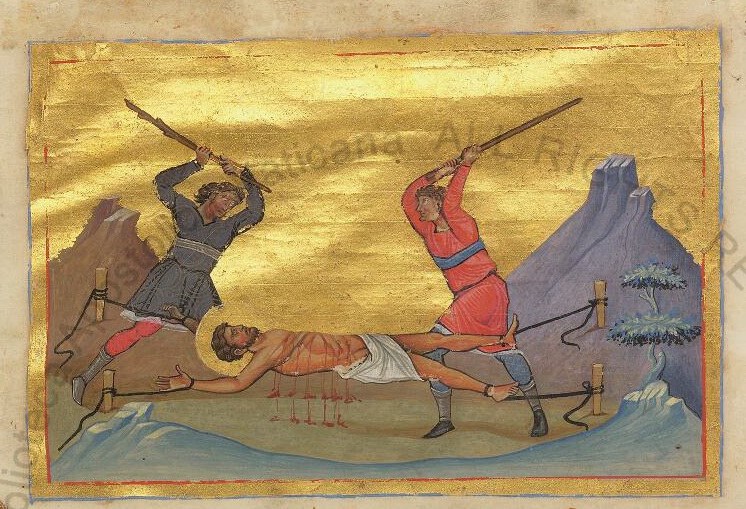
The stored image is the miniature of the Menologion of Basil II (Constantinople, 985): the soldier-martyr, stripped and staked out upon the ground, is beaten to death by two executioners with rods — the manuscript's rendering of the death the synaxarion records. A portrait icon would show him in the dress of a soldier with the martyr's cross.