
Milos of Persia
The Holy Hieromartyr Milos the Wonderworker, Bishop of Susa in Persia, and his Two Disciples
Hieromartyr · Bishop · Martyr · Priest · Deacon · Wonderworker · d. c. 341
Commemorated 10 November — Martyrdom in Persia with his two disciples
Milos (†c. 341) was a Persian nobleman and soldier who became bishop of Susa (the Shushan of the Prophet Daniel), a hierarch graced with the gifts of prophecy and healing whom the Church styles the Wonderworker. Driven from his see by its pagan people, he journeyed to Jerusalem and to Alexandria, where he met Anthony the Great, before returning to Persia. There, in the great persecution of the Christians under Shapur II, he was arrested with his disciples and put to the sword, while his two disciples — a presbyter and a deacon — were killed with clubs and stones, around the year 341. He is commemorated on November 10.

From soldier to bishop
Milos (in the Syriac Mīlēs) was of the Persian nobility and by profession a soldier — the notices call him once a general — who forsook the world for the service of Christ. For the austerity of his ascetic life he received from God the gifts of prophecy and healing, and he was ordained by the bishop remembered in the acts as Bethlapat of Geddegoupolis (the see of Beth-Lapat). He was set over the church of Susa in Elam, the ancient Shushan where the Prophet Daniel saw his visions (Daniel 8:2) — a city by then largely pagan and hostile to the Gospel.
Exile and return
When the people of Susa rose against him and drove him from his episcopal city, Milos did not return by force but withdrew into exile for the Gospel's sake. He went first to Jerusalem, and from there to Alexandria in Egypt, where he met and was strengthened by the great father of monks, Anthony the Great (commemorated January 17). After some two years the hierarch returned to Persia, to the church of his people, in the years when the Sassanid king Shapur II had loosed against the Christians of his empire the fiercest and longest of the ancient persecutions.
Martyrdom
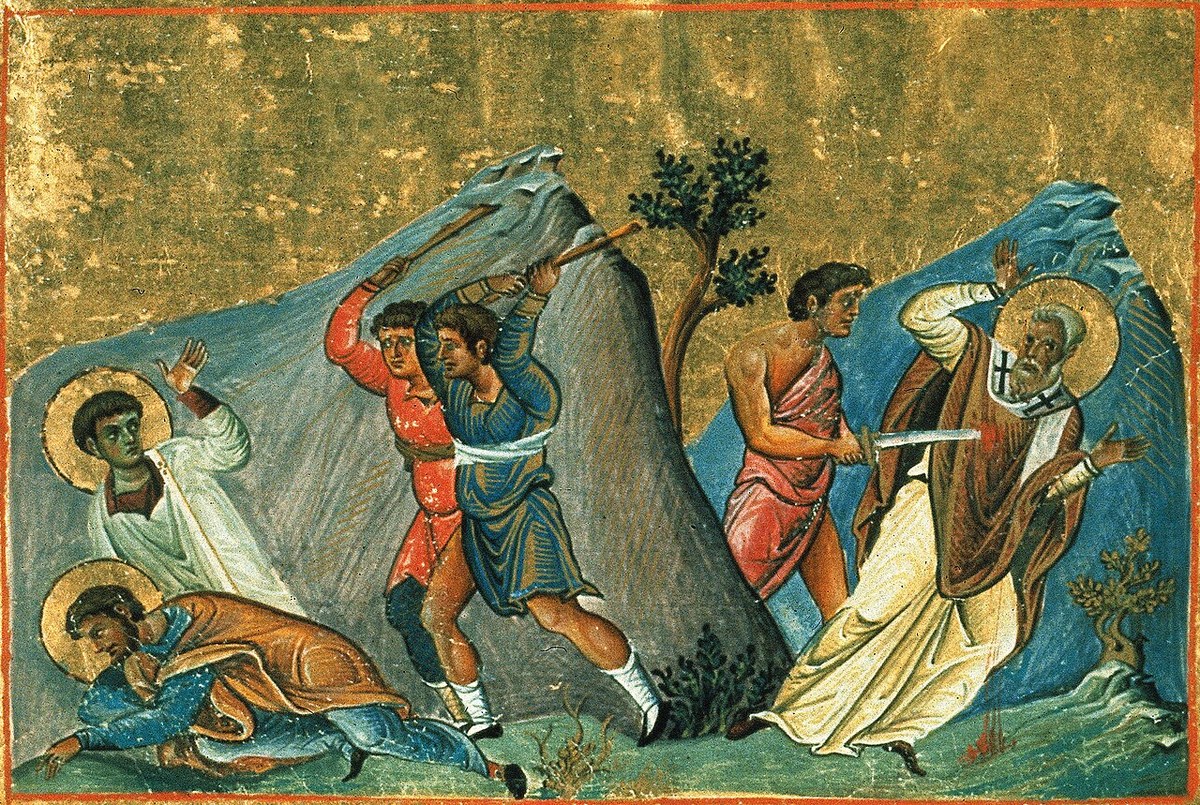
Back in Persia, Milos and his disciples were seized by the local ruler and, refusing to deny Christ, were put to death. The bishop himself was killed with the sword; his two disciples were beaten to death with wooden clubs and stones. So all received the crown of martyrdom, about the year 341.
The names of the disciples
The transmission varies in the number and names of those who suffered with Milos. Some notices give two disciples, Abrosim and Sinon (Sinos); others give three — Euoures (Ebores), Papas, and the deacon Seboes (or Senoei). The divergence is best explained by the different transcriptions of the Persian names into Greek, Syriac and Slavonic; where a presbyter and a deacon are distinguished, the martyred company is a bishop, a priest and a deacon. The Church keeps their memory together with that of their bishop.
Feast and commemoration
November 10 (church date; Old Calendar civil November 23), among the martyrs of the Persian church of the fourth century. The commemoration is kept across the Byzantine-rite calendars (Greek, Slavic, OCA), the day's proper sanctoral service belonging in the Greek Menaion to the martyr Orestes.
Iconography
Milos is depicted as a bishop-martyr, vested in the phelonion and omophorion and holding the Gospel book, flanked by his two disciples. The stored image is the miniature for November 10 from the Menologion of Basil II (Constantinople, c. 985), which names him "bishop of Persia" and depicts him with his two disciples, Euoures the presbyter and Seboes the deacon.
Disputed questions
- Names and number of the disciples. Two (Abrosim and Sinon) in one strand of the tradition, three (Euoures, Papas, and the deacon Seboes/Senoei) in another; the stored miniature names two, "Euoures the presbyter and Seboes the deacon." "Papas" may be a proper name or may render the title of a presbyter, and the several forms are variant transcriptions of the same Persian names rather than certainly distinct persons.
- See and date. Milos is styled bishop of Susa (Shushan) in Elam; his death is placed around 341, within the persecution of Shapur II that fills the Persian martyr-acts of the fourth century, the same yoke under which Aithalas, the great martyr-bishops of Seleucia-Ctesiphon, and many others suffered.